The King Asked Who Tried To Kill Him. The Prisoner Pointed At The Throne And Said, “You Let Him In.”
“YOU KNOW WHO TRIED TO KILL ME?”
The king’s voice thundered through the grand hall.
Every whisper died.
Every torch seemed to lean away from the sound.
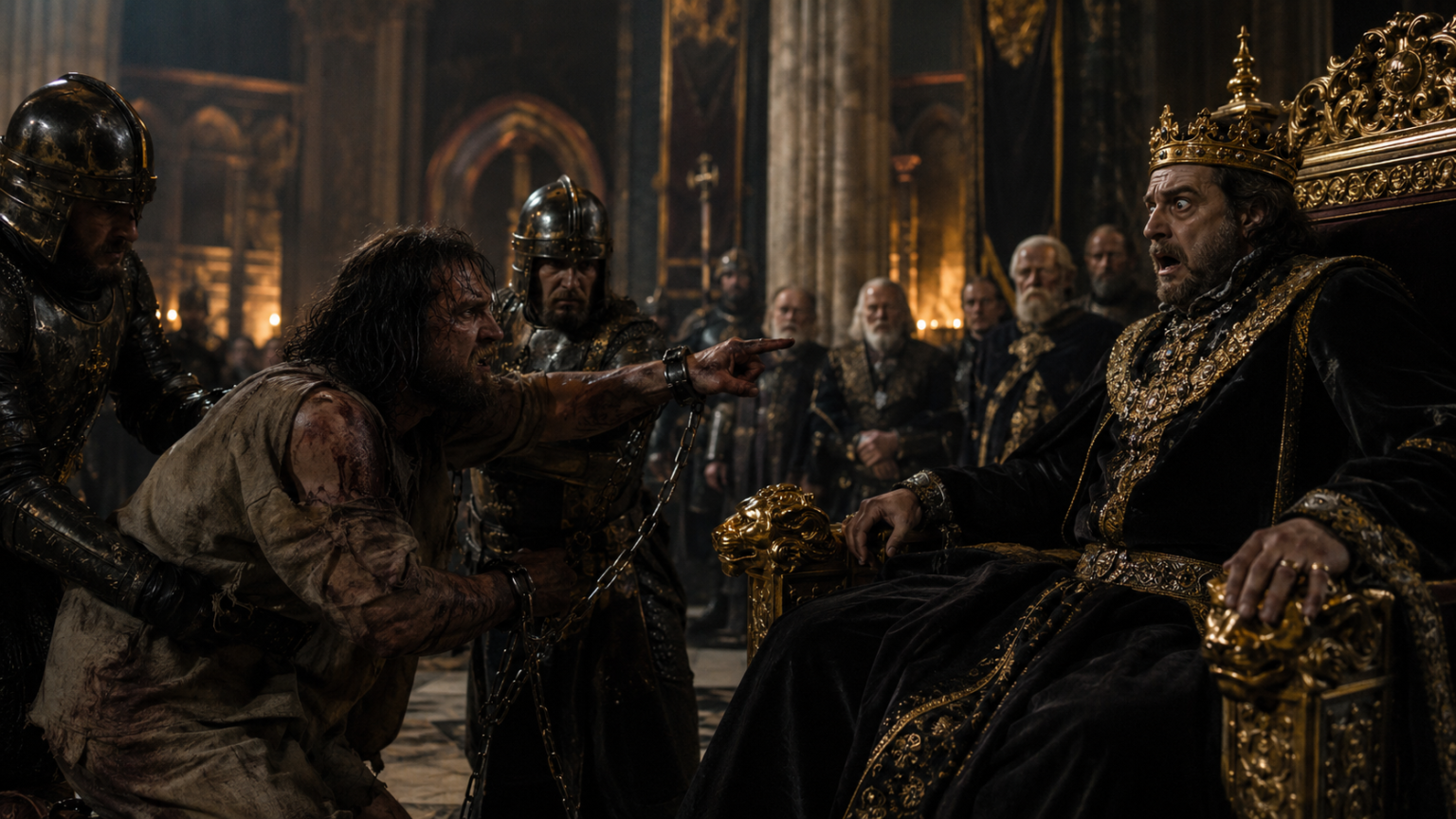
Two armored guards dragged a man in chains across the black stone floor. His boots scraped uselessly beneath him. His face was bruised, his lower lip split, one eye swollen nearly shut. Dried blood marked the collar of his tunic where someone had tried very hard to make him confess before the court ever saw him.
But he was not broken.
Not yet.
They forced him to his knees at the foot of the throne.
Above him sat King Roderic of Valemere, wrapped in black velvet trimmed with gold. One hand rested on the carved arm of his throne. The other pressed against the bandage beneath his ribs, where an assassin’s blade had nearly ended him three nights earlier.
The court had gathered for a confession.
Nobles filled the hall in jeweled silence. Priests stood near the pillars with their hands folded. Soldiers lined the walls with spears angled toward the accused. Everyone wanted a name.
A traitor.
A conspirator.
A foreign spy.
Someone they could drag into the square and burn away the fear that had entered the palace.
The king leaned forward.
His eyes were cold.
“You know who tried to kill me?”
The chained man lifted his head.
His name was Captain Elias Thorn.
Former commander of the king’s personal guard.
Once trusted enough to sleep outside the royal chamber.
Now accused of opening the palace gate to murder.
“I do,” Elias whispered.
The hall tightened around the words.
The king’s jaw flexed.
“Then speak.”
Elias breathed through pain.
The guards gripped his shoulders harder, as if expecting him to lunge.
Slowly, he raised one trembling hand.
The nobles leaned forward.
The priests stopped breathing.
Everyone waited for him to point toward some hidden enemy.
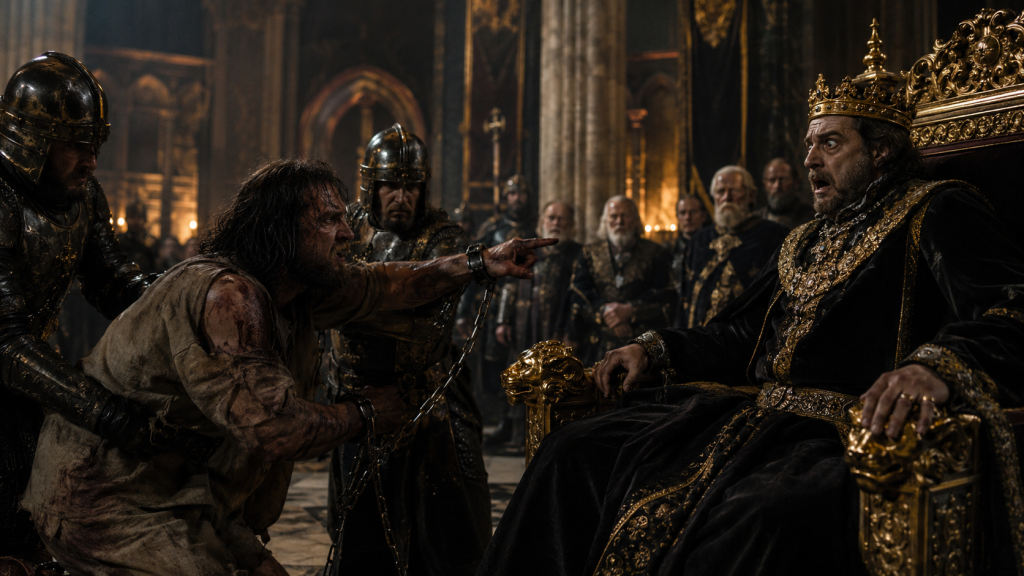
Instead, Elias pointed directly at the throne.
Directly at the king.
And said, “You let him in.”
The sentence struck the hall like iron against bone.
For a heartbeat, no one understood.
Then King Roderic’s face changed.
His rage vanished.
His eyes widened.
Not with anger.
With terror.
Because the prisoner had not accused the king of plotting his own murder.
He had accused him of letting the assassin into the palace years before.
Not through a gate.
Not through a tunnel.
Through grief.
Through trust.
Through a lie wearing the face of the king’s dead brother.
The Captain Who Refused To Confess
Elias Thorn had served the crown for twenty-six years.
He entered the royal guard as a boy with no family name worth speaking and a sword too old to impress anyone. He rose because he listened better than proud men. He watched doors. He remembered faces. He knew which servants carried gossip, which nobles carried knives, and which smiles meant blood would follow before dawn.
King Roderic had once trusted him completely.
That was before Prince Alaric died.
Alaric was the king’s younger brother. Handsome, charming, reckless, beloved by the people in a way Roderic never was. Roderic was iron. Alaric was sunlight. Roderic held council until midnight. Alaric rode through markets without guards and came back with bread in his pockets for stable boys.
The court adored him.
The army admired him.
The people sang his name during festivals.
That should have made him dangerous.
But Alaric loved his brother too much to become a rival.
At least, that was what Elias had believed.
Seven years earlier, Prince Alaric was declared dead after a hunting accident near the Blackwater Gorge. His horse returned riderless. His cloak was found torn on the rocks below. Blood stained the stones. The river carried away whatever remained.
No body was recovered.
The king did not speak for three days.
When he returned to court, something human had gone quiet inside him.
Then Lord Veyran arrived.
He was a minor noble from the western border, unknown to most of court, but he carried letters supposedly written by Alaric before his death. Letters warning that certain nobles plotted against Roderic. Letters advising the king to trust Veyran as he had trusted Alaric.
At first, Elias objected.
“My king,” he said, “your brother never mentioned this man.”
Roderic looked at him with hollow eyes.
“My brother had many friends.”
“None he hid from me.”
That was the first time the king dismissed him from council.
Over the years, Veyran grew closer to the throne.
He did not seize power openly. Clever men rarely do. He became useful. He found conspiracies. He exposed spies. He whispered warnings just before trouble appeared, and trouble always appeared exactly where he said it would.
Roderic began to rely on him.
Elias began to distrust him.
Then the old guards were replaced.
Quietly.
One by one.
A captain sent to the northern road.
A watchman accused of theft.
A gatekeeper found drowned.
A chamber sentry dismissed for falling asleep, though Elias knew the man had stood through worse nights without blinking.
Elias kept records.
That saved him.
And condemned him.
Three nights before the trial, an assassin entered the royal chapel before dawn. King Roderic prayed there alone every morning, kneeling beneath the statue of Saint Arlen, where his brother’s memorial candle burned.
The assassin wore a servant’s cloak.
He reached the altar.
He struck.
The blade entered below the king’s ribs.
Roderic survived only because the assassin hesitated.
One breath.
One fatal breath.
Long enough for guards to burst in and cut him down.
By sunrise, Elias was arrested.
The accusation was simple. His old seal had been found near the chapel passage. A gate roster bore his handwriting. A servant claimed Elias had ordered the west corridor cleared.
All false.
Too cleanly false.
In the dungeon, they beat him for a confession.
He gave none.
Then a kitchen maid risked her life to slip him a message through a crack behind the water bucket.
Captain,
I saw the dead assassin before they burned him.
He had Prince Alaric’s ring.
Not a copy.
The real one.
Elias read the line until the letters blurred.
Alaric’s ring had vanished with him at Blackwater Gorge.
A simple silver band with a hawk carved inside the palm, not outside, because Alaric said princes already displayed too much.
No one outside the royal family and the guard knew the inner mark existed.
If the assassin wore that ring, then the attack was not merely murder.
It was a message.
A ghost had been sent to kill the king.
And someone had made sure Roderic never saw the ring before the body burned.
That was why Elias endured the dungeon.
That was why he did not confess.
That was why, when they dragged him before the throne expecting him to name himself traitor, he raised his broken hand and pointed at the king.
“You let him in.”
The Dead Brother’s Ring
The court erupted after Elias spoke.
Lord Veyran stepped forward first.
Of course he did.
He wore deep blue velvet, a silver chain across his chest, and an expression of wounded loyalty. His hair had gone white at the temples, which only made him appear wiser to fools.
“Your Majesty,” he said, “the prisoner seeks to poison your mind while pain clouds judgment.”
Elias laughed once.
Blood touched his teeth.
“Pain clears some things.”
The guard behind him struck the back of his head.
Elias fell forward.
The king raised one hand.
“Stop.”
The guard froze.
King Roderic descended the throne steps slowly. The movement cost him. His wound was still fresh, and every step tightened the bandage beneath his black robe.
He stopped before Elias.
“What did you mean?”
Elias forced himself upright.
“The assassin wore Prince Alaric’s ring.”
The king’s face tightened.
“Liar.”
“I wish I were.”
A murmur passed through the hall.
Veyran shook his head sadly.
“Your Majesty, this is grotesque. Your brother’s memory—”
“My brother’s memory has been used enough,” Elias snapped.
The hall went silent again.
Veyran’s eyes hardened.
Roderic noticed.
That mattered.
“Where is the assassin’s body?” the king asked.
The royal physician, Master Oren, stepped forward, pale and sweating.
“Burned, Your Majesty. By plague protocol.”
“Plague?”
“There were markings on the skin. We feared poison, disease, foreign rites—”
“Who ordered it?”
Oren swallowed.
His eyes flicked toward Veyran.
Only once.
But once was enough.
The king turned.
Veyran bowed his head.
“I advised caution. You were wounded. The palace was in panic.”
“You burned the man before I woke.”
“I protected you.”
Elias whispered, “He has used that word for seven years.”
Roderic looked back at him.
“What proof remains?”
“Open Prince Alaric’s memorial vault.”
The words struck harder than his accusation.
The king went still.
Veyran spoke sharply.
“No.”
Everyone turned.
The word had come too quickly.
Too forcefully.
Not as counsel.
As command.
Veyran corrected himself at once.
“Your Majesty, I mean only that disturbing your brother’s memorial on the word of a condemned traitor would wound the kingdom.”
Roderic’s eyes narrowed.
“The kingdom has survived wounds before.”
“This would be sacrilege.”
“My brother has no body in that vault.”
“Exactly. It is a place of mourning.”
The king stepped closer to Veyran.
“And if mourning has been made into a hiding place?”
For the first time, Veyran had no immediate answer.
They went to the chapel before sunset.
The entire court followed at a distance, hungry and afraid.
Prince Alaric’s memorial vault lay beneath the eastern altar, where a carved stone slab bore his name and the words:
Beloved Brother. Brightest Son Of Valemere.
Roderic stood before it like a man facing a door he had spent seven years refusing to open.
Elias stood in chains beside him, held upright by two guards because walking had become difficult.
Veyran watched from the aisle.
Too calm.
The stone slab was lifted.
Inside was not a coffin.
Only a ceremonial chest containing the items supposedly recovered after the prince’s death.
A torn riding glove.
A bloodstained scrap of cloak.
A broken hunting horn.
And a sealed silver box.
The king frowned.
“I have never seen that.”
The priest beside him whispered, “It was placed here by Lord Veyran on the first anniversary. He said it held private letters from the prince.”
Roderic’s head turned slowly.
Veyran smiled faintly.
“I wished to spare you.”
The king lifted the silver box.
It was locked.
Elias stared at it.
The lock bore a mark so faint most would miss it.
A hawk carved inside a circle.
Alaric’s private mark.
Roderic broke the lock with the hilt of his dagger.
Inside lay letters.
Many letters.
All in Alaric’s hand.
Or close enough to fool a grieving brother.
Roderic unfolded the first.
His eyes moved across the page.
Then stopped.
Elias watched his face.
At first, confusion.
Then pain.
Then recognition.
The king whispered, “He never wrote my name this way.”
Veyran’s expression changed.
Just slightly.
The king reached for another letter.
Then another.
Each one contained warnings.
Enemies.
Plots.
Advice.
All of it the foundation upon which Veyran had built his influence.
All of it forged.
At the bottom of the box lay something wrapped in black cloth.
Roderic opened it.
A silver ring fell into his palm.
Not the prince’s.
A copy.
The hawk was carved on the outside.
Wrong.
Too visible.
Too obvious.
A decoy made by someone who knew of the ring but not its secret.
The king stared at it.
Elias’s voice was rough.
“The assassin had the real one.”
Veyran moved then.
Not toward the king.
Toward the side door.
Captain Rorik of the palace guard drew his sword.
“Stop.”
Veyran sighed.
Then the chapel doors slammed shut from outside.
Several guards near the pillars turned their spears inward.
Not toward Elias.
Toward the king.
Veyran’s sorrowful mask vanished.
Beneath it was something colder.
Older.
Sharper.
“You should have let your brother stay dead,” he said.
The Man Beneath The Gorge
The chapel became a battlefield.
Steel rang beneath painted saints. Priests screamed and fled behind pillars. Courtiers dropped to the floor in silk and jewels. Loyal guards clashed with Veyran’s men while the king, still wounded, reached for a sword he should not have needed inside a house of prayer.
Elias moved before the guards holding him could decide whether to obey fear or duty.
He slammed his chained wrists into one man’s throat, kicked the other behind the knee, and staggered toward the king.
A spear drove toward Roderic’s side.
Elias caught it with his chains.
The impact tore skin from his wrists.
He held anyway.
Captain Rorik cut the attacker down.
“Your Majesty, behind the altar!”
Veyran vanished through a hidden stair beneath the memorial vault.
Roderic tried to follow.
Elias grabbed his sleeve.
“No.”
The king turned on him.
“He knows where Alaric is.”
“Yes,” Elias said. “That is why he wants you chasing him angry.”
The words stopped the king.
Barely.
But enough.
Elias pointed to the silver box.
“If Veyran kept forged letters here, he kept real proof elsewhere. He wanted this vault found only when he controlled the moment. The question is why now?”
Roderic looked down at the letters.
Then at the ring.
Then at the false grief he had been kneeling before for years.
His voice was hollow.
“My brother is alive.”
Elias did not answer quickly.
That was answer enough.
They found the first clue in the bottom of the silver box.
A thin strip of parchment hidden beneath the velvet lining.
Not in Alaric’s hand.
In a woman’s.
The message had only seven words.
The hawk sleeps where black water remembers.
The king knew the place at once.
Blackwater Gorge.
The place Alaric supposedly died.
The place Roderic had never returned to because grief had made the road unbearable.
By midnight, the king rode out with Elias, Captain Rorik, twelve loyal guards, and the royal physician under arrest in a supply wagon.
Veyran had fled ahead of them.
The ride to Blackwater Gorge took six hours through cold rain and forest roads. Roderic said almost nothing. Elias rode bound but no longer chained at the ankles. Rorik wanted him locked in a cart. The king refused.
“He saved me in the chapel.”
“He also stands accused of treason,” Rorik said.
“So do half the men in my palace.”
No one argued after that.
Dawn broke gray over the gorge.
Blackwater earned its name honestly. The river below ran dark through jagged stone, fast and deep enough to carry secrets for miles.
The old hunting lodge still stood near the cliff line, abandoned since Alaric’s death.
Or so the records claimed.
The door had fresh scratches near the latch.
Inside, dust covered the front room.
Too much dust.
Elias stepped to the hearth and crouched.
The ashes were old on top.
Fresh beneath.
“Someone used this place recently.”
Roderic moved through the lodge like a man walking inside an old wound.
Alaric had laughed here.
Drunk too much here.
Sung badly here.
Once, after a storm trapped them in the lodge for three days, he had convinced Roderic to carve their names under the table like boys instead of princes.
The table still stood by the window.
Roderic knelt and looked beneath it.
There they were.
Roderic and Alaric.
Two crooked names carved beside a crude hawk.
But below them, newer marks scarred the wood.
Three lines.
One word.
Below.
Elias looked at the floorboards.
They found the trapdoor beneath a rug that had been nailed down.
The chamber below smelled of damp earth, iron, and sickness.
A tunnel stretched from the cellar toward the gorge wall, carved into the rock. Lantern hooks lined the passage. Old chains hung from the stone.
At the end stood a locked iron door.
Behind it, someone coughed.
The king froze.
The sound was weak.
Human.
Alive.
Rorik broke the lock with an axe.
The door opened.
A man sat chained to the far wall.
Thin.
Bearded.
Hair tangled.
Skin pale from years without sun.
A scar ran from his collarbone to his jaw, old and badly healed. His right hand rested in his lap, and on one finger was a silver ring.
The real ring.
The hawk carved inside the palm.
Roderic took one step forward.
The man lifted his head.
His eyes were fever-bright.
But still Alaric’s.
The king made a sound no one in that room would ever forget.
“Brother.”
Alaric stared at him.
Not with joy.
With fear.
Then rage.
His voice came out like broken stone.
“You finally came.”
Roderic stopped as if struck.
Elias looked away.
There are reunions too painful for witnesses.
The king crossed the room and dropped to his knees before the chained man.
“I thought you were dead.”
Alaric laughed.
It became a cough.
“Convenient.”
Roderic flinched.
“I believed them.”
“That was convenient too.”
The king bowed his head.
The words were cruel.
They were also earned.
Rorik cut the chains.
Alaric nearly collapsed when they released him. Roderic caught him, but his brother shoved weakly against his chest.
“Don’t.”
Roderic let go at once.
Alaric looked at Elias.
Recognition came slowly.
“Captain Thorn.”
Elias bowed his head.
“Your Highness.”
“You look terrible.”
“So do you.”
A ghost of Alaric’s old smile passed over his face.
Then vanished.
“Veyran?”
“Fled,” Roderic said.
Alaric’s eyes sharpened.
“Then he went for the boy.”
The king went still.
“What boy?”
Alaric looked at him with bitter surprise.
“You don’t know.”
Roderic’s face drained.
Alaric reached beneath the straw mattress with shaking hands and pulled out a small wooden horse.
Its paint was nearly gone from being held too often.
“My son,” he whispered. “Veyran kept him hidden in the old monastery. Said if I ever stopped writing, the child would vanish.”
Elias closed his eyes.
The forged letters in the vault had not all been forged.
Some had begun as Alaric’s real hand.
Coerced.
Twisted.
Used to lead the king by grief.
Roderic looked at the wooden horse.
His voice shook.
“What is his name?”
Alaric’s answer came barely above a breath.
“Julian.”
Then horns sounded above the lodge.
Not royal horns.
Veyran’s.
Alaric grabbed Roderic’s sleeve with surprising strength.
“He will kill the boy before he lets you have proof.”
The king rose.
His face changed.
Grief had once made him blind.
Now it made him dangerous.
“Not this time.”
The Child At The Monastery Gate
The old monastery of Saint Oren lay two miles beyond Blackwater Gorge, hidden among pine trees and broken stone walls.
It had been closed for thirty years.
Officially.
Elias had learned that official closure often meant private use.
They reached it under a sky bruised with storm clouds.
Alaric rode wrapped in a cloak, barely conscious but refusing to remain behind. Roderic argued once. Alaric looked at him with such hatred that the king stopped.
Some wounds cannot be commanded shut.
The monastery gate stood open.
That was the first bad sign.
The second was the silence.
No birds.
No horses.
No voices.
Elias dismounted first.
His body screamed from the dungeon beating, but pain had become background noise. He signaled two guards to the left wall, two to the broken chapel, and moved toward the courtyard.
A child’s wooden cup lay overturned near the well.
Alaric saw it and nearly fell from the saddle.
“Julian.”
Roderic caught his arm.
This time, Alaric did not pull away.
A voice called from the chapel steps.
“Majesty.”
Lord Veyran stood beneath the cracked archway.
His blue cloak was torn from the chapel fight, but his posture remained elegant. One hand rested on the shoulder of a small boy standing before him.
The child was perhaps six.
Dark hair.
Wide eyes.
Alaric’s mouth.
Roderic’s bloodline in miniature.
A knife rested lightly against the boy’s throat.
Alaric made a broken sound.
Julian’s eyes darted toward him.
“Father?”
Veyran smiled.
“How touching. The dead gather quickly when summoned.”
Roderic stepped forward.
“Let him go.”
“Still giving orders after all these years of being led.”
Elias moved slowly to the side.
Veyran noticed.
“Captain Thorn, if you take another step, the child bleeds.”
Elias stopped.
The courtyard froze around the boy’s breathing.
Roderic’s voice was low.
“You used my brother.”
“I preserved the kingdom.”
“You imprisoned him.”
“I prevented civil war.”
“You tried to kill me.”
“I tried to correct my mistake.”
Alaric’s voice cut through.
“You made me write those letters.”
Veyran glanced at him.
“At first. Then I improved them. You were always too emotional for statecraft.”
Alaric shook with fury.
“My son.”
“A useful safeguard.”
Roderic looked at the boy.
Julian was trying not to cry.
Trying like a child who had been taught crying made adults crueler.
The king’s face changed.
Not rage now.
Recognition.
He had been that child once in different ways.
Raised among men who called fear discipline and tenderness weakness.
Veyran pressed the blade closer.
“Here is what happens next. I leave with the boy. You declare the matter resolved. Alaric remains dead. Thorn remains traitor. The kingdom remains stable.”
Roderic slowly removed his crown.
Everyone stared.
Even Veyran.
The king set it on the wet ground.
“If the price of your stability is a child’s throat,” he said, “then the kingdom can break.”
Veyran’s smile faltered.
“You would throw away a crown for him?”
Roderic looked at Julian.
“No. I should have thrown away pride sooner.”
Veyran’s grip shifted.
A small movement.
Elias saw Julian’s eyes move toward the right.
Not random.
There was someone inside the chapel.
A figure behind the broken altar.
A woman holding a stone.
The kitchen maid who had smuggled Elias the note.
Mira.
She had followed.
Or been there all along.
Elias met her eyes.
One breath.
Two.
Then he shouted, “Alaric!”
Veyran’s eyes flicked.
Mira threw the stone.
It struck Veyran’s temple.
Julian dropped.
Elias lunged.
Roderic moved too.
Veyran slashed blindly, catching Elias across the shoulder before Roderic drove him backward against the chapel steps. Captain Rorik seized the boy and pulled him clear.
Alaric slid from his horse and crawled the last few feet toward Julian.
The boy broke free of Rorik and ran to him.
“Father!”
Alaric caught him with both arms and collapsed around him as if the child were the only thing holding his bones together.
For a moment, the courtyard forgot Veyran.
That almost cost them.
Veyran pulled a second blade from his boot and lunged toward Alaric’s back.
Roderic intercepted him.
The two men crashed into the broken arch.
Veyran was older but quick, and he knew the king’s wound. His blade drove toward the bandage again and again, forcing Roderic back.
“You never deserved the throne,” Veyran hissed.
Roderic parried.
“No.”
The answer startled him.
Veyran’s eyes flashed.
Roderic continued, “But I have finally learned you deserved it less.”
He struck Veyran’s wrist.
The blade fell.
Elias slammed into Veyran from the side, chains still hanging from one wrist. Together, he and Roderic drove the lord to the ground.
Veyran laughed through blood.
“You think this ends me? Half your court fed from my hand. Half your laws came from my counsel. Half your reign is mine.”
Roderic looked down at him.
“That is why you will live long enough to name all of it.”
Veyran’s smile faded.
Alaric stood with Julian clinging to him.
Weak.
Starved.
Furious.
Alive.
“Start with the hunting accident,” Alaric said.
Veyran looked at him.
“You were supposed to die in the gorge.”
Alaric nodded slowly.
“I know.”
“You should have.”
Julian buried his face in his father’s cloak.
Roderic’s sword touched Veyran’s throat.
“No more.”
He did not kill him.
Not because Veyran deserved mercy.
Because truth deserved a witness.
And the king had finally learned that dead enemies often leave living lies behind.
The Throne Room That Heard The Truth
They returned to Valemere without music.
No trumpets.
No victory banners.
No polished procession.
The king came back wounded, mud on his cloak, crown in his hand instead of on his head. Beside him rode the brother declared dead seven years earlier, thin as a famine saint, with a child asleep against his chest. Behind them came Captain Elias Thorn, no longer in chains, though the iron marks around his wrists remained raw.
Lord Veyran entered the city bound across a mule.
The people saw.
That mattered.
By the time they reached the palace, the court had already begun rearranging its face. Men who had praised Veyran now whispered that they had always found him troubling. Women who had repeated his warnings now said they had suspected forgery for years. Priests who had blessed his counsel suddenly remembered omens.
Roderic listened to none of it.
He ordered the great hall opened.
Not for celebration.
For testimony.
Veyran was placed in the same spot where Elias had knelt days before.
That was no accident.
The king stood before the throne but did not sit.
Alaric sat nearby with Julian on his lap. The boy refused to let go of the wooden horse. Mira, the kitchen maid, stood under royal protection beside Captain Rorik. Elias stood at the king’s right hand.
The court filled slowly.
Fearfully.
Roderic held up the forged letters.
“These ruled me for seven years.”
No one spoke.
He held up the false ring from the vault.
“This comforted my grief.”
Then he lifted the real ring from Alaric’s hand.
“This survived the truth.”
Alaric’s eyes remained fixed on Veyran.
The questioning lasted three days.
Veyran resisted at first.
Then he named one man.
Then another.
Then entire rooms.
The physician who burned the assassin’s body.
The priest who sealed the forged letters.
The guards who took Alaric from the gorge after the failed murder.
The scribe who copied his hand.
The noble houses that feared Alaric’s popularity and Roderic’s weakness.
The ministers who preferred a grieving king because grief made him obedient.
The plot was larger than one man, though Veyran had sat at its center like a spider patient enough to call the web a kingdom.
Alaric’s survival had begun as leverage.
Then as a source of forged letters.
Then as insurance.
Julian, born to a monastery healer who died under suspicious fever, became a second chain around his father’s throat.
And the assassination attempt?
That was Veyran’s final correction.
He had sent a man wearing Alaric’s ring to kill Roderic so that the king, if he survived, would be driven into madness, purge the wrong enemies, and depend on Veyran completely.
But the assassin hesitated.
Because he was not a stranger.
He was one of Alaric’s former guards, forced into service after years of threats against his family. He carried the ring deliberately, hoping someone would see.
A dead man had tried to leave a clue in murder.
That knowledge haunted Roderic.
It should, Elias thought.
Some truths must haunt kings if laws are to change.
At trial, Veyran claimed he acted for stability.
He said Alaric’s popularity would have split the kingdom. He said Roderic’s grief had prevented reckless reform. He said a controlled king was better than a beloved prince. He said the people needed symbols, not truth.
Alaric stood then.
Weakness made him sway.
Roderic moved as if to help.
Alaric raised one hand.
Not yet.
He faced the court alone.
“You used my brother’s love for me as a leash,” he said. “You used my son’s life as a lock. You called fear stability because it kept you powerful. Do not dress rot in royal language.”
The hall remained silent.
Then Julian, too young to understand court decorum and too angry to care, said clearly, “He hurt my father.”
That broke something.
Not legally.
Humanly.
Veyran’s grandeur shrank under a child’s sentence.
The verdict came before sunset.
Guilty of treason.
Attempted regicide.
Kidnapping of a royal prince.
False imprisonment.
Forgery of royal correspondence.
Murder by conspiracy.
Abuse of crown authority.
The sentence was life in the lower tower, where sunlight entered only one hour each day.
Roderic refused execution.
Not from mercy.
From memory.
“Let him live with names,” the king said.
Every morning, a clerk read aloud the names of those killed, exiled, imprisoned, or falsely accused under Veyran’s system. The list took longer each year as more truth surfaced.
The kingdom changed after that.
Slowly.
Painfully.
Not because one villain fell.
But because the king admitted the villain had ruled through him.
That admission was the first reform.
Roderic opened all sealed counsel records from the years after Alaric’s disappearance. Many nobles objected. Several fled before their records were read. The royal guard was rebuilt with independent command review. No private adviser could issue orders under the king’s seal without a public register. No memorial vault could contain sealed documents. No accusation of treason could be tried without the accused facing the evidence.
Elias was offered his command back.
He refused.
The king looked hurt.
Good, Elias thought.
Pain could educate rulers when praise failed.
“What do you want?” Roderic asked.
“An office that can investigate the crown’s own orders.”
The council erupted.
Elias continued.
“With authority to examine sealed correspondence, guard rotations, prisoner lists, and royal expenditures. Reports made public. Appointment protected from dismissal by royal anger.”
Roderic looked at him for a long time.
Then said, “You ask for a knife pointed at my throat.”
Elias answered, “You have seen what happens when no knife is there.”
The king approved it.
The Office of the Crown Watch was born that winter.
Nobles called it an insult.
Commoners called it Elias’s Door, because for the first time, people without titles could bring accusations against royal officers and be heard before they vanished.
Alaric did not return easily to life.
People expected joy.
They received a man who flinched at locked rooms, distrusted letters, slept with a dagger under his pillow, and sometimes forgot he was no longer in the gorge chamber. Julian followed him everywhere for months, as if his father might disappear if not watched.
Roderic tried to make repairs too quickly.
Alaric rejected most of them.
A restored title.
A palace apartment.
A ceremonial welcome.
A statue.
“A statue?” Alaric said, staring at him. “I spent seven years chained under stone, and you offer me more stone?”
Roderic had no answer.
That became common between them.
Still, small things returned first.
A shared meal without politics.
A ride beyond the palace walls.
A memory of their mother’s terrible singing.
The first time Alaric laughed, Roderic lowered his head and wept silently into his wine cup.
Julian noticed.
“Kings cry?”
Alaric answered before Roderic could.
“Badly.”
Julian considered that.
“Uncle Roderic cries quietly.”
“He does most things too quietly,” Alaric said.
Roderic smiled through tears.
He deserved worse and knew it.
Years later, when the wounds had scarred instead of bled, the king returned to the great hall on the anniversary of Elias’s accusation.
He did not dress in black velvet.
He wore plain dark wool.
Alaric stood beside him.
Julian, taller now, stood near the throne with the wooden horse tucked under one arm, though he pretended he was too old for it.
Elias stood before the court, no chains on his wrists, but the scars still visible.
Roderic addressed the hall.
“Years ago, I demanded the name of the man who tried to kill me. I wanted a traitor I could punish without changing myself.”
The court listened.
Some uncomfortably.
Good.
“Captain Elias Thorn pointed at me and said, ‘You let him in.’ He was right.”
A murmur moved through the hall.
The king did not stop.
“I let Lord Veyran into my grief. I let forged letters speak louder than living counsel. I let suspicion replace judgment. I let my brother become a tool in the hands of men who understood my pain better than I did.”
He turned toward Alaric.
“I believed you dead because fighting for any other truth hurt too much.”
Alaric’s face tightened.
He did not forgive publicly.
Roderic had not asked.
The king looked back at the court.
“A throne that cannot be accused cannot be trusted. A king who fears truth will always be ruled by the first man willing to lie for him.”
That sentence was carved later above the entrance to Elias’s Door.
The kingdom remembered the story many ways.
Some said the prisoner accused the king of hiring his own assassin.
Some said the dead prince rose from the chapel vault.
Some said Lord Veyran turned into a serpent when the forged letters burned.
People always decorate what already frightens them.
But the true story remained sharper.
A wounded king demanded a name.
A beaten captain pointed at the throne.
A false grave opened.
A brother returned from darkness.
A child was saved from a monastery.
And a kingdom learned that the most dangerous enemy is not always the one outside the gates.
Sometimes he enters quietly.
With sympathy.
With counsel.
With letters that say exactly what grief wants to hear.
And by the time the king realizes the assassin has crossed the threshold, the hand that opened the door may be his own.