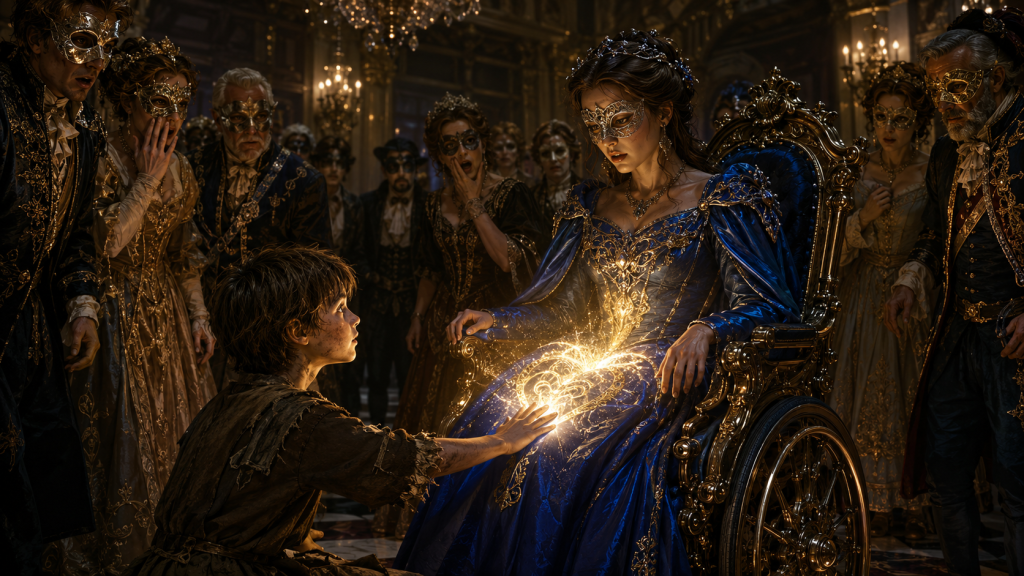
A Dirty Boy Asked The King For Help. When He Said His Mother’s Name Was Lucy, The King Realized The Secret He Buried Had A Son.
“I NEED YOUR HELP.”
The boy’s voice was barely louder than the crackle of the hearth.
Still, it reached the throne.
The great hall of Westmere Castle had been full of noise a moment before. Courtiers whispering over wine. Petitioners shuffling in nervous lines. Guards shifting spears against stone. A minstrel tuning his lute near the side arch, hoping no one important noticed he had broken a string.
Then the boy stepped forward.
Small.
Filthy.
Alone.
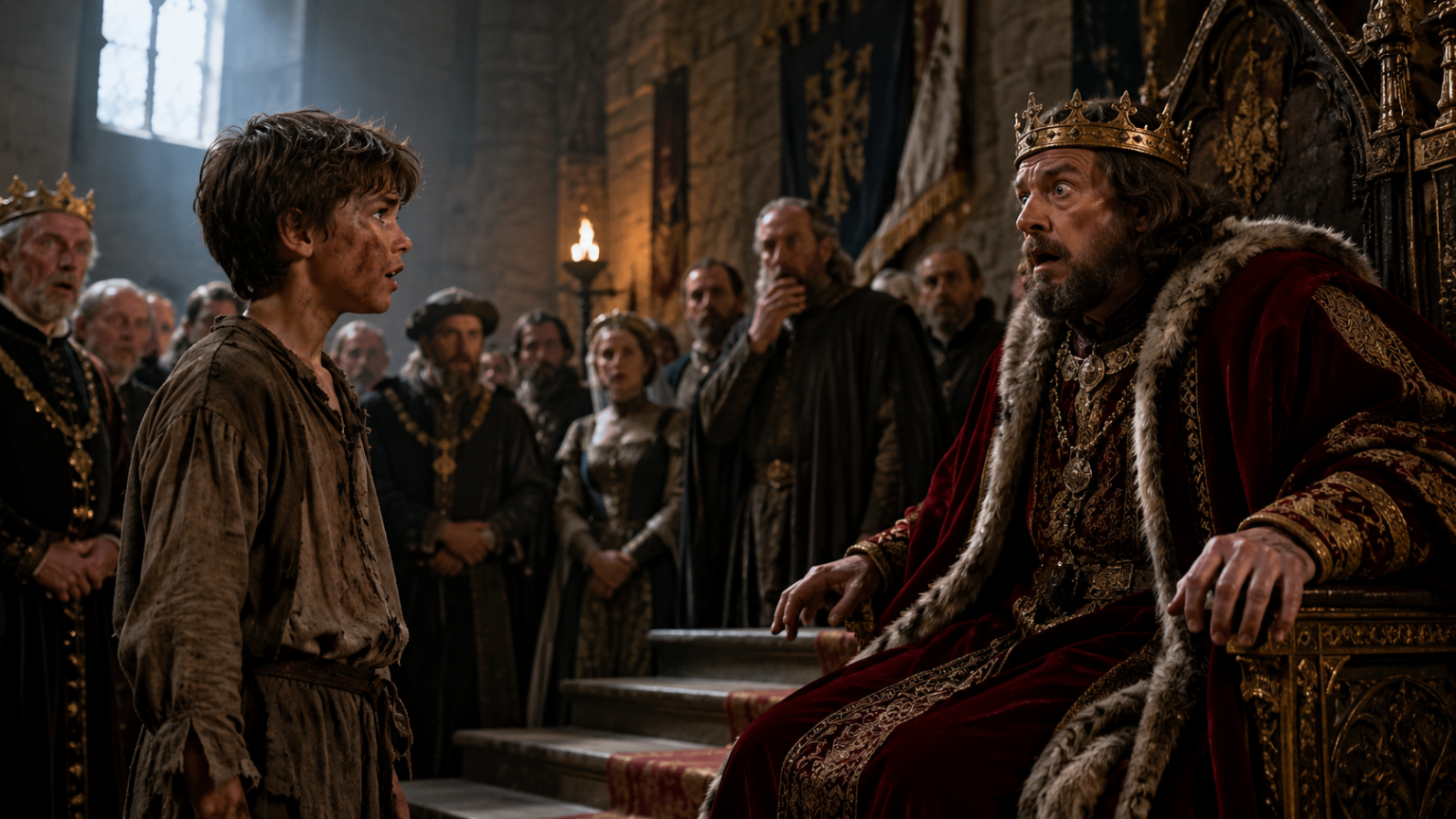
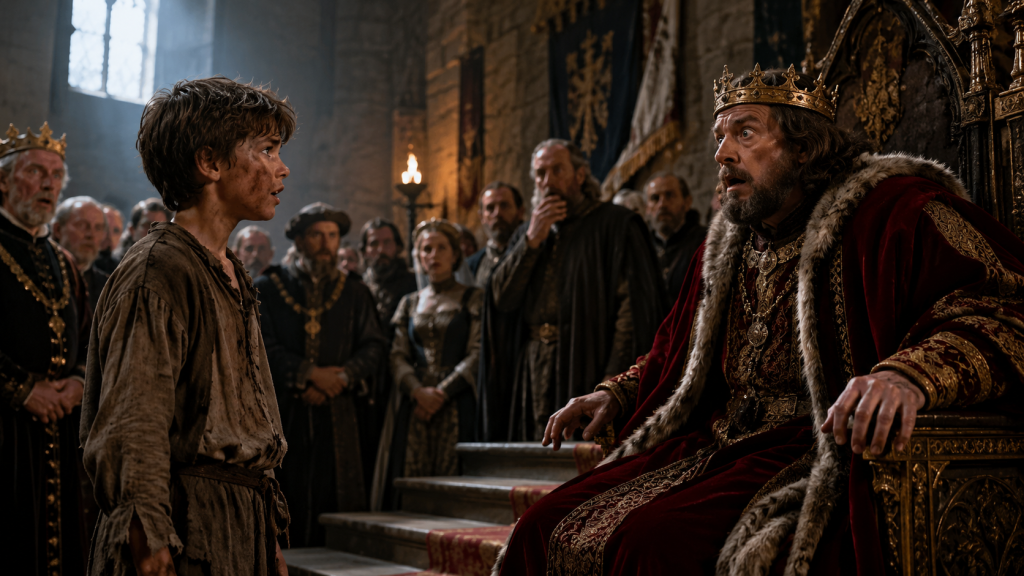
His tunic was torn at one shoulder. Mud clung to his knees. His hair had been cut roughly, as if someone had taken a knife to it in a hurry. One cheek was bruised purple beneath a layer of dirt.
The nobles nearest him recoiled.
“Another beggar,” someone murmured.
“Remove him,” said another.
The boy heard them.
He did not move.
King Alistair leaned forward on the throne.
He was not a young king anymore. Silver threaded his beard. Deep lines marked the corners of his eyes. He wore a crown of iron and gold, but that morning he looked more tired than magnificent.
The boy stared up at him with desperate, unwavering eyes.
Alistair lifted one hand.
The guards stopped.
“What happened?” the king asked.
The boy swallowed.
His small chest rose and fell as if he had run for miles.
“My mother said only you can help me.”
The hall changed.
Not visibly.
But everyone felt the king’s attention sharpen.
“Who is your mother?”
The boy’s fingers tightened around a scrap of cloth clutched in his hand.
“Lucy.”
The name landed like a stone dropped into deep water.
King Alistair did not move.
Then his eyes widened.
All color drained from his face.
A goblet slipped from a nobleman’s hand somewhere to the left and struck the floor, spilling wine across the stone like blood.
Lucy.
No one at court had spoken that name in eighteen years.
Not in the king’s presence.
Not above a whisper.
Not if they valued comfort.
Alistair gripped the arm of his throne until his knuckles whitened.
“What did you say?”
The boy flinched but repeated it.
“My mother’s name is Lucy.”
The king descended the throne steps before anyone could announce him.
The courtiers parted.
The guards looked uncertain.
Alistair stopped in front of the child, close enough now to see the shape of his eyes.
Gray-green.
Not Lucy’s.
His own.
The boy held out the scrap of cloth.
“She said to show you this.”
Alistair took it.
It was a torn piece of blue silk, faded with age, embroidered at the corner with a tiny silver lark.
The private mark of Lady Lucienne Vale.
Lucy.
The woman the king had loved before the crown.
The woman he had abandoned to save a kingdom.
The woman he had been told died before she could hate him for it.
The king’s breath broke.
“Where is she?”
The boy looked toward the doors, then back at him.
His lips trembled.
“They took her.”
A silence fell so hard it seemed to crush the room.
“Who?” Alistair asked.
The boy’s eyes filled, but his voice did not shake.
“The men with your crest.”
The Name The Court Was Taught To Forget
Before he became King Alistair of Westmere, he had been Prince Alistair, third son of a dying house and least likely to wear the crown.
That was why he had once been almost free.
Almost.
He met Lucy Vale in the spring before the plague wars, when the river flooded the lower orchards and half the court fled to the hunting lodge to avoid the stench of wet earth. Lucy arrived with her father, a minor border lord whose lands mattered only when armies needed somewhere to march.
She was not considered a beauty by court standards.
That was what people said before watching her laugh.
After that, standards became less useful.
Lucy had dark hair, quick hands, and a way of looking directly at people no matter how high their rank. She climbed trees in riding skirts, beat two knights at chess on the same afternoon, and once told Prince Alistair his poetry sounded like a horse stepping on a harp.
He loved her almost immediately.
She did not love him immediately back.
That made him love her worse.
They were young enough to believe honesty could protect them.
For one summer, it did.
They met in the old library behind the chapel, where rain leaked through the ceiling and the royal historians stored maps no one trusted. They rode beyond the east meadow without guards. They shared apples stolen from the kitchens and argued about everything.
Kingship.
War.
Duty.
Whether mercy was strength or simply the luxury of people far from danger.
Lucy believed mercy required more courage than cruelty.
Alistair said cruelty often called itself necessity.
She smiled at him then.
“Remember that if they ever give you a crown.”
He laughed.
“They won’t.”
Then his eldest brother died of fever.
His second brother died in a border ambush.
His father collapsed during winter court and never stood again.
By autumn, Alistair was heir.
By winter, he was betrothed to Princess Maribel of Northmere, because Westmere needed soldiers, grain, and a northern alliance more than its new heir needed a heart.
Lucy did not cry when he told her.
That hurt more than tears.
She stood in the old library, one hand on the table between them, face pale but steady.
“Did you choose it?”
“No.”
“Did you refuse?”
He said nothing.
Her mouth tightened.
That silence became the first betrayal.
Alistair reached for her.
She stepped back.
“I would have understood duty,” she said. “I will not forgive cowardice dressed as duty.”
He had no answer.
Because she was right.
The wedding happened before spring.
Maribel was kind.
That made it worse.
She was not vain, cruel, or foolish. She was a princess raised to become a bridge between kingdoms. She understood politics better than most men in the council chamber. She knew before vows were spoken that Alistair’s heart had been left somewhere else.
She did not punish him for it.
The crown did.
After the wedding, Lucy disappeared from court.
Officially, her father returned to the borderlands and took her with him.
Unofficially, no one knew.
Alistair asked once.
Only once.
Lord Chancellor Edran told him Lady Lucienne had accepted a marriage offer in the south.
“She is safer away from court,” Edran said. “And so are you.”
Alistair hated him for that.
Then hated himself for doing nothing.
Years passed.
His father died.
Alistair became king.
The border wars worsened.
Queen Maribel lost two infants in childbirth and then, after years of dutiful partnership rather than love, died of winter lung sickness with her hand in his.
Before she died, she said something he never forgot.
“You have spent your life trying not to look backward. It has not made you kinder.”
He asked, “Did you hate me?”
She smiled faintly.
“No. That would have required you to be more present.”
That was Maribel.
Even dying, she left truth like a blade wrapped in silk.
After her death, Alistair ruled alone.
He became respected.
Then feared.
Then efficient.
He told himself each step was necessary.
The kingdom stabilized. Roads were rebuilt. Grain stores filled. Rebellions were crushed before they grew teeth. The court praised his discipline.
No one mentioned Lucy.
Then, twelve years into his reign, a sealed note arrived without sender.
Three words.
Lucy is dead.
No explanation.
No body.
No witness.
Just three words on rough paper.
Alistair burned the note and did not sleep for two nights.
By the third morning, he decided grief without proof was self-indulgence. There was a kingdom to govern.
So he buried her in silence.
Not in earth.
In himself.
That grave held until the boy walked into the hall.
Now Alistair stood before a child with his eyes, holding Lucy’s blue silk in his hand, hearing that men with his crest had taken her.
“What is your name?” he asked.
The boy hesitated.
“Sam.”
“Samuel?”
“My mother calls me Sam.”
The king almost smiled.
Lucy would have hated ceremony enough to shorten any name.
“How old are you?”
“Eleven.”
The hall whispered.
Alistair felt the calculation strike every courtier at once.
Eleven.
Born years after Lucy vanished.
Years after Alistair’s wedding.
Years after the court had folded her name into silence.
The boy could not be his son.
Not if the official story was true.
But official stories were often written by the same men who benefited from them.
Alistair crouched so his face was level with the child’s.
“Where did they take her?”
Sam looked toward the upper gallery.
Not randomly.
At someone.
Alistair followed his gaze.
Lord Chancellor Edran stood beneath a carved arch, one hand resting on his cane, his old face unreadable.
For a moment, nothing moved.
Then Sam whispered, “That man was there.”
The king rose.
And the court learned that old secrets do not return gently.
They come back with witnesses.
The Boy From Black Hollow
Lord Chancellor Edran had served three kings.
That was what people said when they wanted to end an argument.
He had outlived factions, scandals, wars, heirs, queens, and men who thought themselves indispensable. He moved slowly now, leaning on a silver-headed cane, but his mind remained sharp enough to frighten anyone who mistook age for weakness.
When the boy accused him, Edran did not flinch.
He simply bowed.
“Your Majesty, the child is frightened. He may have seen many old men.”
Sam stepped closer to the king.
“No.”
His voice was quiet, but the refusal carried.
Edran’s pale eyes shifted to him.
“You should be careful, boy.”
Alistair turned sharply.
“Do not warn him.”
The chancellor bowed again.
“As Your Majesty commands.”
But the damage was done.
Alistair had heard the tone beneath the words.
Not concern.
Possession.
He looked at the captain of the guard.
“Seal the hall. No one leaves.”
The court erupted.
Edran lifted a hand.
“Your Majesty, surely this is unnecessary.”
“That remains to be seen.”
Alistair led Sam into the council chamber beside the hall, away from the staring crowd but not away from witnesses. He ordered Captain Rorik, two royal scribes, and the old court physician to remain. Edran was brought in under guard.
Not arrested.
Not yet.
That distinction mattered.
Sam sat on a chair too large for him, both feet dangling above the floor. Someone brought water and bread. He drank first, then grabbed the bread with both hands and ate as if expecting it to vanish.
Alistair watched.
Each bite accused the palace more deeply than words.
“Where do you live?” he asked.
“Black Hollow.”
The physician frowned.
“That village was abandoned years ago.”
Sam shook his head.
“Not all.”
Black Hollow lay beyond the western marshes, near the old silver road. It had been emptied after mine fever, according to tax records. No official household remained. No priest, no reeve, no market dues.
A perfect place for people meant not to exist.
“Who lives there with you?”
“My mother. Old Mina. Tovey the smith. Three little ones. Some others.”
“How many?”
Sam counted silently on his fingers.
“Maybe twenty.”
Edran sighed.
“Your Majesty, abandoned villages often attract vagrants. It is unfortunate but not unusual.”
Sam stared at him.
“You came with soldiers.”
Edran’s mouth closed.
Alistair leaned forward.
“When?”
“Three nights ago.”
“What happened?”
The boy’s fingers tightened around the bread.
“They came after dark. Mother heard horses first. She made me hide in the root cellar. She put the blue cloth in my hand and said if they took her, I had to go to the king.”
His voice wavered.
“She said not to trust roads. Not to trust priests. Not to trust anyone who says her name like they own it.”
Alistair felt something twist inside him.
That sounded like Lucy.
Painfully.
“What did the men want?”
Sam swallowed.
“A book.”
Edran’s cane tapped once against the floor.
Small sound.
Sharp.
Alistair noticed.
“What book?”
“My mother’s black book.”
“Did they find it?”
Sam looked down.
“No.”
“Where is it?”
The boy said nothing.
Edran smiled faintly.
“There, Your Majesty. The child has been coached to conceal—”
Alistair slammed his fist on the table.
The boy jumped.
So did the scribes.
The king instantly regretted frightening Sam, but his eyes remained on Edran.
“You will not speak unless I ask you.”
Edran bowed his head.
“Forgive me.”
Alistair turned back to Sam, lowering his voice.
“Your mother told you not to give the book to anyone?”
Sam nodded.
“Good. Then do not tell me yet.”
The boy looked surprised.
So did everyone else.
A king refusing a secret was rare enough to unsettle a room.
Alistair continued.
“Tell me only what happened after they came.”
Sam closed his eyes.
His voice became smaller.
“They broke the door. Mother told them the book was gone. One man hit her. I wanted to come out, but she started singing.”
“What song?”
Sam looked at him.
“The lark song.”
Alistair nearly lost his breath.
The lark song was not a common tune. It was something Lucy invented that summer in the orchard, nonsense words over a melody she said sounded like a bird refusing to be polite.
She sang it when she wanted him to know not to interrupt her.
Not to act.
Not to be foolish.
“I stayed hidden,” Sam whispered. “Then the old man came in.”
His eyes moved to Edran.
“He said, ‘You should have stayed buried, Lucy.’”
The physician crossed himself.
Alistair looked at Edran.
The chancellor’s expression remained sorrowful, but the hand on his cane had tightened.
Sam continued.
“She laughed at him.”
Despite everything, the boy’s mouth flickered with pride.
“She said, ‘You first.’”
For half a second, Alistair almost saw her.
Lucy standing in a broken doorway, bleeding perhaps, afraid surely, still sharp enough to cut the man who came to erase her.
“They took her in a wagon,” Sam said. “Old Mina wanted to follow, but Mother told her no. She told me to run east before dawn.”
“How did you enter the castle?”
“Tovey knew an old drain gate.”
Captain Rorik frowned.
“There is no drain gate open to the lower court.”
Sam looked at him.
“There is if you’re small.”
Alistair would have laughed if rage had not filled too much of him.
He turned to Edran.
“What is the black book?”
The chancellor gave the weary look of an old servant forced to explain childish things.
“I do not know, Your Majesty.”
Sam said, “He’s lying.”
Edran looked at the boy.
This time, his mask cracked.
Only a hair.
Enough.
Alistair stood.
“Lord Edran, you will surrender your seal, keys, and correspondence until this matter is resolved.”
The chamber went still.
The chancellor’s face slowly lifted.
“Your Majesty, I have served this crown since before you first held a sword.”
“And perhaps that is the problem.”
A flush crept up Edran’s neck.
“You would strip me of office over a beggar’s accusation?”
“No,” Alistair said. “I would strip you of office because when a child said Lucy’s name, you looked afraid.”
For the first time in decades, Lord Edran seemed old.
Not powerful-old.
Just old.
He placed his seal on the table.
Then the keys.
But when a guard reached for his cane, he smiled.
“Surely, Your Majesty, you do not suspect a lame old man’s walking stick.”
Sam suddenly stood.
“Don’t touch it!”
Everyone froze.
Edran’s eyes flashed.
The boy pointed.
“He hit Mother with it. But the end came off. There was a knife inside.”
Captain Rorik drew his sword.
Edran moved.
Not like an old man.
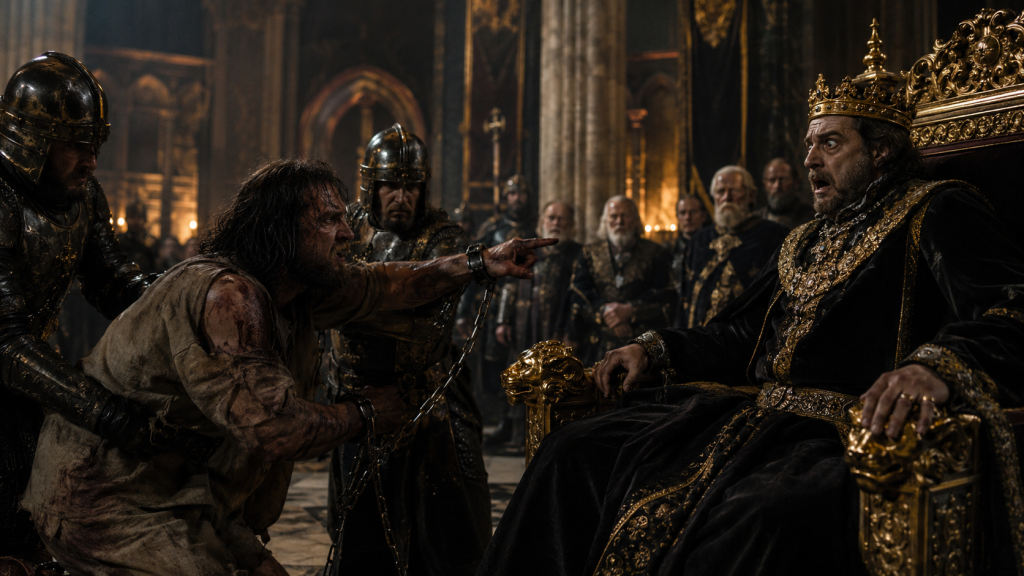
The cane blade slid free in a flash of thin steel. He seized the nearest scribe, pressing the hidden blade under the young man’s chin, and backed toward the side door.
“Your Majesty,” he said softly, “you always were sentimental when someone said her name.”
Alistair’s face went cold.
“Release him.”
“In a moment.”
“You will not leave this castle.”
Edran’s smile returned.
“I left it years ago. You simply never noticed I was ruling from inside it.”
Then he threw the scribe forward, slashed the candle stand, and plunged the room into smoke and fire.
By the time the guards reached the door, Lord Edran was gone.
And Sam, pale and shaking beside the table, whispered the thing that chilled the king more than the escape.
“He’s going back to kill my mother.”
The Book Beneath The Stone Well
Alistair did not send soldiers west.
He led them.
That caused nearly as much panic as Edran’s escape.
The council begged him to remain in the castle. The captain argued that the chancellor might be luring him away from the capital. The physician insisted the king had not slept enough to ride through marshland at night.
Alistair ignored them all.
For eighteen years, other men had told him what safety required.
Lucy had disappeared.
His life had become a polished cage.
A child had come from a dead village asking for help.
He would not answer from a throne.
Sam rode with him.
That caused even more panic.
But the boy refused to remain behind, and Alistair recognized the look in his eyes. It was the look of someone who knew adults might promise rescue and arrive too late.
So the king wrapped him in a guard’s cloak and placed him before him on his own horse.
They rode through the eastern gate at dusk with twenty loyal guards, Captain Rorik, and a royal physician who complained under his breath the entire way while packing enough bandages to treat a battlefield.
The road west turned ugly after sunset.
Stone gave way to mud. Farms thinned. Trees twisted toward the marsh. The air smelled of peat, stagnant water, and old leaves. Twice, horses stumbled where the road vanished beneath floodwater.
Sam did not complain.
Alistair noticed.
Children who have learned not to complain have often learned it from people who punish need.
“Are you cold?” the king asked.
“No.”
“You are shaking.”
“I’m not cold.”
That answer hurt.
Fear, then.
Alistair adjusted the cloak around him anyway.
After a while, Sam asked, “Did you know my mother before?”
The question came softly.
Alistair looked over the dark road.
“Yes.”
“Was she a lady?”
“Yes.”
Sam thought about that.
“She doesn’t act like ladies in stories.”
“No. She rarely did what stories asked.”
“Did you love her?”
Captain Rorik, riding nearby, suddenly became deeply interested in the horizon.
Alistair could have avoided the question.
He had avoided harder ones for less.
But Sam deserved more than royal fog.
“Yes,” he said.
The boy was silent for a long time.
“Did she love you?”
The king’s throat tightened.
“I think she did once.”
“Why aren’t you with her?”
Because I was weak.
Because I was crowned.
Because I let men convince me that abandoning one woman could save thousands.
Because I feared losing power before I understood what power would take from me.
He said, “I failed her.”
Sam looked down at the horse’s mane.
“She doesn’t like people who say sorry but don’t fix things.”
Despite the dark, despite the terror, Alistair smiled faintly.
“No. She does not.”
Black Hollow appeared near midnight.
It was not abandoned.
Not fully.
Ruined cottages leaned beneath sagging roofs. Old mine sheds stood empty along the ridge. A broken chapel tower rose above the trees. Small garden plots had been scraped into the poor soil behind the houses. Smoke stains marked chimneys still in use.
A hidden village.
A village of people who had disappeared from the kingdom’s ledgers but not from life.
The king’s soldiers moved in quietly.
Too quietly.
No dogs barked.
No voices called.
Sam went rigid.
“They’re hiding.”
Alistair dismounted.
“Where?”
The boy pointed toward the old well in the center square.
At first, Alistair saw only stone and weeds.
Then a shape moved behind the well wall.
An old woman emerged with a kitchen knife in one hand.
Her hair was white and wild. Her back bent. Her eyes were fierce enough to stop three armed guards.
“Don’t come closer,” she said.
Sam slipped from the horse and ran.
“Mina!”
The old woman’s face broke.
She dropped the knife and caught him in both arms.
“Oh, little fox. I thought they’d taken you too.”
Alistair stepped forward slowly.
“I am King Alistair.”
Mina did not bow.
“I know who you are.”
There was no reverence in her tone.
Only accusation.
Good, Alistair thought.
He was beginning to prefer honest hatred to polished loyalty.
“Where is Lucy?” he asked.
Mina looked at Sam.
The boy nodded.
The old woman’s expression changed.
“They took her toward the old mine road. But if Edran returns, he’ll come here first.”
“Why?”
Mina looked at the well.
“For the book.”
Sam’s face tightened.
Alistair followed her gaze.
“The book is in the well?”
Mina snorted.
“Not in the water. Under the stone.”
Tovey the smith appeared from behind the chapel with a hammer in one hand and two children clinging to his tunic. Others emerged slowly from shadows: women, old men, thin boys, a girl with a bandage over one eye.
The vanished people of Black Hollow.
Mina led the king to the well. With Tovey’s help, they shifted a loose ring of stone near the base. Beneath it was an oilskin bundle wrapped in waxed cord.
Sam took it first.
He held it against his chest.
No one tried to take it from him.
Alistair crouched.
“Your mother told you to guard it?”
Sam nodded.
“Then you decide when I see it.”
The boy looked into his face, searching for the trick.
Finding none, or perhaps choosing hope because no other tool remained, he handed the bundle over.
The black book inside was not large.
Its leather cover was cracked. Pages had been added, sewn in, folded, hidden between other pages. It smelled of smoke, damp, and time.
Alistair opened it beneath torchlight.
The first page held Lucy’s handwriting.
If this book reaches Alistair, then Edran has finally run out of shadows.
The king’s hand trembled.
He turned the page.
Names.
Dates.
Payments.
False death records.
Border incidents that had justified wars.
Letters intercepted before reaching the throne.
Orders issued under the royal seal while Alistair was kept ignorant by careful counsel.
And Lucy’s own story.
She had not accepted a southern marriage.
She had been taken.
Not publicly.
Not violently enough to cause scandal.
Edran had arranged her confinement under the pretense of protecting the royal succession from a woman whose existence threatened the northern alliance.
She was held for months in a convent prison.
She escaped with help from servants loyal to Queen Maribel.
Alistair stopped reading.
Maribel.
His late wife had known.
He turned the page.
There was a letter in Maribel’s hand, copied carefully.
Lucy,
He is a coward, but not a monster. I do not know if that is enough to save him. It may be enough to save you. Take the western road. Trust no council rider. If you carry his child, hide the child better than you hide yourself.
Alistair sat back on his heels.
The marsh wind moved through the ruined square.
His wife had saved the woman he loved.
His chancellor had buried them both.
His kingdom had been ruled by lies wearing his own seal.
Sam stood beside him.
“My mother said the book is full of dead people.”
Alistair’s voice was rough.
“Not dead. Silenced.”
Mina spat into the dirt.
“Some dead.”
The king looked at her.
She pointed to the book.
“Every name crossed twice means Edran sent men.”
Alistair looked again.
Many names had been crossed twice.
Too many.
Before he could read further, a horn sounded from the ridge.
Not royal.
Not local.
A harsh, low signal.
Mina turned pale.
Tovey lifted his hammer.
Sam whispered, “He came back.”
Torches appeared along the mine road.
Dozens.
Lord Edran had not fled alone.
And somewhere beyond those torches, if the boy was right, Lucy was still alive.
The Woman In The Mine Road
The attack came from two sides.
Edran’s men knew Black Hollow.
That told Alistair everything.
They moved through the old goat paths, the abandoned smelting yard, the marsh track behind the chapel. These were not soldiers stumbling into a forgotten village. They were men returning to a place they had watched for years.
The king’s guard formed a line in the square.
Too few.
Alistair had brought twenty. Edran had nearly fifty.
But royal guards defending a king fight differently from hired men defending secrets.
The first clash rang across the village like a blacksmith’s nightmare.
Steel.
Shouts.
Horses screaming in mud.
Children crying beneath floorboards.
Mina dragged Sam toward the old chapel, but the boy twisted free and ran back toward the well.
“The book!”
Alistair saw him.
So did one of Edran’s men.
The attacker lunged.
Alistair reached him first.
The king had not drawn a sword in true combat for years, but training carved deeply into men raised among blades. He caught the strike, drove his shoulder into the man’s chest, and sent him crashing into the well stones.
Sam clutched the book.
Alistair seized him by the back of the cloak and pulled him behind the guard line.
“Stay down!”
Sam looked furious.
Then a voice cut through the fighting.
“Your Majesty!”
Not Edran.
A woman.
Alistair turned.
At the far edge of the village, near the mine road, two men dragged a woman between them.
Her hair was streaked with gray.
Her dress torn.
Hands bound.
Face bloodied.
But even at a distance, even after eighteen years, even through smoke and torchlight—
He knew her.
Lucy.
The world narrowed to one impossible figure.
She lifted her head.
Their eyes met.
For one second, Alistair was not king, not widower, not ruler of a wounded realm.
He was a young man in a leaking library being told his poetry was terrible.
Lucy smiled.
Barely.
Then Lord Edran stepped from behind her and pressed a knife beneath her chin.
“Enough!” he shouted.
The fighting slowed.
Not stopped.
No battle stops cleanly.
But enough men turned for the old chancellor’s voice to take hold.
Edran stood behind Lucy, his cane blade gleaming in one hand.
“Your Majesty,” he said, breathing harder than before, “you should have remained in your castle.”
Alistair stepped forward.
Captain Rorik grabbed his arm.
The king shook him off.
“Release her.”
Edran laughed.
“You always did say the simplest things when frightened.”
Lucy’s eyes moved to Sam.
The boy tried to run to her.
Mina caught him around the chest and held tight.
“Mother!” he screamed.
Lucy’s face broke for the first time.
“My little fox,” she whispered.
Edran’s blade pressed closer.
“Touching. Truly.”
Alistair’s voice was low.
“What do you want?”
“The book.”
“No,” Lucy said immediately.
Edran tightened his grip.
She gasped.
Alistair’s hand clenched around his sword.
Edran smiled.
“There. That old weakness again. The whole kingdom bends whenever this woman breathes.”
Lucy spat blood onto the ground.
“The kingdom bends because you’ve been standing on its neck.”
Some of the villagers gave a grim little cheer.
Edran ignored them.
“The book, Your Majesty. Or she dies here, and the boy after her.”
Sam made a small sound.
Alistair looked at the book in the child’s hands.
Inside it were names, crimes, proof. The anatomy of eighteen years of manipulation. It could tear down half the court. It could restore the dead to memory. It could prevent Edran’s allies from quietly surviving him.
And Lucy knew that.
Her eyes locked on Alistair.
Do not.
She did not need to say it.
He heard her.
Edran saw the exchange and sighed.
“This is why you never became great, Alistair. You mistake attachment for conscience.”
Alistair looked at him.
“No. I mistook your counsel for wisdom.”
The words struck.
Edran’s face hardened.
“You were a boy when I found you. A frightened prince with dead brothers and no spine for rule. I made you king.”
“You made me useful.”
“I made you survive.”
“At what cost?”
Edran laughed.
“At the cost every throne requires. You think kings are built from love? They are built from removals. Your brothers removed. Your father removed by time. Your lover removed by necessity. Your wife smart enough to die before she became inconvenient.”
Alistair went cold.
Lucy stared at Edran.
“What did you say?”
Edran’s mouth closed.
Too late.
Alistair stepped closer.
“Maribel died of winter lung.”
Edran looked almost bored now.
“Maribel died because she helped Lucy escape, then began writing letters to border houses. She was going to expose the convent prison. She was going to make your private shame a public crisis.”
The village went silent beneath the dying battle noise.
Alistair could not breathe.
Queen Maribel.
Kind, distant, honest Maribel.
Dead not from sickness, but from courage.
Lucy’s eyes filled.
“I didn’t know,” she whispered.
Edran’s grip tightened.
“Of course not. Dead women carry secrets better than living ones.”
Something in Alistair changed then.
Not rage.
Rage had come before.
This was colder.
Clearer.
The end of being ruled by the need to believe he had been helpless.
He lowered his sword.
Edran smiled.
“Yes. The book.”
Alistair turned to Sam.
The boy clutched it.
His face twisted.
“Don’t give it to him.”
Alistair walked to him slowly and knelt.
“I won’t.”
Sam stared.
“Then what?”
The king placed one hand over the black book.
“Your mother carried the truth for years. You carried it to me. Now everyone carries it.”
He stood and faced the village.
“Read it.”
Sam’s eyes widened.
Alistair looked at Captain Rorik.
“Read it aloud.”
Edran’s smile vanished.
“No.”
Rorik understood instantly. He seized the book from Sam, opened it to the marked pages, and began shouting names into the night.
Lord Harven. Paid for false border raids.
Bishop Cael. Signed confinement orders for women declared unstable after inheritance disputes.
Master Orrin. Poison supplier.
Edran’s network.
Edran’s crimes.
Edran’s allies.
The villagers took up the names.
Mina shouted one.
Tovey another.
A guard another.
Within moments, the black book was no longer a single object Edran could bargain for.
It was sound.
Memory.
Witness.
Spreading through mouths he could not cut down fast enough.
Edran’s face twisted.
He shoved Lucy forward and raised the blade to strike.
But Lucy had been waiting.
She drove her heel into his foot, slammed the back of her head into his chin, and dropped hard.
The knife flashed above her instead of through her.
Alistair charged.
So did Sam.
The king reached Edran first, but the old man’s hidden blade found him beneath the ribs.
Alistair staggered.
Lucy screamed.
Sam threw himself at Edran’s arm with all the fury of a child who had crossed half a kingdom and found the monster still touching his mother.
Edran struck him across the face.
Sam fell.
That was his final mistake.
Lucy rose from the ground with a fallen guard’s dagger in hand.
No court grace.
No noble restraint.
She drove the blade through Edran’s cane hand and pinned it against the wooden post of the village well.
Edran screamed.
The sound was thin.
Human.
Small.
Alistair, bleeding, stepped close and pressed his sword against the chancellor’s throat.
“For eighteen years,” the king said, “I thought I was carrying the burden of rule.”
Edran gasped, trapped against the post.
Alistair’s voice shook.
“I was carrying your lies.”
He did not kill him.
Lucy wanted him to.
Sam wanted him to.
Half the village probably wanted to help.
But Alistair looked at the people of Black Hollow, at the book still being read aloud, at the names moving from page to voice to memory.
“No,” he said softly. “Let him hear every name first.”
Edran was chained to the well until dawn.
And through the long night, by torchlight and rain, the hidden people of Black Hollow read the black book aloud until the king’s kingdom finally began telling the truth.
The Court That Had To Listen
They returned to Westmere Castle with Lucy alive, Sam at her side, and Lord Edran in chains.
No procession had ever looked like it.
The king rode wounded but upright. Lucy rode beside him, wrapped in a borrowed cloak, bruised and exhausted but unbowed. Sam sat before her, refusing to let go of her sleeve. Behind them, villagers from Black Hollow carried copies of pages from the black book, each guarded by royal soldiers.
Edran rode bound to a mule.
Mina insisted on that.
“He doesn’t deserve a horse,” she said.
No one argued.
By the time they reached the capital, the names had outrun them.
Black Hollow riders had spread copies to monasteries, market squares, and border keeps. Captain Rorik sent sealed transcripts to judges not named in the book. The court could not contain what had already been spoken aloud by villagers, soldiers, and children.
That was Alistair’s first real victory.
Not capturing Edran.
Making secrecy impossible.
The trials began within a month.
The great hall became a court of inquiry, its tapestries removed so every wall stood bare and cold. Alistair refused to sit on the throne during testimony. He sat on a plain chair at floor level, with Lucy, Sam, and the families of the disappeared occupying the front benches.
The nobles hated this.
Good.
Lucy testified first.
Her voice was rough from captivity, but it carried.
She described the old library. The forced removal. The convent prison. Maribel’s secret aid. The road to Black Hollow. The years of hiding. The black book built from smuggled letters, dying confessions, servants’ whispers, stolen ledgers, and names entrusted to her by people who had no court that would hear them.
Then she described Sam.
Not as proof of blood.
As a child.
Born in a hidden room during a storm, with Mina holding one hand and Tovey boiling water in a pot used the day before for turnips. Raised among people the crown had forgotten. Fed by neighbors who had almost nothing. Taught to run, read, listen, and never trust official silence.
When asked whether Sam was the king’s son, Lucy looked at Alistair.
The hall held its breath.
“Yes,” she said.
Sam stared at the floor.
The court erupted.
Alistair did not.
He simply closed his eyes.
There it was.
A life he had not known.
A son born outside the palace because the palace had become too dangerous for truth.
When it was his turn, the king stood.
He did not defend himself.
That shocked the court more than any confession.
“I will not claim ignorance as innocence,” he said. “I signed orders I did not read closely enough. Trusted counsel I did not question. Accepted absences because they made ruling easier. I let my grief for one life become convenient blindness to many.”
His eyes moved to Lucy.
“Some crimes were committed in my name without my knowledge. That does not erase the name.”
Then he looked at Edran.
The old chancellor sat chained, one bandaged hand resting useless in his lap, his face gray but still proud.
“You taught me that rule required removals,” Alistair said. “Today we begin returning what was removed.”
Edran was convicted of treason, murder, unlawful imprisonment, forgery of royal orders, conspiracy against the crown, poisoning Queen Maribel, and the systematic erasure of citizens through false records.
He refused repentance.
Even at sentencing, he spoke like a tutor correcting a slow pupil.
“You will learn,” he told Alistair. “Truth is not a foundation. It is a flood.”
Alistair looked at the packed hall.
At Lucy.
At Sam.
At Mina.
At the villagers.
At families holding scraps of proof and years of grief.
“Then let it wash the rot out.”
Edran was imprisoned in the old convent where Lucy had once been held, not as private vengeance, but as public record. The convent became an archive of state crimes, guarded by clerks, judges, and witnesses chosen from among the affected families.
Every morning, a page from the black book was read outside his cell.
Mina suggested this.
Lucy approved.
Sam thought it was too kind.
He was eleven. Mercy would take time.
The kingdom changed slowly.
Messily.
Power rarely gives back what it stole just because a king has been embarrassed.
But the black book did what armies sometimes cannot.
It named.
Names became cases.
Cases became hearings.
Hearings became opened graves, restored inheritances, freed prisoners, corrected records, returned lands, and apologies that often arrived too late to matter but mattered anyway because lies hate being corrected in ink.
Queen Maribel was reburied with full honor after evidence proved she had been poisoned for helping Lucy escape. Alistair stood at her tomb with Lucy beside him.
That was not simple.
Nothing about them was simple.
Lucy looked at the marble coffin and said, “She saved my life.”
Alistair nodded.
“She saved mine too. I just lived too poorly to notice.”
Lucy did not comfort him.
He was grateful.
Their reunion did not become a ballad.
Ballads skip the hard parts.
Lucy did not fall weeping into his arms and forgive eighteen years because he had ridden west once. She loved the boy they made. She loved the memory of who Alistair had been. She did not yet know what to do with the king who stood before her.
Some days she spoke to him almost kindly.
Some days she could barely look at him.
He accepted both.
Sam moved into the castle but refused the prince’s apartments.
Too large.
Too high.
Too many doors.
He slept for months in a small chamber near Lucy’s room, with a chair wedged beneath the handle and a knife under his pillow until Captain Rorik gently taught him better places to hide blades.
He hated court clothes.
He hated tutors who spoke to him as if poverty had made him slow.
He loved the stables.
He loved the kitchens.
He loved the royal library after discovering the map room had secret drawers.
When the court demanded a formal declaration of his status, Alistair asked Sam what he wanted.
The council nearly collapsed from offense.
Sam said, “I want Mother safe. I want Mina to stay. I want Black Hollow on maps.”
“You may have all three,” Alistair said.
“And I don’t want to be called Your Highness by people who would have kicked me out yesterday.”
Alistair glanced at the council.
“That may be difficult.”
Sam crossed his arms.
“Good.”
Lucy smiled for the first time in the hall.
Eventually, Sam was recognized as Samuel Lucien of Westmere, royal son by blood and heir by choice only if he accepted the burden when grown.
That last clause was Lucy’s demand.
“No child should be turned into a tool of succession before he understands the weight,” she said.
Alistair signed it.
The nobles called it dangerous.
The people called it just.
The people were closer.
Years passed.
Sam grew taller.
Not polished.
Never that.
He learned law from a former smuggler turned magistrate because he said noble tutors made law sound like furniture. He learned swordplay from Rorik and dirty fighting from Mina, who claimed knees were placed on men specifically to be kicked when necessary.
He visited Black Hollow every spring.
The first time its name appeared on a royal map, the villagers gathered around the parchment and cried.
Not because maps are sentimental.
Because being named is the first defense against being erased.
Lucy founded the Office of Lost Records, where anyone could bring a rumor, a missing person, a false death notice, a stolen inheritance, or a silence that had grown teeth. Its clerks were trained to distrust perfect paperwork.
Alistair funded it from the confiscated estates of Edran’s conspirators.
Mina sat by the door three days a week and frightened liars before they reached the desk.
As for Alistair and Lucy, they became something neither court nor song knew how to define.
Not husband and wife.
Not strangers.
Not the young lovers they had been.
They walked together sometimes in the old library where the roof still leaked after every expensive repair. They spoke of Maribel. Of Sam. Of the dead. Of the kingdom. Sometimes they spoke of the summer before the crown, but carefully, as one handles glass found in ashes.
One rainy afternoon, Alistair found Lucy repairing the binding of the black book.
“You should let the archivists do that,” he said.
She did not look up.
“They use too much paste.”
He sat across from her.
Silence settled.
Then he said, “Do you hate me?”
Her hands stilled.
“I did.”
He nodded.
“I know.”
“I still do, some mornings.”
The truth hurt less than he deserved.
“And other mornings?”
She looked at him then.
“Other mornings I see you trying.”
He swallowed.
“That seems little.”
“It is.”
He accepted that too.
She returned to the book.
After a while, she said, “Sam asked me if you loved him.”
Alistair went still.
“What did you say?”
“I said yes.”
His eyes closed.
“Thank you.”
“I also said love is not proof a man knows how to stay.”
He opened them.
Lucy’s gaze was steady.
“So stay better.”
He did.
Not perfectly.
But better.
On Sam’s eighteenth birthday, the kingdom gathered not for a coronation, but for the opening of the Black Hollow Archive in the capital. The old black book was placed behind glass, its pages preserved, its first line visible to all.
If this book reaches Alistair, then Edran has finally run out of shadows.
Sam stood before it wearing plain dark blue, no crown, no jewels, only the small silver lark pin that had once marked Lucy’s silk.
Alistair stood in the crowd.
Not on the dais.
Lucy stood beside him.
Mina, very old now and deeply annoyed that no one had brought a proper chair, sat in the front row with a cane across her lap like a weapon.
Sam addressed the hall.
“When I came to the castle, I asked the king for help because my mother told me only he could help me.”
He looked toward Alistair.
“I was wrong.”
A ripple moved through the nobles.
Alistair smiled faintly.
Sam continued.
“One man cannot carry truth alone. Not a king. Not a witness. Not a child with a book. Truth survives when enough people refuse to hand it back to those who buried it.”
Lucy’s eyes shone.
Sam placed one hand on the glass above the black book.
“This archive exists because my mother wrote names down when no court would hear them. Because Black Hollow hid people the realm forgot. Because Queen Maribel chose courage in secret. Because an old woman taught me where to kick and when to run. Because a king finally learned that help is not mercy from above. It is repair.”
Mina shouted, “And because the boy had sense enough to listen to women!”
The hall erupted in laughter.
Even Alistair laughed.
Sam grinned.
“Especially that.”
Years later, when Alistair died, he left no grand final command. He left a letter for Sam and one for Lucy.
Sam’s letter contained only a few lines.
My son,
You came to me asking for help. You gave it instead.
If you take the crown, distrust comfort. If you refuse it, distrust ease. Either way, keep the map wide enough for hidden villages.
Your father,
Alistair
Sam read it twice.
Then folded it carefully.
He did eventually take the crown, but not for another four years. He said a kingdom that waited eighteen years to tell the truth could wait a little longer for a king who understood what he was agreeing to.
When he was crowned, he wore the silver lark pin beside the royal crest.
Some nobles objected.
Quietly.
They had learned.
The old story traveled far beyond Westmere.
People told it differently in different places.
A beggar boy entered a castle.
A king heard a dead woman’s name.
A black book destroyed a chancellor.
A hidden village returned to the map.
But the heart of the story remained simple.
A child came into a hall full of powerful people and said, I need your help.
And for once, after years of silence, the throne did not send him away.
It listened.
Not soon enough.
Not cleanly.
Not without blood, guilt, and the breaking of old lies.
But it listened.
And because it did, Lucy lived.
Black Hollow was named.
Maribel was honored.
The dead were counted.
The lost were sought.
The boy who had arrived covered in dirt grew into a ruler who kept a copy of the kingdom map above his desk, with one instruction written beneath it in his mother’s hand.
Look where no one important wants to look.
King Samuel read it every morning.
And every morning, before signing judgments, hearing petitions, or trusting any document too perfect to be innocent, he touched the small silver lark at his collar and remembered the day he stood before a king with mud on his face, fear in his chest, and his mother’s name on his tongue.
Lucy.
The name that opened the grave.
The name that broke the silence.
The name that brought a hidden son home.