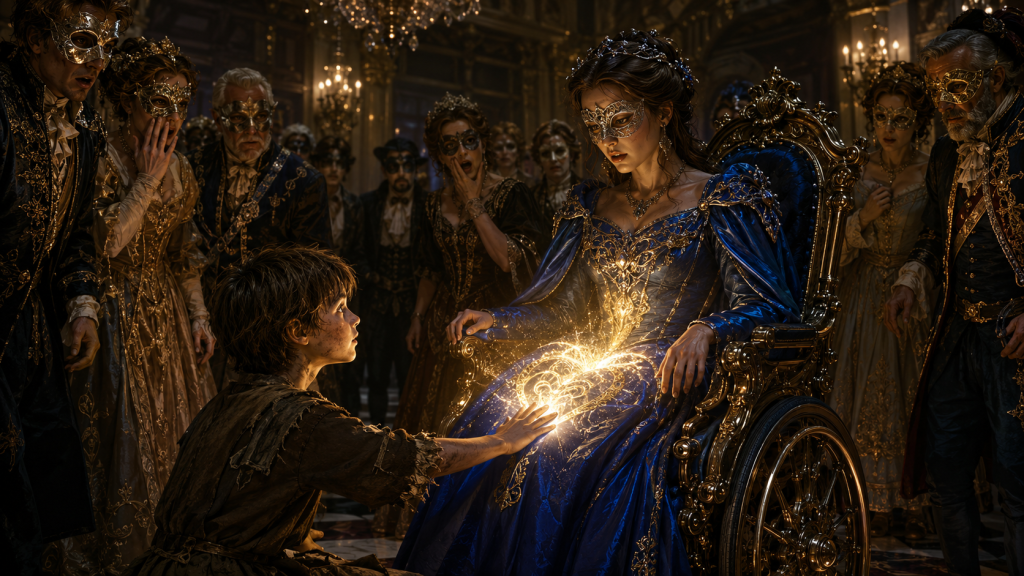
A Dirty Boy Told A Father His Daughter Was Not Blind. When The Little Girl Whispered “I See Light,” He Realized His Wife Had Been Poisoning Her.
“YOUR DAUGHTER IS NOT BLIND.”
The words struck Marcus Vale harder than a scream.
For a moment, the park disappeared.
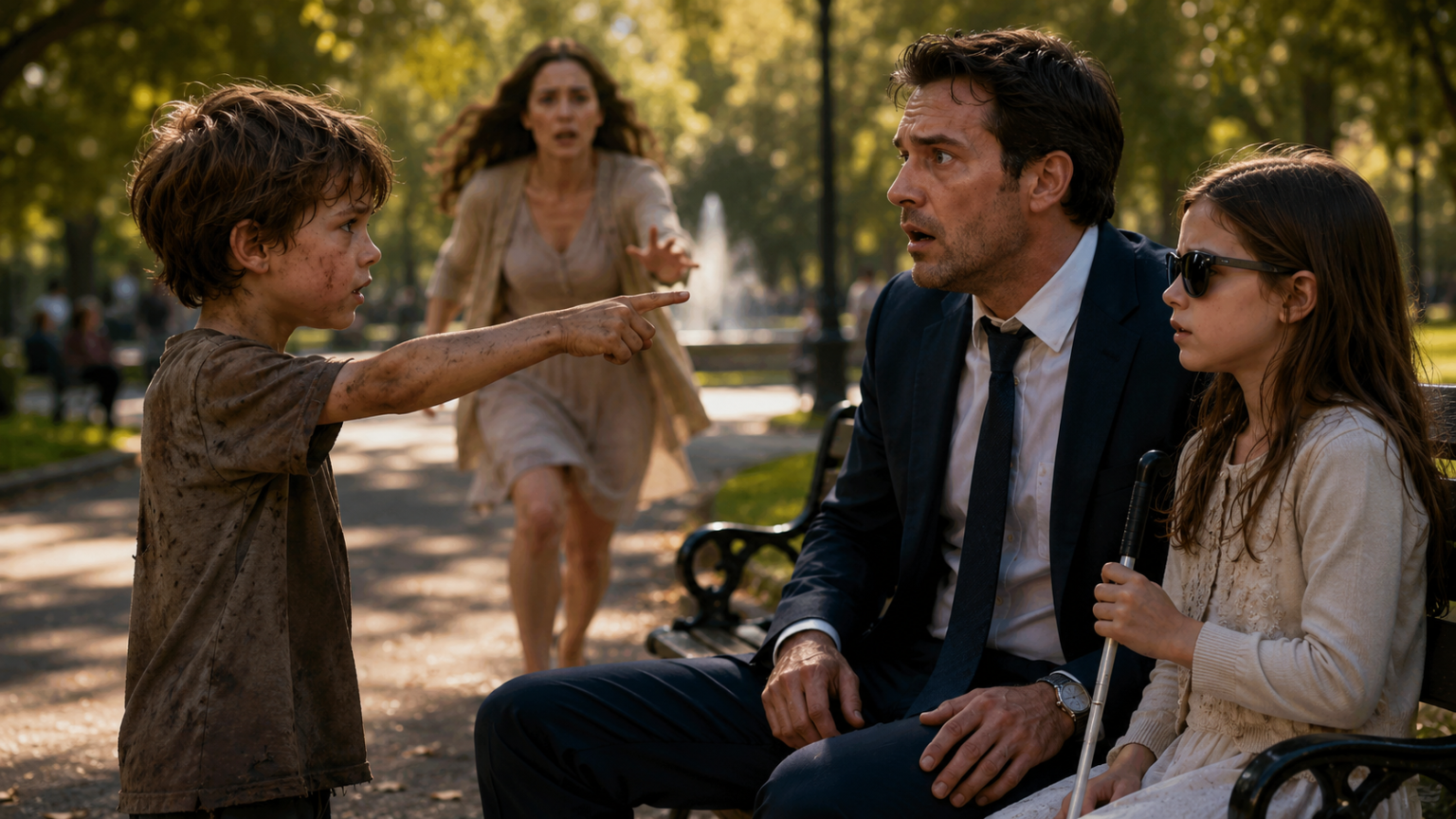
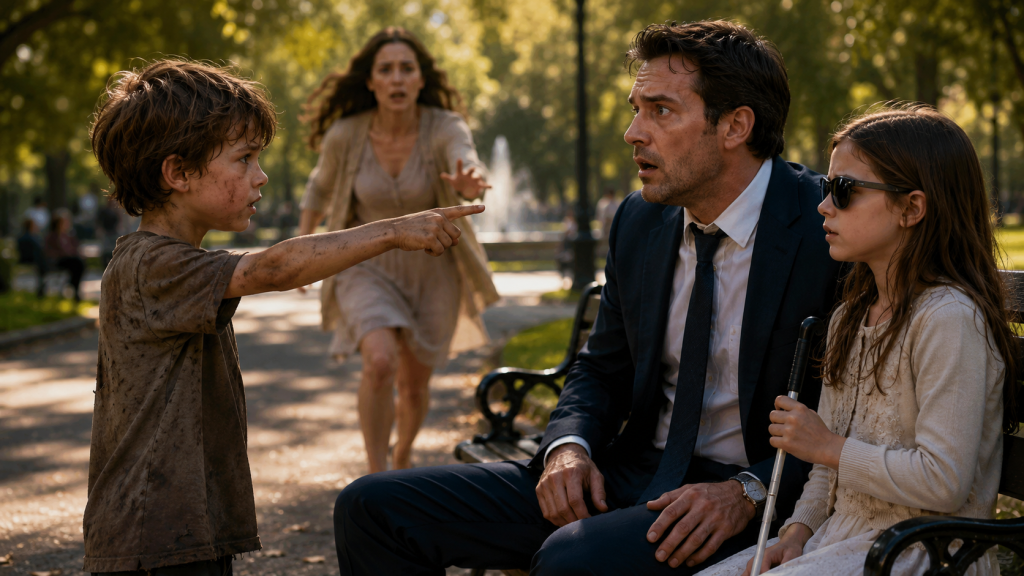
The laughter from the playground faded. The birds in the sycamore trees went silent. The soft scrape of shoes on the walking path, the distant bark of a dog, the wind moving across the grass—all of it fell away until the only thing left was the dirty boy standing in front of him with one finger pointed toward his child.
Marcus froze on the bench.
His daughter sat beside him.
Eight-year-old Sophie Vale.
Small hands folded around the handle of her white cane.
Dark sunglasses covering her eyes.
Pink cardigan buttoned wrong at the top because she insisted on doing it herself, even on the days her fingers trembled.
She did not move.
She never moved quickly anymore.
Not since the doctors told Marcus her condition was degenerative.
Not since the headaches began.
Not since the light slowly left her world and every room in their house became a place she had to memorize by touch.
Marcus stood so fast the bench creaked behind him.
“What did you just say?”
The boy did not step back.
He was maybe twelve.
Thin.
Filthy.
His clothes were too large, his sneakers split at the sides, his hair cut unevenly as if by someone with no mirror and no patience.
But his eyes were clear.
Too clear.
“She’s not sick,” he said quietly.
Marcus’s jaw tightened.
“Get away from my daughter.”
The boy’s gaze flicked to Sophie.
Then back to Marcus.
“Someone is doing this to her.”
The air changed.
Marcus felt it before he understood why.
A wrongness.
A pressure beneath the ordinary afternoon.
Then a voice cut through the park.
“Marcus!”
He turned.
His wife was running toward them from the café path.
Elena.
Perfect hair coming loose.
Designer coat open.
Face pale with something far beyond worry.
Panic.
Real panic.
“Marcus, don’t listen to him!” she shouted.
The boy did not look at her.
He raised his finger again.
This time, closer.
Stronger.
“It’s your wife.”
Everything stopped.
Marcus stared at the boy.
Then slowly, mechanically, he turned toward Elena.
Her face drained.
Only for a second.
But he saw it.
Because husbands learn their wives’ faces over years. They learn the difference between fear and performance, between surprise and recognition, between a woman running to help and a woman running to stop something from being said.
“Elena?” he whispered.
Sophie’s head moved.
Not toward her mother’s voice.
Toward the boy.
Marcus went cold.
She had not tracked motion in months.
Her lips parted.
“Daddy…”
Her voice was soft.
Uncertain.
Shaking.
“I see light.”
Silence exploded around him.
Elena stopped running.
Just for one second.
Her eyes widened as if the entire world had opened the wrong door.
Marcus could not breathe.
Sophie lifted one hand toward the sunlight filtering through the trees.
“I see… bright.”
The boy stepped backward.
His face had gone grim now, almost sad.
Marcus turned toward his wife, ready to ask the question that would destroy everything.
But before he could speak, the boy whispered, “You’re too late.”
Then Sophie gasped.
Her cane dropped onto the pavement.
And Elena reached into her coat pocket.
The Girl Who Lived In Darkness
Sophie Vale had not been born blind.
Marcus remembered that because memory had become a punishment.
He remembered her at three, chasing bubbles in the backyard, laughing whenever they burst against her nose. He remembered her at four, naming colors incorrectly on purpose because she liked watching him pretend to be outraged.
“That is not purple,” he would say.
“It is Sophie purple,” she would answer, which apparently ended all arguments.
At five, she painted the family dog blue with washable watercolor and told Elena she was helping him “be more interesting.”
At six, she began complaining that lights hurt.
At first, Marcus thought she was being dramatic.
Children often were.
Then the headaches came.
Then dizziness.
Then mornings when she woke crying because the walls “looked fuzzy.”
Elena handled everything.
That was what Marcus told himself later.
Over and over.
Elena handled the appointments. Elena found the specialists. Elena tracked the medications, supplements, eye drops, vision therapy, dietary restrictions, light sensitivity protocols, sleep schedules, and endless instructions that turned their bright home into a padded system of fear.
Marcus paid.
Elena managed.
That had always been the rhythm of their marriage.
He built companies. She built order.
Marcus Vale owned a chain of upscale rehabilitation clinics across three states. He knew medical language well enough to speak confidently in rooms full of professionals, but not deeply enough to challenge them when they spoke about rare pediatric optic neuropathies and autoimmune complications.
The doctors were cautious.
Elena was certain.
That mattered.
She kept folders.
Charts.
Printed studies.
Medication logs.
She showed up to every appointment polished, prepared, worried but composed. Marcus arrived late too often, guilty and breathless from conference calls, asking questions Elena had already asked, receiving answers she had already summarized.
“She’s declining,” Elena would say afterward in the car.
Marcus would look back at Sophie, buckled into her seat, sunglasses on even in cloudy weather.
“What do we do?”
“We protect her from false hope.”
That became Elena’s favorite phrase.
False hope.
It ended arguments before they could begin.
When Marcus suggested another specialist in Boston, Elena said false hope.
When Sophie asked if she might see clearly again someday, Elena kissed her forehead and said false hope could hurt more than darkness.
When Marcus wondered aloud if the medication made Sophie too tired, Elena cried quietly at the kitchen sink and asked whether he thought she would ever harm her own child.
He never raised it again.
The blindness progressed.
Or seemed to.
Sophie began using a cane. Then large-print books became audiobooks. Then she stopped drawing because she said the colors no longer stayed still. Then she began turning her head toward voices instead of faces.
Marcus grieved in practical ways.
He installed railings.
Changed rugs.
Marked stair edges.
Bought tactile games.
Learned how to describe sunsets without sounding like he was mourning them.
Elena grieved beautifully.
That was what people said.
She gave interviews for pediatric vision awareness campaigns. She raised money. She spoke at charity lunches about motherhood, resilience, and learning to “love your child through the life they have, not the one you imagined.”
People cried.
Marcus cried once in the back row where no one could see.
Sophie, meanwhile, grew quieter.
She stopped asking why her mother always gave her the drops.
She stopped complaining that the tea tasted bitter.
She stopped telling Marcus that some mornings she could see shadows, because Elena would gently correct her.
“No, sweetheart. That’s your brain remembering.”
At night, Marcus sometimes sat by Sophie’s bed after she slept.
He would look at the sunglasses on the nightstand, the cane by the dresser, the stuffed rabbit she no longer reached for unless someone placed it in her hands.
Then Elena would appear at the doorway.
“You can’t keep watching her like she’s disappearing,” she would whisper.
“I’m afraid she is.”
Elena’s face would soften.
“She needs you strong.”
So he became strong in the way adults often become strong around illness.
He became quiet.
Efficient.
Useful.
He did not know that silence was making him easier to deceive.
The park visit had been Elena’s idea.
“She needs fresh air,” she said that morning.
Sophie had been unusually pale. Her hands shook while eating breakfast. She said the room felt too bright, though the curtains were drawn.
Marcus wanted to call the doctor.
Elena said they had an appointment next week.
“Let her have one normal afternoon,” she said.
So they went to Harrington Park, where Sophie used to feed ducks before the pond was closed for repairs.
Elena left them on the bench while she went to buy coffee.
Marcus sat beside his daughter and described the park.
“Two kids fighting over a red scooter. A golden retriever losing a battle with a stick. A man pretending not to be tired while jogging badly.”
Sophie smiled faintly.
“Is he wearing tiny shorts?”
Marcus glanced over.
“Unforgivably tiny.”
She giggled.
The sound almost healed him.
Then the dirty boy appeared.
He stood near the path for nearly a full minute before speaking.
Marcus noticed him because the boy was staring at Sophie.
Not with pity.
Not with curiosity.
With recognition.
Marcus instinctively shifted closer to his daughter.
“Can I help you?”
The boy stepped forward.
His voice was low.
“Your daughter is not blind.”
Marcus’s first feeling was anger.
Instant.
Protective.
A child’s illness draws cruelty from strangers in strange forms. Advice. Prayers. Accusations. Miracle cures. People who knew nothing but spoke as if certainty were kindness.
He was ready to drive the boy away.
Then Sophie turned her head toward him before the boy spoke again.
Not toward the sound.
Toward him.
Marcus noticed.
But did not understand.
Not yet.
The boy looked at Sophie and said, “She sees light when your wife isn’t near her.”
The sentence was impossible.
Specific.
Horrifying.
Then Elena started running.
And Marcus’s life split into before and after.
The Boy Who Knew Too Much
Elena’s hand moved inside her coat pocket.
Marcus saw it because everything had slowed.
The boy saw it too.
He lunged forward and slapped a small amber bottle from her hand before she reached Sophie.
It hit the pavement, bounced once, and rolled beneath the bench.
Elena screamed.
Not from pain.
From exposure.
“What are you doing?” she cried. “He’s attacking us!”
People turned.
A jogger stopped. A mother pulled her stroller closer. An older man lowered his newspaper. The park, moments ago indifferent, became a circle of witnesses.
Marcus grabbed Elena’s wrist before she could reach the bottle.
She stared at him.
“Marcus, let go.”
“What is that?”
“Her medicine.”
“She already had her medicine this morning.”
“She needs another dose.”
His grip tightened.
“For what?”
“For her condition.”
The boy crouched and picked up the bottle with the edge of his sleeve, careful not to touch it directly.
“Don’t let her take it.”
Elena’s face twisted.
“You filthy little thief.”
Sophie flinched.
Marcus looked at his daughter.
She was breathing too fast now, one hand pressed over her eyes.
“Daddy,” she whispered. “It’s brighter.”
Elena’s panic sharpened.
“That’s part of the episode. Marcus, she needs the drops now.”
“Drops?” the boy said.
He held up the bottle.
“These aren’t drops.”
Marcus looked.
The label had been peeled off.
Inside was a cloudy liquid.
Not Sophie’s usual prescribed bottle.
“Elena.”
His wife’s eyes filled instantly.
That was how she always won difficult rooms.
Tears before accusation.
“After everything I’ve done,” she whispered. “After every appointment, every night awake, every seizure scare, every time I held her while you were working—now you’re listening to some street boy?”
The words found old guilt and pressed hard.
Marcus almost loosened his grip.
Almost.
Then Sophie said, “Mommy, why does my mouth taste metal?”
Elena froze.
The boy went pale.
“Hospital,” he said.
Marcus turned to him.
“What?”
“She needs a hospital. Now.”
Elena shook her head quickly.
“No. No hospitals. Her specialist said—”
Marcus took out his phone.
Elena grabbed his arm.
“Marcus, stop.”
He stared at her hand on him.
For years, he had mistaken her control for competence.
Now it looked like fear.
He dialed emergency services.
Elena backed away.
Only one step.
But enough.
The boy moved between her and Sophie.
Marcus noticed how he stood.
Not like a random street kid.
Like a child who had learned where danger comes from inside a house.
“What’s your name?” Marcus asked him.
“Leo.”
“How do you know this?”
Leo glanced at Elena.
She looked at him with such hatred that Marcus’s blood ran cold.
“I heard her,” Leo said.
“When?”
“At the shelter clinic.”
Elena snapped, “He’s lying.”
Leo’s jaw tightened.
“No, I’m not.”
The ambulance arrived in seven minutes.
Police arrived in nine because the dispatcher heard Marcus say his daughter may have been poisoned.
Elena tried to leave in minute eight.
She said she was going to get Sophie’s medical folder from the car.
Marcus told the officer not to let her go.
That sentence changed his marriage more than any accusation could have.
Elena looked at him as if he had struck her.
“Marcus.”
He could not look away from Sophie.
Paramedics checked her pulse, pupils, blood pressure, oxygen. One of them smelled the bottle and immediately sealed it in a plastic evidence bag.
“What is it?” Marcus asked.
The paramedic did not answer directly.
That was answer enough.
At the hospital, Sophie was taken through emergency doors while Marcus gave rapid, broken answers to doctors who suddenly seemed far less certain than all the specialists Elena had chosen.
Medications?
Elena handled those.
Supplements?
Elena handled those.
Diet?
Elena handled that too.
Any known toxic exposures?
No.
Yes.
Maybe.
He did not know.
That was the most damning answer.
He did not know what had entered his daughter’s body for two years.
Elena sat in the waiting area between two officers, crying softly. People looked at her with sympathy. She was very good at appearing like the most wounded person in any room.
Leo sat across from Marcus, knees drawn up, dirt still on his face, eyes fixed on the emergency doors.
A nurse had given him a sandwich.
He had not eaten it.
Marcus sank into the chair beside him.
“Tell me everything.”
Leo’s gaze stayed forward.
“She came to the shelter clinic three weeks ago.”
“Elena?”
Leo nodded.
“My aunt cleans there. Sometimes I sleep in the storage room if it’s too cold outside. I heard your wife talking to a man in the supply office.”
“What man?”
“I don’t know. Doctor maybe. Nice coat. Gray hair. She called him Dr. Vale.”
Marcus’s stomach turned.
Dr. Adrian Vale.
No relation, despite the shared name.
Sophie’s neuro-ophthalmology specialist.
The expert Elena had insisted was the only one who understood Sophie’s rare condition.
“What did she say?”
Leo rubbed both hands together.
“She said the dose wasn’t holding long enough anymore. That Sophie had started reacting to light between treatments.”
Marcus felt the room tilt.
“And he said?”
“He said it was getting dangerous. That liver tests were changing. That if you asked questions, she should push for inpatient monitoring at his private facility.”
Marcus closed his eyes.
Private facility.
Vale Children’s Neuro-Recovery Center.
One of the clinics Marcus’s company had considered acquiring the previous year before Elena advised against mixing family care with business.
“She said something else,” Leo continued.
Marcus opened his eyes.
“What?”
Leo finally looked at him.
“She said once Sophie was declared permanently blind and cognitively fragile, you would sign anything.”
The words did not make sense at first.
Then they did.
Marcus’s company.
His assets.
The trust.
The foundation Elena wanted to build in Sophie’s name.
The medical decisions.
The legal authority.
His daughter’s blindness was not only cruelty.
It was leverage.
Marcus stood so abruptly the chair slammed backward.
Elena looked up from across the room.
Their eyes met.
For the first time since the park, her tears stopped.
A doctor entered before Marcus could move.
“Mr. Vale?”
He turned.
The doctor’s face was grave but not hopeless.
“We found evidence of toxic exposure. We’re running confirmatory tests, but the pattern is consistent with repeated administration of a compound known to cause optic nerve dysfunction, neurological symptoms, and light sensitivity.”
Marcus gripped the chair.
“Can she recover?”
The doctor hesitated.
“Some damage may be reversible if exposure stops. Some may not. But she is responding to treatment.”
Marcus’s throat closed.
“Did she say anything?”
The doctor’s expression softened.
“She asked if the light was supposed to have colors.”
Marcus sat down before his legs failed.
Across the waiting room, Elena slowly lowered her face into her hands.
Not like a grieving mother.
Like someone realizing the first locked door had opened.
The Mother Everyone Believed
Elena Vale was not arrested that night.
That was the first lesson Marcus learned about truth.
Knowing something and proving it are different battles.
Doctors could say Sophie had been poisoned. They could preserve the bottle Leo knocked away. They could document inconsistencies in her medical history. Police could question Elena. They could seize her purse, her phone, her car.
But Elena had spent years building the role she now needed.
Devoted mother.
Medical advocate.
Exhausted caregiver.
Fundraiser.
Public face of rare pediatric blindness.
She had files, emails, prescriptions, expert opinions, and a husband who had signed more forms than he remembered.
She had Dr. Adrian Vale.
And Adrian Vale had credentials thick enough to bury doubt.
By midnight, Elena’s attorney arrived.
By morning, the story was already shifting.
A disturbed homeless boy had interfered with a child’s emergency medication.
A frightened father had misunderstood a complex medical condition.
A mother was being vilified after years of sacrifice.
The police did not release Elena, but they did not charge her immediately either.
Marcus sat beside Sophie’s hospital bed as daylight crept gray through the blinds.
Her sunglasses were gone.
For the first time in months, her eyes were uncovered.
Red.
Watery.
Sensitive.
Alive.
She blinked at the ceiling, then turned toward the window.
“Daddy?”
“I’m here.”
“Is morning white or yellow?”
Marcus covered his mouth.
The question destroyed him.
Then rebuilt something.
“Both,” he whispered. “A little of both.”
She smiled faintly.
“I thought so.”
A nurse adjusted the dimmer switch.
Sophie winced but did not turn away.
Marcus held her hand.
“I’m sorry.”
She frowned.
“For what?”
“For not knowing.”
She thought about that.
“Mommy said you were busy.”
The sentence cut deeper than accusation.
He had been busy.
Not absent entirely.
Not negligent in the obvious way. He read bedtime stories, attended school meetings, paid for care, held her during bad headaches, built tactile shelves, learned braille labels with her for one summer before Elena said the teacher was rushing them.
But he had trusted the wrong person with the closest details.
That was enough.
Leo remained in the pediatric waiting room under temporary protective supervision because he refused to leave until Sophie woke.
Marcus found him there with three empty pudding cups and a blanket around his shoulders.
“You saved her,” Marcus said.
Leo looked uncomfortable.
“I just said what I heard.”
“You followed us to the park?”
Leo nodded.
“Why?”
“I saw your wife there before. She always gave Sophie something when you walked away.”
Marcus felt sick.
“You watched more than once?”
“I wanted to be sure.”
“Why?”
Leo looked down.
“My sister got sick too.”
The room went still.
Marcus sat across from him.
“What was her name?”
Leo’s hands tightened around the blanket.
“Maya.”
“How old?”
“Seven.”
Marcus’s voice lowered.
“What happened?”
Leo stared at the floor.
“She went to that doctor. Dr. Vale. She had headaches. My aunt worked at the shelter clinic, so he said he’d help for free. Then Maya started seeing spots. Then she got worse.”
Marcus’s pulse slowed.
Not from calm.
From dread.
“Did she lose her sight?”
Leo shook his head.
“She died.”
The word entered the room quietly.
No drama.
No music.
Just a child naming the reason he had learned to listen at doors.
Marcus could not speak.
Leo continued.
“They said it was a brain thing. Rare. My mom believed them because Dr. Vale cried when he told us.”
Marcus stood.
The hospital floor seemed unstable beneath him.
Dr. Adrian Vale was not only covering for Elena.
He had done this before.
Maybe not to create blindness.
Maybe to test compounds.
Maybe to manufacture rare conditions for research funding.
Maybe for reasons Marcus could not yet imagine.
But Maya had died.
And Leo had recognized the pattern in Sophie before any adult did.
Marcus called Detective Mara Chen, the investigator assigned to Sophie’s case, and told her everything.
Chen did not sound surprised.
That scared him.
“We’ve had two prior complaints involving Dr. Vale’s clinic,” she said. “Both collapsed.”
“Why?”
“Records disappeared. Parents recanted. One witness overdosed.”
Marcus looked through the waiting room glass at Leo.
Not a dirty boy now.
A witness.
A survivor.
A child who had carried suspicion longer than any child should.
“What do you need?” Marcus asked.
“Access.”
“To what?”
“Your wife’s medical files. Her email. Your foundation records. Any communication with Dr. Vale. And if you want my honest answer, Mr. Vale, we need him to believe Elena is still protected.”
Marcus understood.
The thought repulsed him.
Then he looked at Sophie’s hospital door.
“Use me.”
Detective Chen arrived an hour later.
She was short, blunt, and tired in a way that suggested she had spent years watching rich people weaponize delay.
She interviewed Leo first.
Gently.
Professionally.
No pity.
He responded better to that.
Then she spoke to Marcus privately.
“Your wife is already framing this as caregiver hysteria mixed with medical complexity. Dr. Vale will likely support her. If we move too early, they bury the records.”
“What do you want me to do?”
“Call Dr. Vale. Tell him Sophie is improving. Tell him Elena is in trouble. Tell him you need to understand what happened before police twist it. Sound scared. Not angry.”
Marcus stared at her.
“I am angry.”
“I know. That’s why you’ll need to act.”
He almost laughed.
Nothing was funny.
Detective Chen set up the recorded call.
Marcus dialed.
Dr. Adrian Vale answered on the third ring.
“Marcus. I’ve been trying to reach Elena. What on earth is going on?”
His voice was warm.
Concerned.
The voice Marcus had trusted while his daughter’s world went dark.
Marcus closed his eyes.
“They think she poisoned Sophie.”
A pause.
Just half a breath too long.
“That’s absurd.”
“She’s improving.”
This pause was longer.
“What do you mean?”
“They’re saying the exposure stopped and now she can see light.”
Dr. Vale’s tone shifted.
Not much.
Enough.
“Marcus, listen carefully. Temporary visual fluctuation can occur during neuroinflammatory episodes. It does not mean—”
“Don’t give me medical language right now,” Marcus said, letting panic break through because it was not difficult. “My wife may be arrested. My daughter is asking about colors. I need to know what Elena gave her.”
“Prescribed supportive treatment.”
“What treatment?”
“I’d prefer not to discuss this over the phone.”
“Why?”
“Because you’re emotional.”
Marcus almost shattered the phone in his hand.
Detective Chen lifted one finger.
Steady.
Marcus breathed.
“Adrian,” he said, lowering his voice. “If Elena goes down, she will say you told her to do it.”
Silence.
There it was.
Not outrage.
Calculation.
When Dr. Vale spoke again, the warmth was gone.
“Where are you?”
“At the hospital.”
“Leave. Come to my clinic tonight. Use the rear entrance. Bring any medication bottles they haven’t taken.”
“Why?”
“Because if the police test the wrong thing without context, everyone’s life becomes very difficult.”
Marcus looked at Chen.
She nodded.
Dr. Vale added, softly, “Including Sophie’s.”
The threat was polished.
Almost invisible.
But Marcus heard it now.
He had learned the sound of monsters speaking gently.
The Clinic With No Windows
Vale Children’s Neuro-Recovery Center looked peaceful from the outside.
White stone.
Soft blue signage.
A fountain near the entrance.
Large photographs of smiling children in the lobby, each framed beside phrases like Seeing Possibility and Healing Through Hope.
Marcus had admired the branding once.
Now he noticed there were no windows on the east wing.
He arrived at 9:17 p.m. through the rear service entrance with Detective Chen’s wire beneath his shirt, two plainclothes officers in a van across the street, and rage folded so tightly inside him it felt like calm.
Dr. Adrian Vale opened the door himself.
He wore no lab coat tonight.
Just a dark sweater and expensive shoes.
“Did anyone follow you?”
Marcus forced a bitter laugh.
“I’m not an idiot.”
“Tonight, let’s both hope not.”
The clinic was dim after hours. Hallway lights glowed low along polished floors. The murals of clouds and balloons looked sinister in the dark.
Dr. Vale led Marcus to a private consultation room.
“Where is Elena?” Marcus asked.
“With attorneys, I assume. She stopped answering after police took her phone.”
“Did she poison my daughter?”
Dr. Vale sighed.
There it was.
The disappointed expert.
The patient teacher.
The man preparing to explain cruelty until it sounded like necessity.
“Sophie has an unusual neurological profile,” he said. “Your wife was participating in an intervention protocol.”
“Intervention?”
“Experimental, yes. But promising.”
“She was going blind.”
“She was being guided through a controlled visual suppression model.”
Marcus stared at him.
“That is not a thing.”
Dr. Vale smiled sadly.
“Not in language you would understand.”
Marcus stepped closer.
“Try.”
For the first time, irritation flashed across the doctor’s face.
“Children’s neuroplasticity can be manipulated. Sensory dependency, perception, response to visual stimuli—these can be altered. If induced impairment can be reversed, we can develop treatments for actual blindness.”
“You used my daughter as a test subject.”
“Your daughter was monitored.”
“She was poisoned.”
“She was dosed.”
Marcus’s hands curled.
Dr. Vale saw and lifted his chin.
“Careful.”
That word again.
The favorite word of people standing on crimes.
Marcus let his voice drop.
“Did Elena know?”
“Enough.”
“Why would she agree?”
Dr. Vale looked almost amused.
“Because she understood what you did not. Sophie’s illness made Elena visible. Important. Admired. She became the mother of a tragic child. Donors loved her. You trusted her. Your foundation accounts opened. Your clinics became accessible. Everyone got what they needed.”
Marcus felt bile rise.
“And Sophie?”
Dr. Vale’s smile faded.
“Sophie was unfortunate but scientifically valuable.”
In the surveillance van, Detective Chen had everything.
But Dr. Vale was not finished.
Men like him often confess only after convincing themselves confession is superiority.
“Maya Reyes was the first stable case,” he said, almost to himself.
Marcus went still.
Leo’s sister.
“She was not meant to die. Her mother was inconsistent with follow-up.”
“You killed her.”
“Poverty killed her. Instability killed her. I offered treatment.”
“You experimented on shelter children.”
Dr. Vale’s eyes hardened.
“Do you know how medical progress happens? Not through charity galas. Not through grieving parents holding candles. It happens because someone is willing to go where timid minds won’t.”
Marcus stepped forward.
“You went where children couldn’t stop you.”
Dr. Vale reached into a drawer.
Marcus moved instinctively, but the doctor only removed a tablet.
He tapped the screen and turned it around.
Rows of files.
Patient codes.
Visual response data.
Dose schedules.
Children’s names.
Some Marcus knew from Elena’s charity events.
Some from Dr. Vale’s promotional videos.
Some marked deceased.
Marcus felt something inside him go quiet.
The wire had the confession.
But this was the ledger.
Dr. Vale realized his mistake when Marcus did not look shocked enough.
His eyes dropped to Marcus’s collar.
Then narrowed.
“You’re recording.”
Marcus grabbed the tablet.
Dr. Vale lunged.
They crashed into the desk.
A tray of instruments hit the floor.
The doctor was stronger than he looked, powered by panic and the fury of a man discovering that the subjects of his work had learned to speak.
He struck Marcus across the jaw.
Marcus held the tablet.
The door burst open.
Not police.
Elena.
For one impossible second, Marcus thought she had come to stop Dr. Vale.
Then he saw the syringe in her hand.
“Give it to him,” she said.
Dr. Vale froze.
Marcus stared at his wife.
Her face was tear-streaked, hair loose, eyes wild.
“Elena.”
She was not looking at him.
She was looking at the tablet.
“All of it is on there?”
Dr. Vale snapped, “You shouldn’t be here.”
“You said you destroyed the early files.”
“Elena—”
“You said Maya’s file was gone.”
Marcus’s breath caught.
Elena knew about Maya.
She had known a child died.
Her hand shook around the syringe.
Dr. Vale stepped toward her.
“Calm down.”
She laughed.
It was an ugly sound.
“You don’t get to tell me calm after making me the mother in every headline.”
Marcus stared at her.
“You cared about headlines?”
Elena finally looked at him.
Her face twisted.
“You have no idea what it was like to disappear in your life.”
He almost could not process the sentence.
“Our daughter was suffering.”
“And everyone finally saw me!” she screamed.
The hallway swallowed her words.
No performance now.
No soft grief.
No devoted mother.
Only hunger wearing mascara.
“You had the company. The speeches. The respect. I had luncheons and empty rooms and people asking what you were building next. Then Sophie got sick and suddenly they listened. They cried when I spoke. They wrote about me. They called me brave.”
Marcus whispered, “So you kept her sick.”
Elena sobbed once.
“I didn’t think it would go that far.”
Dr. Vale said sharply, “Stop talking.”
She turned the syringe toward him.
“No. You stop.”
The door burst open again.
This time, police.
“Drop it!”
Elena startled.
Dr. Vale bolted toward the side exit.
Marcus threw the tablet toward Detective Chen and tackled the doctor before he reached the door. Both men hit the floor hard. Dr. Vale clawed for something in his pocket, but officers dragged his arms behind him.
Elena stood frozen, syringe still in hand, officers shouting at her to drop it.
Marcus looked at her.
For one second, he saw the woman he married.
Or the woman he thought he married.
Then Sophie’s voice echoed in memory.
I see light.
“Drop it,” he said.
Elena’s face crumpled.
The syringe fell.
Detective Chen cuffed her gently.
Not because Elena deserved gentleness.
Because the room had already seen enough violence disguised as care.
As officers led her away, Elena looked back.
“Marcus.”
He said nothing.
She began to cry again.
This time, no one moved to comfort her.
The First Color She Named
Dr. Adrian Vale’s clinic fell apart before sunrise.
Police found the east wing behind a badge-locked door disguised as a records archive. Inside were exam rooms with no windows, drug storage cabinets, unregistered trial logs, and video recordings of children undergoing visual response tests while sedated, frightened, or restrained under the language of “stabilization.”
Some children were still patients.
Some were located within days.
Some families had been told their child’s decline was natural, genetic, unavoidable, tragic.
Some had been told, like Leo’s family, that death was nobody’s fault.
The tablet opened the first door.
The clinic servers opened the rest.
Dr. Vale had built a private research network using vulnerable children, desperate parents, charity referrals, and wealthy families who could provide money, influence, or cover. Elena had not designed the system.
She had joined it willingly when it made her feel powerful.
That distinction mattered to prosecutors.
It did not matter much to Marcus when he sat beside Sophie’s hospital bed watching doctors try to save what remained of her sight.
The recovery came slowly.
Not as a miracle.
Not cleanly.
At first, she saw brightness.
Then shapes.
Then motion.
Then color in fragments that exhausted her.
Her optic nerves were damaged but not destroyed. The toxic compound had inflamed and suppressed function over time. Stopping exposure helped. Treatment helped. Youth helped.
Luck helped.
Marcus hated that luck had a role.
He wanted justice to repair biology.
It did not.
One morning, three weeks after the park, Sophie looked at a cup of gelatin on her tray and frowned.
“Is that red?”
Marcus leaned forward.
His voice failed.
The nurse looked at him, smiling through tears.
“Yes,” he managed. “It’s red.”
Sophie considered it.
“I don’t like red.”
He laughed and cried at the same time.
“That’s okay.”
“I like yellow better.”
“Then we’ll get yellow.”
That afternoon, Leo visited.
He stood awkwardly at the door, hair washed now, wearing new clothes that made him look both younger and more uncomfortable.
Sophie turned toward him.
Not perfectly.
Not fully.
But toward him.
“You’re Leo?”
He nodded.
“You told my dad?”
“Yeah.”
“Thank you.”
Leo looked down.
“You’re welcome.”
She reached for the bedside table, found a small cup of yellow gelatin, and held it out.
“Do you like yellow?”
Leo stared at it.
Then smiled for the first time Marcus had seen.
“Better than hospital sandwiches.”
Detective Chen found Leo’s mother two days later.
She had not abandoned him, as shelter records implied. She had been arrested on an old warrant after trying to confront Dr. Vale at the clinic following Maya’s death. The charge had been inflated. Her complaints dismissed as grief-induced instability.
Marcus paid for her attorney.
Leo refused to thank him at first.
Good, Marcus thought.
Distrust had kept the boy alive.
Eventually, Leo and his mother moved into transitional housing funded not by Elena’s charity, which was dissolved under court order, but by a restitution fund created from seized clinic assets and Marcus’s own money.
He did not name it after Sophie.
That was his first wise decision in months.
Sophie told him so.
“Don’t put my name on sad buildings,” she said.
“I won’t.”
“Or bracelets.”
“Noted.”
“Or a race.”
“There was not going to be a race.”
She looked skeptical.
Her sight improved enough that she no longer needed the sunglasses indoors. Bright light still hurt. Reading was difficult. Some peripheral vision remained unreliable. Doctors warned that progress could plateau.
Marcus learned not to demand miracles from recovery.
He learned to celebrate ordinary things without turning his daughter into inspiration for adults.
The first time Sophie walked through the park again, she held his hand in one hand and her cane in the other.
“I still want it,” she told him.
“The cane?”
“Yes.”
“Okay.”
“People will think I’m still blind.”
“You don’t owe people an explanation.”
She nodded seriously.
“Good. People ask too many questions.”
They sat on the same bench.
The place where everything had shattered.
The place where everything had begun to heal.
Sophie looked through the trees.
“What color are leaves?”
“Green.”
“All the same green?”
“No. Lots of kinds.”
She squinted.
“That’s annoying.”
Marcus smiled.
“Nature is excessive.”
She leaned against him.
“Was Mommy here?”
He closed his eyes.
“Yes.”
“Is she in jail?”
“Yes.”
“Forever?”
“I don’t know.”
The trial had not happened yet.
Elena’s attorneys argued coercion, emotional manipulation by Dr. Vale, caregiver burnout, diminished responsibility. Dr. Vale’s attorneys argued scientific misunderstanding, parental consent, and procedural irregularities in the raid.
Detective Chen built the case anyway.
Patient by patient.
File by file.
Dose by dose.
Maya Reyes became the center of it.
Not Sophie.
Marcus insisted on that when reporters came sniffing for the rich child miracle story.
Maya had died first.
Her name deserved to lead.
At trial, Leo testified behind a screen.
His voice shook, but he did not stop.
He described hearing Dr. Vale and Elena in the shelter clinic. He described his sister’s symptoms. He described following Elena at the park because he saw Sophie turn toward sunlight when Elena walked away.
The defense tried to make him look unreliable.
Homeless.
Traumatized.
Attention-seeking.
Leo listened.
Then said, “I know what adults sound like when they lie because I had to.”
The jury remembered that.
Sophie did not testify in open court. Her recorded medical interview was enough.
In it, she said, “Mommy told me light was dangerous. But she was more scared of light than I was.”
That sentence ran across newspapers for days.
Elena cried through most of the trial.
Some of the tears were probably real.
That was the hardest part for Marcus to accept. Monsters do not always feel nothing. Sometimes they feel deeply for themselves. Sometimes they love and harm in the same breath, then call the harm complicated.
Elena pleaded guilty midway through, after prosecutors introduced messages proving she increased Sophie’s doses before public charity events to ensure symptoms appeared severe.
Dr. Vale went to verdict.
He was convicted on charges including aggravated child abuse, illegal human experimentation, fraud, manslaughter in Maya’s death, conspiracy, obstruction, and poisoning.
At sentencing, Maya’s mother spoke first.
She held a photograph of a smiling girl with missing front teeth.
“My daughter was not data,” she said. “She was not a case. She was not poor enough to matter less. Her name was Maya. She liked strawberries, hated socks, and thought the moon followed our bus home.”
Dr. Vale looked down.
Not in shame.
In irritation.
The judge noticed.
So did everyone else.
Marcus spoke only briefly.
“I trusted expertise without demanding humanity,” he said. “My daughter paid for that. Other children paid more. I will spend the rest of my life making sure no doctor, donor, parent, or institution can hide cruelty behind words ordinary people are afraid to question.”
Elena refused to look at him during her sentencing.
Then, just before she was led away, she turned toward Sophie in the gallery.
Sophie wore a soft yellow sweater.
No sunglasses.
Elena’s face broke.
“Sophie,” she whispered.
Sophie held Marcus’s hand.
She did not answer.
That was her right.
Years passed.
Sophie’s vision never became perfect.
It became hers.
That was how she described it.
Some days bright. Some days blurry. Some days good enough to paint. Some days tired enough to rest.
She painted often.
At first, everything was yellow.
Yellow suns.
Yellow dogs.
Yellow houses.
Yellow trees that offended her art teacher but delighted Marcus.
Then slowly came green, blue, orange, purple.
Not Sophie purple.
Real purple.
Though she insisted hers had been better.
Leo became part of their lives in a way no one planned.
He visited after school. Then weekends. Then holidays. His mother and Marcus became allies in the lawsuits against the clinic network, which expanded into a national investigation of private pediatric research oversight.
Leo never liked being called a hero.
“I was scared the whole time,” he said once.
Sophie, then twelve, looked up from a painting.
“That’s what makes it count.”
He accepted that from her.
From no one else.
Marcus sold his clinic chain after restructuring it under independent patient governance and whistleblower protections. He used most of the proceeds to fund legal advocacy for families harmed by medical abuse.
He named the foundation The Light Project only after Sophie approved it.
“No faces of sad kids on posters,” she said.
“Agreed.”
“No fancy galas where people clap because they feel guilty.”
“Agreed.”
“And Leo gets to yell at the board if they sound fake.”
Leo, sitting nearby, said, “I accept.”
The Light Project’s first case reopened Maya Reyes’s medical file and corrected her cause of death.
Her mother received the amended certificate on a rainy Tuesday.
She called Marcus crying.
Then called Leo.
Then they all went to the cemetery together.
Leo placed a yellow flower at Maya’s grave because Sophie said yellow was the first color after darkness and Leo pretended that was cheesy while carrying the flowers himself.
On the anniversary of the day in the park, Marcus and Sophie returned to the bench.
Every year.
Not for sadness only.
For truth.
At fifteen, Sophie sat beside him with a sketchbook open on her lap.
“You know what I remember most?” she asked.
Marcus looked at her.
“The boy yelling?”
“No.”
“Elena running?”
“No.”
“What?”
She shaded the edge of a tree carefully.
“I remember thinking the world was getting brighter, and being scared to say it because Mommy would be upset.”
Marcus’s chest tightened.
“I’m sorry.”
“You say that every year.”
“I mean it every year.”
“I know.”
She kept drawing.
Then said, “I don’t think you were too late.”
He looked at her.
“That’s what Leo said. In the park.”
“I remember.”
“He was wrong.”
Marcus swallowed.
“Sophie—”
“You were late,” she said, still drawing. “But not too late.”
The distinction entered him slowly.
Painfully.
Like mercy with conditions.
She looked up then.
Her eyes still had trouble focusing quickly, but when they found him, they held.
“You listened.”
He nodded.
Barely.
She returned to her sketch.
Marcus looked across the grass.
Children ran near the fountain. A dog chased a ball. A woman read on a blanket. Ordinary life moved through sunlight as if nothing terrible had ever happened there.
But Marcus knew better than to resent ordinary life.
Ordinary was what survival wanted when the alarms stopped.
A few minutes later, Leo arrived with iced drinks and a complaint about the price.
He was sixteen now, taller, still wary, still carrying the posture of someone who watched exits without thinking.
Sophie took her drink.
“Is this yellow?”
“Lemonade,” Leo said.
She sipped.
“Too sour.”
“Your standards are oppressive.”
“My vision was poisoned. I’m allowed standards.”
“Hard to argue.”
Marcus laughed.
The sound came easier now.
Not always.
But more often.
Sophie flipped her sketchbook around.
The drawing showed the park bench, the trees, the path, and three figures.
A man seated.
A girl beside him.
A boy standing in front of them, finger raised.
But in the drawing, the boy was not dirty.
He was bright with sunlight behind him.
Leo stared at it.
“I did not look that dramatic.”
“You absolutely did,” Sophie said.
Marcus smiled.
Leo’s ears turned red.
At the bottom of the page, Sophie had written five words.
Light came with the truth.
Marcus looked at the sentence for a long time.
Then at his daughter.
Then at the boy who had refused to be dismissed.
Then at the place where Elena had stopped running because exposure had finally outrun her.
The world had not collapsed in one breath that day.
It had opened.
Horribly.
Mercifully.
And the first crack of light had come not from a doctor, not a father, not a court, not a system built to protect children.
It had come from a homeless boy who heard the wrong conversation, remembered his dead sister, followed a mother with poison in her pocket, and dared to point at the person everyone trusted most.
Your daughter is not blind.
Those words had sounded impossible.
Cruel.
Insane.
They had also been the first true thing Marcus had heard in years.
He reached over and touched Sophie’s hand.
She let him.
Across the park, sunlight moved through the leaves in a dozen shades of green.
Sophie squinted at them.
“Nature is still excessive,” she said.
Marcus smiled through the ache in his chest.
“Yes.”
Leo dropped onto the bench beside them.
“Better than darkness.”
Sophie looked toward the trees, then down at her yellow drink, then at the sketch in her lap.
“Yeah,” she said softly. “It is.”
And for once, no one corrected what she saw.