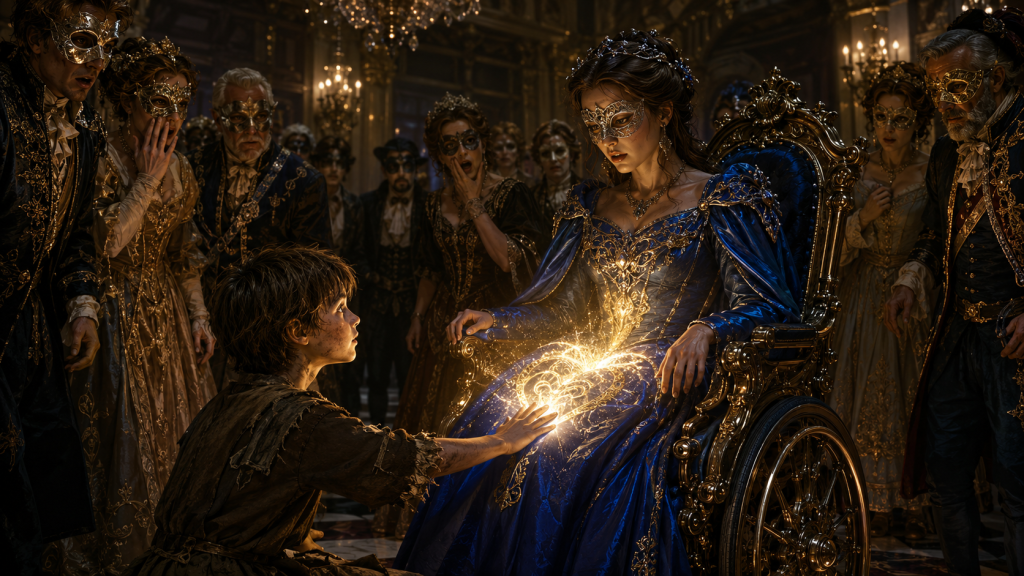
A Ragged Boy Counted To Three And Touched The Masked Lady’s Knee. When Golden Light Filled The Ballroom, Everyone Realized She Was Not Paralyzed—She Was Sealed.
“ONE… TWO… THREE…”
The boy whispered the numbers like a prayer.
His tiny hand reached across the polished marble floor.
The grand ballroom held its breath.
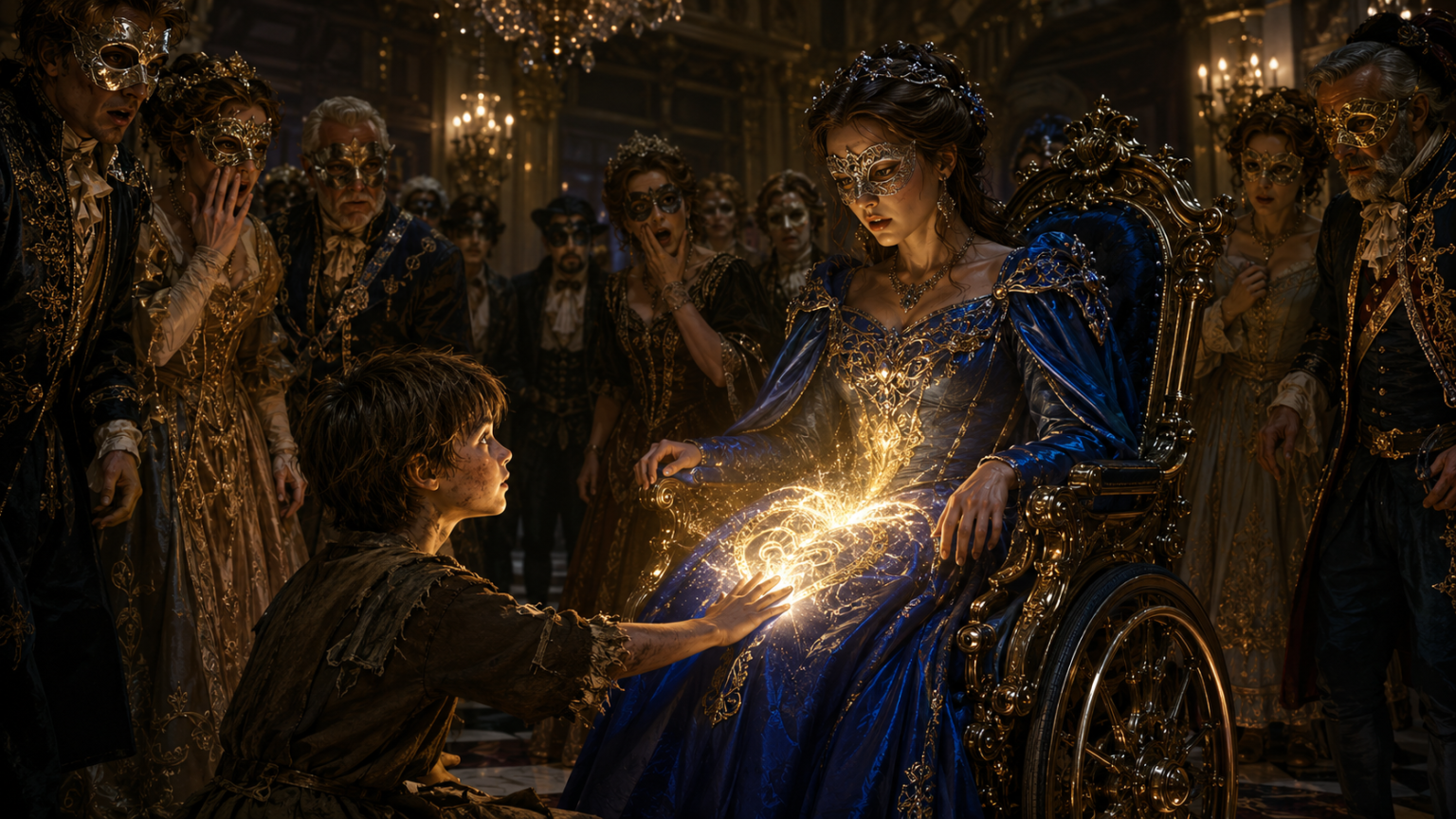
Music had stopped halfway through a waltz. Silk skirts froze in mid-sway. Masked nobles turned their painted faces toward the center of the room, where a ragged child knelt before the most untouchable woman in the kingdom.
Lady Seraphine Veyra sat in a gilded wheelchair beneath the chandelier light.
Her gown was deep blue silk embroidered with silver thread. Her gloved hands rested perfectly in her lap. A silver mask covered the upper half of her face, shaped like moonlight, smooth and cold and beautiful.
She had not walked in twelve years.
She had not danced since the night her family died.
She had not spoken above a whisper in public for so long that some courtiers believed grief had hollowed her voice.
The boy before her did not belong there.
Everyone knew it.
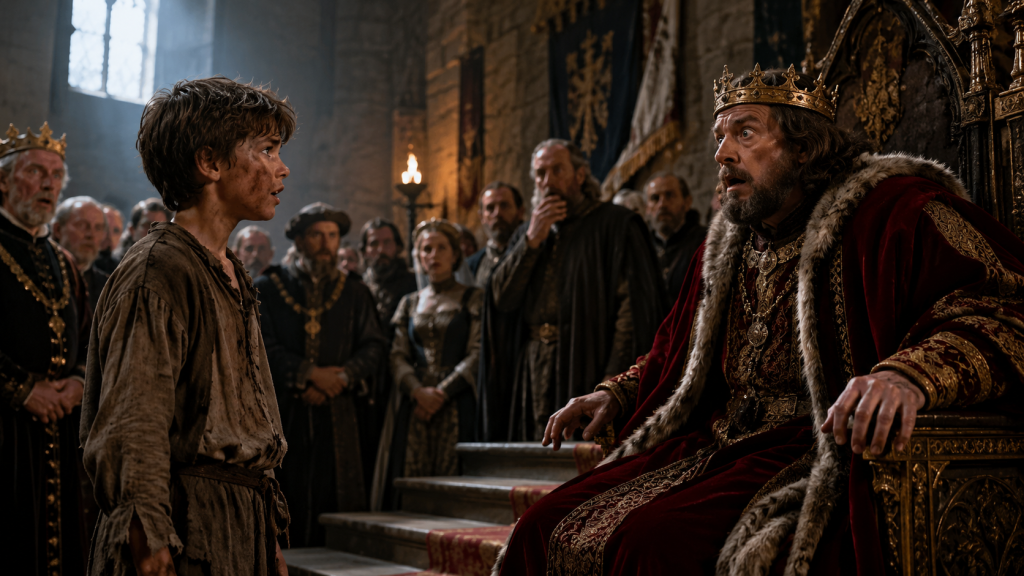
His shirt was torn. His feet were bare. Dirt darkened his knees. His hair stuck to his forehead in damp curls, and one sleeve hung open where the seam had given up.
“What is he doing here?” someone whispered.
“Remove him.”
“Such a disruption.”
The boy ignored them.
He placed one small, calloused hand gently on Lady Seraphine’s knee.
Not begging.
Not pleading.
Counting.
“One… two… three…”
A faint shimmer appeared beneath his palm.
At first, it looked like a trick of candlelight on silk.
Then the glow deepened.
Gold pulsed through the blue fabric like a hidden heart awakening after years of silence.
Lady Seraphine gasped behind her mask.
Her fingers curled against the arms of the wheelchair.
The ballroom went dead silent.
The golden light spread from her knee to her hands, then up the silver embroidery of her gown, tracing ancient patterns no tailor had sewn.
The nobles stepped back.
Not in wonder.
In fear.
Because the glow was not a healing charm.
Not a child’s miracle.
Not pity for a fragile woman.
It was recognition.
The boy looked up at her and whispered, “Mama said you would shine if I counted right.”
Lady Seraphine’s lips parted.
“Who is your mother?”
The child touched the glowing mark again.
“Elara.”
The name struck the ballroom harder than thunder.
Behind their masks, several nobles went pale.
At the far end of the hall, Duke Morcant stopped smiling.
Lady Seraphine slowly lifted one trembling hand to her silver mask.
For twelve years, the court had called her broken.
Confined.
Harmless.
But the golden light rising through her body told a different story.
She had not been weakened.
She had been locked.
And a ragged boy with dirt on his hands had just turned the key.
The Lady In The Silver Mask
Lady Seraphine Veyra had learned to sit beautifully.
That was what the court expected of wounded women.
If a woman could not stand, she should at least look graceful while remaining still. If she could not dance, she should smile faintly when others danced. If grief had taken her family, her movement, and her voice, then she should wear mourning like jewelry and make everyone else feel noble for pitying her from a distance.
Seraphine had mastered it.
The lowered gaze.
The quiet nod.
The hands folded just so.
The silver mask worn every year at the Moonfall Ball because scars, like truth, made nobles uncomfortable when revealed beneath too much light.
Twelve years earlier, she had been the brightest woman in the southern court.
Not because she was beautiful, though people said she was.
Not because she was rich, though House Veyra owned half the river vineyards and three mountain fortresses.
Seraphine was bright because she seemed to carry summer inside her bones. She rode too fast, laughed too loudly, challenged ministers in council, and danced until musicians begged for mercy.
Her younger sister Elara was quieter.
Sharper.
The kind of girl who noticed what others forgot to hide.
Together, the Veyra sisters were beloved by the old king and feared by men who preferred noblewomen decorative, obedient, and unaware of ledgers.
Their family carried an old bloodline.
Older than the throne.
Older than the current houses.
People called it superstition by daylight and whispered prayers to it after dark.
The Veyras were said to descend from the first sunbinders, women and men who could channel light through living flesh, healing wounds, revealing lies, strengthening oaths, and burning through hidden enchantments.
Seraphine never believed the stories fully.
Until the night of the fire.
It happened during the last Moonfall Ball held at Veyra Manor.
The ballroom was filled with lanterns, music, and blue banners. Seraphine danced with Lord Caelan, a laughing cousin she had almost agreed to marry because he loved horses, books, and leaving court early.
Elara stood near the balcony, one hand resting on her stomach.
Only Seraphine knew why.
Elara was pregnant.
Secretly.
Dangerously.
The father was not a nobleman.
He was a healer named Tomas from the lower quarter, a man with kind hands and no title. Elara intended to marry him after the festival and face the family fury afterward.
Seraphine had promised to stand beside her.
She never got the chance.
Near midnight, the lights went out.
Not dimmed.
Vanished.
Every candle, lantern, and hearth flame died at once.
Then came the screaming.
Seraphine remembered fragments.
Smoke pouring through the doors.
Men in black masks moving between dancers.
Her father shouting for the guards.
Her mother falling near the musicians’ balcony.
Elara grabbing Seraphine’s wrist and pushing something into her hand.
A little gold charm shaped like a sun with three broken rays.
“Count if you need light,” Elara whispered.
Then pain.
A blade across Seraphine’s back.
A fall.
Marble against her cheek.
A voice above her, calm and familiar.
“Leave her breathing. A dead Veyra becomes a martyr. A broken one becomes a warning.”
When Seraphine woke, she could not move her legs.
Her family was dead.
Elara was gone.
The manor had burned.
And Duke Morcant, a distant cousin by marriage, stood beside her bed with tears in his eyes and control of her estate already in his hands.
He told the court that raiders had attacked during the ball.
He told them Elara had died in the fire.
He told them Seraphine’s spine had been damaged beyond repair.
The physicians agreed.
All of them.
Too quickly.
Seraphine tried to speak the truth.
At first.
She said the attackers were not raiders. They moved like trained palace men. They knew the manor’s hidden doors. They spared certain documents and destroyed others. They came for Elara.
But grief made people unreliable.
Pain made people confused.
A woman newly paralyzed, masked to hide burns along one cheek, surrounded by men speaking gently over her—what could she prove?
Duke Morcant handled everything.
The estate.
The investigation.
The servants.
The physicians.
The guards.
Her medicines.
Especially her medicines.
They told her the bitter black drops were for nerve pain. They made her sleep. They made her forget pieces of days. They made her voice thin and her thoughts slow.
When she refused them, the pain sharpened in her back and legs until she begged for relief.
So she drank.
Year after year, she became what the court could tolerate.
A beautiful ruin.
A noble tragedy.
A woman wheeled into balls as a reminder of violence safely explained.
No one feared her anymore.
That, Seraphine later understood, was the point.
But the body remembers what the mind is drugged to forget.
Every year at Moonfall, beneath the chandelier light, she felt something stir in her bones when the musicians played the old Veyra waltz.
Heat.
Gold.
A pressure beneath her skin.
Then Morcant would lean close, cup in hand, and whisper, “You look tired, cousin.”
She would drink.
The warmth would die.
Until the ragged boy came.
He slipped into the Moonfall Ball through a service corridor no child should have known. The guards saw him too late. By the time anyone reached for him, he was already crossing the ballroom floor.
Straight toward Seraphine.
His eyes were not afraid.
That was what struck her first.
Not his dirt.
Not his torn clothes.
His certainty.
He knelt before her as if he had been sent.
Then he counted.
One.
Two.
Three.
And when his hand touched her knee, the thing buried inside her woke.
The Boy Who Counted Like A Key
The boy’s name was Niko.
He was ten years old, though hunger made him look younger.
He had lived most of his life in the ruins beneath the city’s old aqueduct, where people without papers, titles, families, or safe names found ways to survive outside the official mercy of the kingdom.
His mother called the place the Understreet.
Others called it the gutter kingdom.
Niko knew every tunnel between the east market and the old chapel. He knew which bakers threw away burnt loaves before dawn, which guards kicked first and asked questions never, which wells were clean, and which noble houses gave leftover food only when guests could see.
His mother, Elara, taught him more important things.
Never let strangers see the mark on your chest.
Never say the name Veyra unless there are no walls nearby.
Never trust men who pity too easily.
And if I do not return, find the lady in the silver mask.
Niko used to think the lady was a story.
His mother told many stories when the nights were cold and fear needed covering.
She told him about a house on a hill with windows that caught sunrise. About two sisters who raced horses through vineyards. About a blue ballroom where the floor shone like water. About a song that made the candles sway.
“Were you rich?” Niko asked once.
His mother smiled.
“Briefly.”
“Were you a princess?”
“No.”
“A witch?”
“Only according to stupid men.”
He liked that answer best.
Elara worked as a healer in the Understreet. People came to her with fever, knife wounds, childbirth pains, infected feet, broken fingers, and secrets. She could not always save them, but she always tried.
When she touched the sick, her hands sometimes glowed faintly gold.
Niko noticed.
So did others.
That was why they moved often.
“Is it magic?” he asked when he was seven.
Elara looked at her palms.
“It is inheritance.”
“Do I have it?”
She touched the small golden birthmark on his chest, shaped like three broken rays.
“Yes.”
“Can I heal people?”
“Maybe one day.”
“What do I do now?”
She took his little hand and pressed it to her own.
“Count.”
“One, two, three?”
“Slowly. Like opening a door.”
“Why three?”
“Because light must be called, welcomed, and released.”
That made no sense.
He practiced anyway.
Sometimes his fingers warmed. Sometimes nothing happened. Once he made a dead candle smoke for half a second and celebrated so loudly his mother made him hide under a blanket.
Then, three weeks before the Moonfall Ball, men came into the Understreet.
Not city guards.
Not thieves.
Clean boots.
Quiet blades.
Silver pins hidden under their collars.
Morcant’s men.
Elara heard them before Niko did.
She pushed him behind a false wall near their sleeping alcove and pressed a cloth bundle into his hands.
“If they take me, you go to the ball.”
“What ball?”
“The Moonfall Ball. At the royal palace.”
“I can’t go there.”
“You can.”
“They won’t let me.”
“Then crawl where they don’t look.”
His eyes filled.
“Come with me.”
Elara cupped his face.
“I have been trying to reach her for years. Morcant watches me too closely now. But he will not expect you.”
“Who?”
“My sister.”
Niko stared.
“The lady in the mask?”
Elara nodded.
“She is not broken. She is sealed.”
“What does that mean?”
“It means someone locked her light inside her body and called it illness.”
The footsteps grew louder.
Elara spoke faster.
“When you find her, touch her knee. Count like I taught you. The seal is anchored where the blade struck her spine and where they claim she cannot feel. If your light is truly mine, it will answer hers.”
“What if it doesn’t?”
“Then run.”
“What if it does?”
Elara’s face twisted with grief and hope.
“Then the world changes.”
The men broke through the outer tunnel.
Elara kissed his forehead once.
Then pushed the wall shut between them.
Niko did not cry.
Not because he was brave.
Because his mother had trained him to be silent when silence mattered.
He heard the struggle.
A man cursed.
His mother laughed once.
Then someone struck her.
He bit his sleeve until he tasted blood.
By the time he crawled out, she was gone.
The cloth bundle held three things.
A gold charm shaped like a sun with three broken rays.
A faded blue ribbon embroidered with a silver crescent.
And a note written in his mother’s cramped hand.
Seraphine,
If this child reaches you, he is mine.
If his touch wakes you, then the seal still fears blood.
Morcant killed our house for the Sun Archive.
He kept you alive because only you can open it.
Do not drink what he gives you.
Trust the count.
Elara
Niko could not read all the words.
An old scribe in the Understreet helped him, then told him to forget he had seen it.
Niko did not forget.
On the night of the Moonfall Ball, he entered the palace through the laundry drains with two stolen rolls in his pocket, his mother’s note against his chest, and fear so large it seemed to walk beside him like another child.
He found the ballroom by following music.
Then he saw her.
The lady in the silver mask.
Blue gown.
Still hands.
Lonely even in a room full of dancers.
For a second, he nearly ran.
She looked too grand.
Too far away.
Too late.
Then Duke Morcant stepped behind her chair, holding a crystal cup of dark liquid.
Niko remembered his mother’s words.
Do not drink what he gives you.
He ran.
Past guards.
Past silk.
Past gasps.
He dropped to his knees before Seraphine and counted before anyone could stop him.
One.
Two.
Three.
The gold light answered.
And Duke Morcant dropped the cup.
The Duke Who Feared Her Standing
The shattering glass sounded louder than the music had.
Dark liquid spread across the ballroom floor near Seraphine’s wheel.
Morcant stared at the glow beneath Niko’s hand as if hell itself had opened through the child’s fingers.
Then he recovered.
Men like Morcant always recovered quickly because panic had never been allowed to rule them for long.
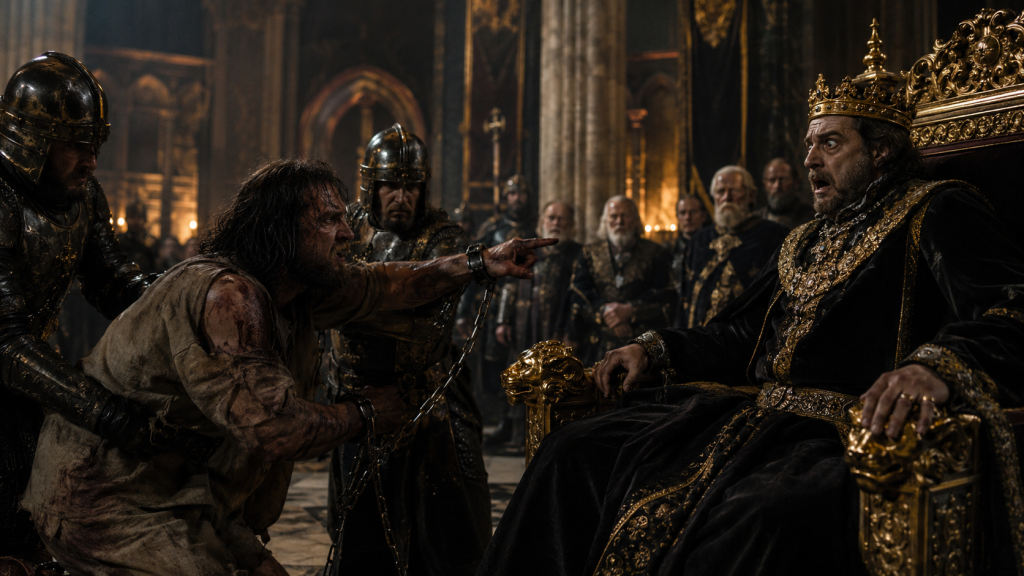
“Seize the boy,” he said.
The guards moved.
Seraphine lifted her hand.
“Stop.”
The word was not loud.
It did not need to be.
For twelve years, Lady Seraphine had spoken softly, politely, carefully, as if every sentence cost more strength than she owned.
This word carried across the ballroom with the weight of command.
The guards stopped.
Morcant looked down at her.
“Cousin, you are overwhelmed.”
The golden light pulsed brighter.
Seraphine turned her masked face toward him.
For the first time in years, she noticed that he did not look concerned when light filled her veins.
He looked afraid.
“What was in the cup?” she asked.
“A calming tonic.”
“Then drink it.”
The ballroom inhaled.
Morcant’s smile thinned.
“You know your physicians require—”
“My physicians are paid by you.”
A murmur moved through the crowd.
Niko remained kneeling, hand still on her knee, tears streaking clean lines through dirt on his face. The light had begun to hurt. Not burning, exactly, but pulling something out of him faster than he knew how to give.
Seraphine felt his hand tremble.
She looked down.
“Enough, child.”
“I don’t know how to stop.”
The honesty in his voice pierced her.
Something ancient stirred inside her, not memory but instinct.
She placed her gloved hand over his.
“Release.”
The light softened.
Then settled under her skin.
Not gone.
Waiting.
Seraphine breathed in.
For the first time in twelve years, she felt her legs.
Pain came first.
Terrible.
White.
Alive.
Her fingers clamped around the wheelchair arms.
The court saw her face twist behind the silver mask and mistook it for suffering.
It was.
But it was not the suffering of emptiness.
It was the suffering of return.
Morcant stepped closer.
“You must not strain yourself.”
Seraphine laughed.
It shocked even her.
A small, broken sound.
Then stronger.
“You have said that to me for twelve years.”
“Because I care for your survival.”
“No,” she said, looking at the spilled dark tonic. “You cared for my stillness.”
Morcant’s eyes hardened.
Around the ballroom, several nobles had begun moving toward the exits.
Not casually.
Not gracefully.
Like people who had suddenly remembered urgent matters elsewhere.
Seraphine saw them.
The old instinct returned.
The one she had buried beneath tonics and velvet.
Court was a battlefield with better shoes.
“Lock the doors,” she said.
The captain of the palace guard hesitated.
Morcant turned sharply.
“This is not your hall to command.”
Seraphine removed her silver mask.
Gasps rippled across the ballroom.
The scars along her cheek were pale now, thin lines from the night of the fire. She had hidden them because Morcant told her the sight distressed others.
Let them be distressed.
Beneath the mask, her eyes were gold.
Not brown with gold flecks.
Not candlelit.
Gold.
The captain lowered his head.
“Lock the doors.”
The guards obeyed.
Morcant’s jaw tightened.
“You reveal yourself too soon.”
Seraphine looked at him.
“What did you do to my sister?”
Niko stood quickly.
His small fists clenched.
Morcant glanced at him.
“Your sister made unfortunate choices.”
“Where is she?” Seraphine asked.
“Dead, if she remained as stubborn as before.”
Niko lunged.
Seraphine caught his shoulder before he reached Morcant’s blade.
She felt the boy shaking under her hand.
“Not yet,” she whispered.
His eyes filled.
“He took her.”
“I know.”
The ballroom whispered.
Elara Veyra alive.
A child.
A hidden power.
A duke afraid.
The story was rearranging itself in real time, and everyone present understood they might not survive the version that remained.
Seraphine turned to the nobles.
“Who here knew Elara lived?”
No one answered.
Too many people looked away.
Good.
Silence was also evidence.
Morcant smiled coldly.
“You think a little light and a street child restore your authority?”
“No,” Seraphine said.
Then she placed both hands on the wheels of her chair.
“Standing will.”
Morcant’s face went blank.
“Seraphine.”
Fear.
There it was.
Pure.
Beautiful.
She pushed herself forward.
Pain tore through her spine and legs so violently she nearly blacked out. Niko grabbed her gown. The captain stepped forward. She shook her head.
No.
If she was to fall, let them see.
If she was to stand, let them remember.
Her feet touched the floor.
The ballroom watched a dead woman’s power return inch by inch.
Her knees shook.
Her body trembled.
Gold light crawled along the veins at her throat.
Then Lady Seraphine Veyra stood.
Not straight.
Not gracefully.
Not without pain.
But standing.
The ballroom erupted.
Some screamed.
Some wept.
Some crossed themselves.
Morcant stepped backward.
Only one step.
But it was enough for everyone to see who had truly been helpless.
Seraphine held out her hand.
“Niko.”
The boy stared at her.
“My mother called me Nikolas when I was in trouble.”
“Then come here, Nikolas.”
He came.
She placed Elara’s gold charm in his palm, the one he had carried against his chest.
The charm blazed with light.
Symbols hidden beneath the ballroom floor began to glow in answer.
A circle.
A sun.
Three broken rays.
Morcant looked down.
His face drained of color.
Seraphine understood then.
The Moonfall Ball was not tradition.
It was location.
The royal ballroom had been built over the entrance to the Sun Archive, the sealed vault of House Veyra, hidden beneath the palace after the old wars.
Only the living light of two Veyra bloodlines could open it.
Morcant had killed her family trying to find the key.
Kept Seraphine alive because he needed one half.
Hunted Elara because she carried the other.
Now Elara’s child had come with light in his blood.
And the floor beneath the nobility had begun to open.
The Archive Under The Ballroom
The marble floor split without breaking.
That was what frightened people most.
No violent crack.
No collapse.
No explosion of stone.
The glowing circle beneath Seraphine and Niko widened, its golden lines threading through the marble like sunlight through water. Then the floor moved in perfect silence, panels sliding apart to reveal a staircase descending into darkness below the ballroom.
Ancient air rose from beneath.
Cold.
Dry.
Untouched.
Every candle in the hall bent toward it.
Morcant shouted, “Do not let her go down there!”
No one moved.
That was the problem with ruling through fear.
It works until people see you afraid.
Seraphine looked at the captain.
“Duke Morcant is to be detained.”
Morcant laughed.
“On what charge?”
Seraphine turned to him.
“Murder of House Veyra. Unlawful confinement. Poisoning. Abduction of Lady Elara. Treason against the crown. Theft of bloodline inheritance. I am sure we will find more downstairs.”
“Your word?”
“My word standing,” she said, “will do for now.”
Two guards seized him.
Morcant did not struggle.
He looked down the golden staircase instead.
“You have no idea what that archive contains.”
Seraphine took one painful step.
Then another.
“Then I will learn.”
Niko stayed beside her.
“You’re hurt.”
“Yes.”
“Should you sit?”
“Probably.”
“Are you going to?”
“No.”
He nodded, accepting this as reasonable adult foolishness.
The captain, three guards, the royal chancellor, and half a dozen witnesses followed them down. Morcant was dragged behind under guard because Seraphine wanted him close enough to watch everything he had failed to steal.
The Sun Archive lay beneath the palace like a buried sunrise.
Golden columns rose from black stone. Shelves of bronze cylinders lined the walls. Crystal lamps flared to life as Seraphine entered, one after another, illuminating mosaics of suns, moons, rivers, and hands joined around flames.
At the center of the chamber stood a sealed dais with two handprints carved into it.
One large.
One small.
Seraphine looked at Niko.
The boy swallowed.
“Again?”
“Again.”
They placed their hands on the stone.
Niko whispered, “One… two… three…”
Light flooded the chamber.
The dais opened.
Inside was not treasure.
Not gold.
Not weapons.
Books.
Ledgers.
Bloodline records.
Oath stones.
Sealed testimonies preserved in sun glass.
The true history of House Veyra and the noble houses that had tried for centuries to control, breed, steal, or extinguish its power.
The chancellor lifted one bronze cylinder and read the inscription.
“Binding rites.”
Another.
“False inheritances.”
Another.
“Names of those sealed without consent.”
Seraphine turned slowly toward Morcant.
His face had gone gray.
“You were not the first,” she said.
He smiled weakly.
“No. Merely the most successful.”
Niko pointed toward the far wall.
“There.”
A narrow alcove had lit in response to the gold charm. Inside sat a recent ledger bound in black leather.
Morcant lunged against the guards.
“No!”
Seraphine reached the ledger first.
Her legs nearly failed halfway there. Niko ducked under her arm, letting her lean on him with the fierce pride of a child carrying something too heavy and refusing to admit it.
The ledger opened to names.
Her father.
Her mother.
House guards.
Physicians.
Servants.
Elara.
Seraphine read the entries with a face that turned colder with every line.
The attack at Veyra Manor had not been raiders.
It had been a sanctioned purge conducted by Morcant with the aid of five noble houses and two royal ministers. The goal was to seize the Sun Archive before the old king died, preventing Seraphine or Elara from using its records to expose generations of illegal bloodline manipulation.
Seraphine had been stabbed with a seal blade, not an ordinary weapon.
It severed her light from her body’s command and trapped it inside the spine.
The black tonic kept the seal dormant.
The wheelchair had never been the source of her prison.
Only its decoration.
And Elara—
Seraphine’s hand stopped.
Niko looked up.
“What?”
Seraphine could not speak.
The ledger stated that Elara had been captured alive three weeks earlier and moved to the old observatory tower before transfer to Morcant’s northern estate.
Alive.
Niko began crying silently.
“Mother?”
Seraphine closed the book.
“Yes.”
Morcant laughed softly.
“She may have been alive when the ink dried.”
Niko turned on him with a sound like an animal.
Seraphine caught him again.
This time, she nearly fell.
The captain stepped forward.
“My lady, let us take him.”
Morcant’s eyes slid toward the stair.
Too quick.
Seraphine saw it.
He wanted them to leave the archive.
Why?
She looked again at the ledger.
At the dates.
At the transfer notes.
At the sealed mark beside the observatory entry.
Not a transport mark.
A ritual mark.
Her blood chilled.
“He did not move her to hide her,” Seraphine whispered.
The chancellor frowned.
“My lady?”
“He moved her to open something else.”
Morcant stopped smiling.
Seraphine turned to the captain.
“The observatory tower. Now.”
They climbed back to a ballroom in chaos.
The guests had been kept inside. Some had removed their masks as if bare faces might make them look innocent. Others were crying, bargaining, whispering family names already found in the archive.
Seraphine ignored them.
Then the palace bells began to ring.
Not celebration.
Alarm.
A guard rushed into the hall.
“Fire at the old observatory!”
Morcant closed his eyes.
Relief.
Seraphine struck him across the face with enough force to make him bleed.
The ballroom gasped.
She leaned close.
“If she dies in that tower, I will not kill you.”
Morcant smiled through blood.
“You don’t frighten me.”
Seraphine’s eyes turned gold again.
“No. I will let Niko decide what truth you hear every day until death begs to be useful.”
For the first time, Duke Morcant looked at the boy.
And trembled.
The Tower Where Light Was Buried
The old observatory tower stood beyond the palace gardens, black against a red sky.
Fire climbed its upper windows.
Servants formed bucket lines. Guards shouted orders. Horses screamed in the courtyard below. Smoke rolled across the moon like spilled ink.
Seraphine refused to be carried.
She accepted a cane.
Then broke it after three steps because her hand shook too hard to use it properly.
Niko took her arm instead.
“You’re too slow,” he said.
“I was stabbed by a seal blade and poisoned for twelve years.”
“My mother says excuses are weeds.”
Despite the fire, despite the pain, despite everything, Seraphine almost laughed.
“She would.”
The tower door was barred from outside.
The captain’s men smashed it open.
Heat breathed out.
Inside, the stair spiraled upward through smoke.
The captain blocked Seraphine.
“My lady, no.”
“My sister is inside.”
“And if you collapse, so are you.”
Niko slipped past both of them.
“Nikolas!”
He ran into the smoke.
Seraphine followed.
Pain became irrelevant after that.
Not gone.
Never gone.
Simply outranked.
They climbed through choking heat. The golden light under Seraphine’s skin flickered with every breath. Niko crawled ahead where smoke thinned near the steps, coughing but moving fast.
Halfway up, they found the first body.
A guard wearing Morcant’s silver pin.
Then another.
Not burned.
Marked by light.
Elara had not gone quietly.
At the top of the tower, the observatory chamber blazed along one wall. Broken glass glittered beneath the open dome. Star charts burned in curling sheets. In the center of the room, chained to an iron frame beneath the great brass telescope, stood Elara Veyra.
Alive.
Barely.
Her dark hair hung loose around her face. Blood marked one temple. Her hands were bound above her head, palms cut and pressed against two gold plates carved into the frame. Light pulsed weakly through the chains.
A ritual.
Forced awakening.
Morcant had tried to use Elara’s blood to open or destroy whatever part of the archive he could not control.
Niko screamed.
“Mother!”
Elara lifted her head.
Her eyes found him through smoke.
For one second, every wound vanished from her face.
“My little sun.”
Niko ran to her.
Seraphine grabbed the hot chain and cried out as it burned her hand.
Elara saw her then.
“Seraphine.”
The name broke twelve years.
The sisters stared at each other across fire, smoke, scars, and stolen time.
Seraphine’s voice trembled.
“You’re late.”
Elara laughed weakly.
“You’re standing.”
“I had help.”
“I see that.”
The tower groaned.
A beam fell near the stair, scattering sparks.
The captain shouted from below.
“My lady!”
Seraphine examined the chains. They were not simple iron. Sunbinding metal. Designed to feed on light and tighten when forced.
Elara’s breath came shallow.
“Don’t touch the plates.”
“What happens if I do?”
“They take what woke in you.”
“Can we break them?”
Elara looked at Niko.
“No.”
Niko shook his head.
“There has to be a way.”
“There is,” Elara whispered. “Count backward.”
He froze.
“You never taught me that.”
“I hoped I’d never need to.”
Seraphine understood.
Calling light opened.
Welcoming light awakened.
Releasing light freed.
Counting backward would unbind.
Or take the light back into the one strong enough to hold it.
Niko was ten.
Seraphine said, “No.”
Elara said, “He can do it.”
“He is a child.”
“He is my son.”
“That is not an argument for sacrifice.”
Elara’s eyes flashed despite exhaustion.
“No. It is an argument for trust.”
Niko wiped his face with his sleeve.
“Tell me.”
Elara’s voice softened.
“Put one hand on mine. One on your aunt’s. Count from three to one. Slowly. Do not pull the light. Ask it to return where it belongs.”
“I don’t know how.”
“You do.”
“I’m scared.”
Elara smiled through tears.
“So am I.”
Seraphine knelt, nearly collapsing beside him.
“You are not doing this alone.”
Niko placed one trembling hand over his mother’s bound fingers and the other in Seraphine’s burned palm.
The tower groaned again.
Fire crawled along the ceiling beams.
Seraphine looked at Elara.
“I thought you were dead.”
“I thought you hated me for leaving.”
“I searched in dreams.”
“I answered in tunnels.”
Niko shouted, “Stop talking sad! Count!”
Both women looked at him.
Then, impossibly, both laughed.
The sound was brief.
Beautiful.
Human.
Niko closed his eyes.
“Three…”
The gold light flared.
The chains tightened around Elara’s wrists.
She gasped.
Seraphine gripped Niko’s hand.
“Steady.”
“Two…”
The light shifted.
Not brighter.
Deeper.
It moved from the chains into the sisters, from Elara’s trapped palms into Seraphine’s awakened spine, then through Niko’s small body like a bridge too narrow for a river but holding anyway.
The metal began to crack.
Niko sobbed.
“One.”
Silence.
Then the chains shattered.
Elara fell forward.
Seraphine caught her.
Niko collapsed against both of them.
The iron frame split from top to bottom. Light burst upward through the open dome, a column of gold that struck the night sky above the burning tower.
Every person in the palace saw it.
Every noble in the ballroom.
Every conspirator hiding behind a mask.
Every servant who had ever lowered their eyes to survive.
The Veyra light had returned.
The captain and his guards carried them down moments before the upper chamber collapsed.
This time, Seraphine allowed help.
Not because she was weak.
Because she had learned that surviving alone was not the same as freedom.
Outside, under a smoke-dark moon, Elara held Niko so tightly he complained he could not breathe.
She did not let go.
Seraphine stood beside them, shaking, burned, barely upright.
Morcant was dragged into the courtyard to see them.
His face collapsed when he saw Elara alive.
Niko looked at him.
Then looked at his mother.
Then at Seraphine.
“What happens to him?”
Seraphine looked toward the burning tower.
Then back at the palace where the ballroom waited, full of people who had mistaken silence for safety.
“Truth,” she said.
Elara nodded.
“All of it.”
The Ballroom Without Masks
The trials began in the same ballroom where Niko had counted to three.
Seraphine insisted.
The nobles objected.
She ignored them.
For years, that room had displayed lies under chandeliers. It had hosted dances funded by stolen estates, marriages arranged through forged bloodlines, and charity auctions where the guilty purchased admiration with money taken from the families they destroyed.
Let the room learn another use.
The masks were banned.
No silver.
No velvet.
No painted smiles.
Every accused noble stood bare-faced beneath the lights while the Sun Archive records were read aloud.
Duke Morcant was first.
He tried dignity.
Then patriotism.
Then technicalities.
Then grief.
He claimed House Veyra’s power was too dangerous to remain uncontrolled. He claimed the archive threatened the stability of noble bloodlines. He claimed Seraphine’s paralysis had been unfortunate but necessary, Elara’s disappearance regrettable but unavoidable, Niko’s existence an “unregulated inheritance risk.”
Elara nearly crossed the room to strike him.
Niko grabbed her sleeve.
“Not yet,” he whispered.
She looked down at him.
He smiled faintly.
“I learned.”
Seraphine testified standing.
Only for seven minutes.
That was all her body allowed.
But she stood.
She described the night of the manor attack. The seal blade. The black tonic. The years of being drugged into stillness. The careful way Morcant touched her shoulder in public while holding her prison in private.
Then Elara testified.
She described fleeing through river tunnels while pregnant, raising Niko among the vanished, healing people with light she barely dared use, sending messages that never reached Seraphine because Morcant intercepted them all.
Finally, Niko testified.
The court tried to place him on a raised chair.
He refused.
“I’m tall enough.”
He was not.
They brought the chair.
He glared but stood on it.
He told them about the Understreet. About his mother’s hands glowing gold in darkness. About the night Morcant’s men came. About crawling through drains into the palace. About counting because his mother told him trust the count.
A minister tried to confuse him with questions about timing.
Niko looked at him and said, “You talk like someone hiding behind curtains.”
The ballroom laughed.
Then Seraphine said, “Answer the child, Lord Pell.”
Lord Pell confessed before sunset.
That was how the trials unfolded.
Not cleanly.
Not quickly.
But relentlessly.
Names from the archive led to hidden rooms, forged marriages, stolen inheritances, sealed heirs, poisoned witnesses, and entire branches of families erased because their blood carried power someone wanted controlled.
The old king, now frail but still alive, ordered the Sun Archive placed under public guardianship. Not royal control. Not noble control. A council of common judges, healers, historians, and surviving families.
The nobles screamed.
The people watched.
The king signed.
Morcant was sentenced to life beneath Veyra Manor, in the surviving cellar where he had ordered the first attack planned. Each morning, a keeper read aloud one name from the archive and one crime tied to it. When the names ended, they began again.
Niko asked if that was enough.
Elara said no punishment was enough.
Seraphine said enough was not the point.
“Then what is?” he asked.
“Memory,” she answered. “And preventing the next silence.”
Seraphine never fully recovered the body she had before.
That was another truth court songs disliked.
She walked again, but with pain. Some days with a cane. Some days not at all. The seal blade had damaged flesh as well as light. The years of tonic had weakened her heart, her nerves, her trust in cups handed by smiling men.
But she was no longer displayed.
She chose when to sit.
She chose when to stand.
That made all the difference.
Elara moved into the restored east wing of the palace only after demanding rooms with three exits, no locked inner doors, and space for Understreet families who wanted treatment without being questioned by officials first.
Niko hated palace shoes.
He hid them in increasingly creative locations until Seraphine declared bare feet acceptable in private chambers and scandalous but survivable elsewhere.
He liked scandalous.
He studied lightbinding reluctantly, reading poorly at first but learning quickly when lessons involved glowing objects, hidden doors, or making arrogant tutors sneeze sparks.
He called Seraphine “Aunt Sera” after three months.
The first time, she turned away so fast he thought he had offended her.
Elara found her later in the corridor, crying into both hands.
“You always were dramatic,” Elara said softly.
Seraphine laughed through tears.
“You vanished for twelve years and returned with a magical gutter child. Do not speak to me of drama.”
The sisters healed strangely.
In pieces.
They argued often.
About Niko.
About the archive.
About whether Seraphine should rest.
About whether Elara should stop treating every palace servant as a possible assassin.
About the past.
Especially the past.
One night, Seraphine finally asked the question that had sat between them since the tower.
“Why did you not come sooner?”
Elara’s face closed.
“I tried.”
“Try again with more words.”
They stood in the archive chamber beneath the ballroom, golden lamps glowing softly around them.
Elara touched one bronze shelf.
“I sent messages. Three in the first year. Two through healers. One through a priest. All vanished. Then Morcant’s men found the woman who carried the last one. They left her hands on my doorstep.”
Seraphine went still.
Elara continued.
“I was pregnant. Then Niko was born. Then I was hunted. Then I was poor. Then I was afraid that if I reached you and failed, Morcant would have both halves of the key.”
Seraphine closed her eyes.
“I thought you chose freedom over me.”
“I thought you hated me for surviving.”
The archive hummed around them.
Old light.
Old grief.
Seraphine took her sister’s hand.
“I did hate you sometimes,” she whispered.
Elara’s eyes filled.
“I know.”
“I hated everyone who could walk away.”
“I know.”
Seraphine opened her eyes.
“But you sent him.”
Elara smiled sadly.
“I sent our last chance barefoot into a ballroom full of wolves.”
“He bit well.”
“He gets that from your side.”
For the first time since childhood, they laughed without pain winning.
Years later, the Moonfall Ball returned.
Not as before.
No masks were allowed.
No gilded wheelchair displayed as noble tragedy.
No dark tonics in crystal cups.
The ballroom doors were opened to commoners, healers, archivists, freed servants, and families named in the Sun Archive.
Nobles came too.
Humbler now.
Or better at pretending.
Either would do for one evening.
Seraphine entered on foot, leaning on a cane of polished blackwood. Her gown was blue again, but simple, with three golden rays embroidered near the hem. Elara walked beside her in dark green. Niko, now seventeen, trailed behind them barefoot until Elara noticed and threatened him with formal boots.
He vanished for ten minutes.
Returned wearing boots.
On the wrong feet.
Seraphine decided not to fight a war before dessert.
The musicians began the old Veyra waltz.
For a moment, Seraphine stood very still.
Elara looked at her.
“You don’t have to.”
“I know.”
Niko stepped forward and offered his hand with exaggerated courtly seriousness.
“My lady, may I count?”
Seraphine rolled her eyes.
“You are insufferable.”
“One…”
“Niko.”
“Two…”
Elara covered a smile.
“Three.”
He touched her hand.
Only a small glow appeared this time.
Warm.
Steady.
No seal breaking.
No revelation burning through lies.
Just light answering light.
Seraphine stepped onto the ballroom floor.
She danced badly.
That was the truth.
Slowly.
Stiffly.
Sometimes stopping when pain tightened her leg.
Niko adjusted without comment. Elara clapped off rhythm on purpose. The crowd watched, not with pity now, but with the reverent discomfort of people witnessing a victory too honest to be graceful.
Halfway through the dance, Seraphine laughed.
The sound rose into the chandelier light.
Not the laugh from before the fire.
Not untouched.
Something deeper.
Scarred.
Alive.
When the music ended, the ballroom bowed.
Seraphine did not.
She remained standing.
Afterward, Niko slipped away to the edge of the room where the marble floor still bore faint golden lines from the night the archive opened.
He knelt and touched the stone.
“One… two… three…” he whispered.
Nothing dramatic happened.
No secret staircase.
No burst of light.
Only a soft warmth beneath his palm.
Seraphine joined him, lowering herself carefully onto the step beside him.
“Looking for more trouble?”
“Always.”
“Good. Our family tradition survives.”
He looked at her.
“Do you miss who you were before?”
Seraphine considered lying.
Then decided he deserved better.
“Yes.”
Niko nodded.
“Mother misses who she was too.”
“I know.”
“Do you hate Morcant?”
“Yes.”
“Still?”
“Yes.”
He thought about that.
“Does it make the light darker?”
Seraphine looked toward the ballroom, where Elara was arguing with a minister twice her size and winning.
“No,” she said. “Only hiding it does.”
Niko touched the golden mark on his chest beneath his shirt.
“When I counted that night, I thought I was saving Mother.”
“You did.”
“I thought I was saving you.”
“You did.”
He frowned.
“But everything got worse first.”
Seraphine smiled faintly.
“Truth often behaves badly when first released.”
That seemed to satisfy him.
Years after that, people told the story of the ragged boy who knelt before the masked lady and counted to three.
In some versions, he healed her instantly.
In others, she rose like a goddess and turned all her enemies to gold.
In the most ridiculous version, the wheelchair transformed into a lion.
Niko liked that one.
Seraphine hated all of them equally.
Because the truth was harder and therefore more beautiful.
He had not healed her.
He had awakened what had been sealed.
She had not risen without pain.
She had stood through it.
The court had not witnessed charity.
It had witnessed the failure of a lie that had mistaken stillness for defeat.
And the light that filled the ballroom that night was not merely magic.
It was memory returning to the body.
It was a sister’s message carried by a child through drains and hunger.
It was a family history hidden beneath marble.
It was proof that power, when buried alive, does not disappear.
It waits.
Under skin.
Under stone.
Under silence.
For the right hand.
The right count.
The right child brave enough to touch what everyone else had been taught to pity.
One.
Two.
Three.
And the sealed woman woke.