

The lavender was still blooming along the front walk of their house on Creekside Drive when Marcus heard his daughter scream.
It was a Tuesday in early October, the kind of morning that hadn't decided yet whether it wanted to be warm or cold, the sky pale and uncertain over the rooftops of Ashford, Pennsylvania. Marcus Calloway had been standing on the porch with his second cup of coffee, watching the leaves drift off the old oak at the edge of the yard, when the sound split everything open.
"Dad — I can't feel my legs!"
The coffee hit the porch boards before he even realized he'd dropped it. He was down the steps and across the flagstone path before the sound had finished echoing. Nora, his fourteen-year-old daughter, was slumped sideways in her wheelchair at the bottom of the ramp, one hand gripping the armrest like it was the only solid thing left in the world, her face a mask of confusion and terror. She'd been managing so well lately. Three months since the accident. The doctors had said sensation was coming back, slowly, unevenly. Progress, they called it. Small victories. But this — this was different. This was reversal.
Marcus dropped to his knees on the cold flagstone beside her. His hands went out and then hovered, suspended, the way they always did in those helpless moments when he wanted desperately to fix something that his hands couldn't reach. "I know," he said, his voice catching on itself. "I know, sweetheart. I'm here."
The sunlight felt wrong on his back. Too still. Too thin.
"I can help her."
The voice came from behind him, from the direction of the iron gate at the edge of the property, and something about its flatness made Marcus's spine go rigid before he'd even turned around. It wasn't a child's panicked voice. It wasn't a neighbor calling out in concern. It was calm in a way that didn't belong in this moment — measured, almost clinical, carrying the particular weight of someone who already knew what they were looking at.
Marcus turned.
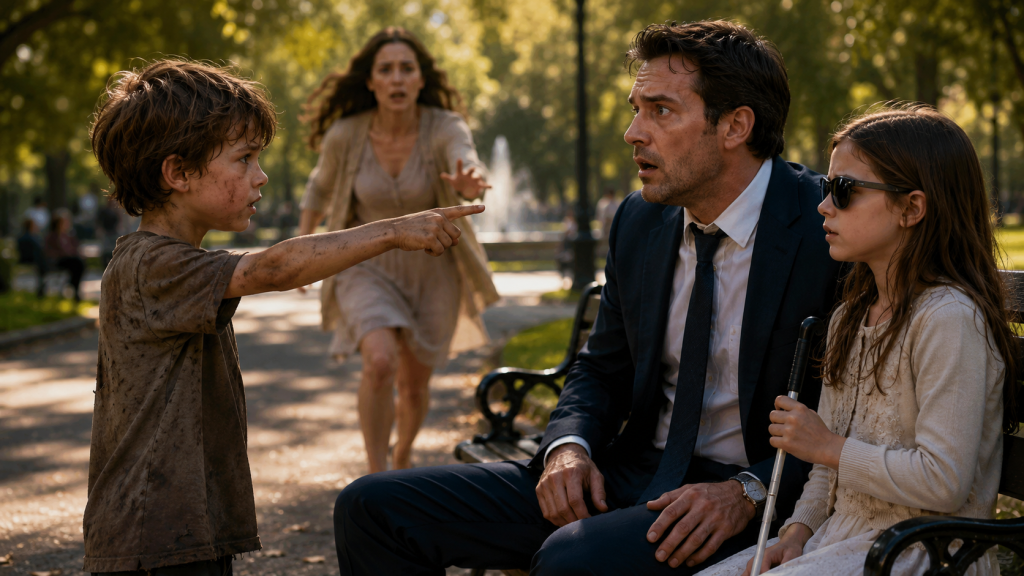
A boy stood just inside the gate. He looked about sixteen, maybe seventeen, wearing a dark green jacket that was one size too big, his hands loose at his sides, his eyes moving between Marcus and Nora with an expression that wasn't quite fear and wasn't quite sympathy. It was something closer to recognition. Like he'd been expecting to find exactly this.
"Stay back," Marcus said. The words came out sharper than he intended, the father-reflex overriding everything else, that ancient territorial instinct that says: unknown person, distressed child, close the distance.
The boy didn't flinch. Didn't step back. Just stood there, watching.
"She's not supposed to be like this," he said.
The sentence landed wrong. Not in the way that a worried stranger says wrong things — stumbling over themselves, apologizing. This landed like a fact being stated by someone who had access to information they shouldn't have. Marcus felt something cold settle in his chest that had nothing to do with the October air.
"What do you mean?" His voice came out lower now. More careful.
The boy stepped forward — one slow step, then another — his gaze dropping briefly to Nora's hands, to the specific way she was gripping the armrest, as though he was checking something against a mental checklist. "This wasn't an accident," he said.
The words hit the morning air and seemed to stay there, suspended.
Nora made a small sound. Marcus turned to look at her and found her staring at the boy with wide, searching eyes, the fear on her face shifting into something more complicated. "How do you know?" she asked. Her voice was barely a whisper, barely anything at all.
The boy met her gaze. He didn't look away. "Because I was there," he said.
Marcus was on his feet before he'd made a conscious decision to stand. He crossed the flagstones in two strides and stopped close enough to the boy that he could see a small, half-healed cut above the kid's left eyebrow — recent, maybe four or five days old, the skin still puckered and red at the edges. "Where?" Marcus said. The single word came out like a door being forced open. "Where were you?"
The boy lifted his right hand, slowly, and pointed. Not toward the street. Not toward the intersection two blocks over where the accident had happened, where a driver had run a red light and clipped Nora's bike and driven away. He pointed toward the small green municipal park at the end of Creekside Drive. The one with the old wooden pavilion and the broken sprinkler heads. The one that had security cameras on its entrance posts that the city had installed two summers ago.
Marcus's mouth went dry.
Inside his jacket pocket, his phone buzzed once. He ignored it. But later — much later — when he finally checked it, he would understand that the timing of that buzz had not been coincidence. That someone, at that exact moment, had been watching the same gate the boy had just walked through.
Act 1: The Morning Everything Changed Shape
The boy's name was Eli Marsh.
He didn't offer that information right away. It came out in pieces, standing in the kitchen of the Calloway house while Marcus sat across from him at the table and Nora stayed in her wheelchair near the doorway, wrapped in a blanket Marcus had grabbed from the couch, unwilling to leave the room despite Marcus's quiet suggestion that she rest. She'd given him a look that said she wasn't going anywhere, and he hadn't pushed it.
Eli was seventeen. He went to Ashford Regional High School, one year ahead of Nora. He lived on the other side of the park, on Dellwood Avenue, in a small gray house with a cracked driveway that Marcus had driven past a hundred times without ever registering. He said all of this quietly, answering Marcus's questions in short complete sentences, his hands wrapped around the glass of water Marcus had set in front of him without asking if he wanted it.
"You said you were there," Marcus said. "At the accident."
"I was cutting through the park. I saw it from the corner of Dellwood and Fifth." Eli set the glass down. "The car didn't just run the light. It slowed down before it hit her. Then it sped up."
The kitchen was very quiet.
Marcus had heard the official version eleven times. He'd read the police report four times. A dark-colored sedan, estimated speed forty to forty-five miles per hour, had entered the intersection on a red light and struck Nora's bicycle as she crossed on the walk signal. Driver failed to stop. Vehicle not yet identified. Case under active investigation. That was the version. Slowed down and then sped up didn't exist anywhere in that version.
"Did you tell the police this?" Marcus asked.
Eli's jaw tightened. "I tried. I called the non-emergency line the same day. They said someone would follow up." He paused. "Nobody did."
"When was this?"
"Three months ago. Day after it happened. I called twice. Left my name both times."
Marcus pulled out his phone and opened the notes app and typed Eli Marsh, called twice, no follow-up. He didn't look up from the phone while he did it. He was thinking about the cut above the boy's eyebrow. About how it was four or five days old. About the timing.
"That cut," Marcus said, finally looking up. "How'd you get it?"
Eli touched the spot above his eye with two fingers, almost involuntarily, and something shifted in his expression — a flash of something that was either embarrassment or fear, gone too quickly to read clearly. "I fell," he said.
Marcus waited.
"Someone pushed me," Eli said. "Off my bike. Near the park. Four days ago. They didn't say anything, they just — it was deliberate. I could tell."
From the doorway, Nora spoke. "Was it the same kind of car?"
Eli looked at her. "I didn't see the car clearly. It happened fast. But afterward, when I was back on my feet — there was a piece of paper on the ground near my bike. Folded up." He reached into the inside pocket of his green jacket and produced a small square of paper, folded in thirds, and set it on the table in front of Marcus. "I don't know if it fell out of someone's pocket or if it was left on purpose. But it has a name on it. And a number. I looked it up."
Marcus unfolded the paper.
The name printed on it, in clean black type, was Dr. Raymond Kesler, and below it was a phone number with a local 814 area code, and below that, in smaller type, was the name of a medical practice: Kesler Neurology Associates, Ashford, PA.
Marcus sat back slowly in his chair.
Dr. Raymond Kesler was the neurologist who had been overseeing Nora's recovery since the accident.
He was also, Marcus suddenly remembered, the man who had called him at seven-thirty the previous Friday morning — before office hours, which was unusual — to say that Nora's most recent nerve conduction study results were "less promising than we'd hoped" and that they might need to "adjust expectations." Marcus had sat in his car in the parking garage outside his office for twenty minutes after that call, holding the phone, telling himself that doctors deliver bad news and that it didn't mean anything beyond what it was.
He looked at Eli. "Where did you find this, exactly?"
"On the ground. Right next to my bike." Eli's eyes were steady. "I don't think it fell from anyone's pocket accidentally."
The words sat on the table between them like a stone being placed deliberately, and Marcus heard them the way you hear something that confirms what you didn't want to already know. He folded the paper back along its crease lines — three careful folds — and put it in his own shirt pocket, next to his heart, where he could feel the small rectangular weight of it for the rest of the day.
Nora's voice came from the doorway again, quieter now. "Dad. This morning — I took my medication before I came outside. The new one Dr. Kesler prescribed last week." She paused. "Twenty minutes later I couldn't feel my legs."
Marcus closed his eyes for exactly two seconds. Then he opened them and looked at his daughter, and she looked back at him, and neither of them said what they were both thinking, because saying it out loud would make it the kind of thing you couldn't unsay.
He stood up from the table.
"Eli," he said, "I need you to stay here for a little while. Can you do that?"
The boy nodded.
Marcus went upstairs to Nora's bathroom, to the white paper pharmacy bag on the windowsill with the orange prescription bottle inside it. He picked up the bottle and held it under the light. Nora Calloway. Methylcobalamin 1000mcg — vitamin B12, essentially, a supplement Kesler had added to her regimen last week, explaining that it supported nerve regeneration and had no significant side effects. Completely routine. Nothing to worry about.
Marcus took out his own reading glasses and examined the label again. Then he looked at the capsules through the amber plastic.
The capsules were the wrong color.
B12 supplements were typically red or deep pink. These were a dull, pale yellow.
He didn't open the bottle. He carried it downstairs, wrapped it in a zip-lock bag from the kitchen drawer, and put it in his jacket pocket next to his keys.
Then he took out his phone and called his college friend Danny Chu, who was a pharmacist in Pittsburgh, and said: "Danny. I need a favor. I need to know what's in a bottle of pills. Tonight if possible."
Danny heard something in his voice. "Marcus. What's going on?"
"I'm not sure yet," Marcus said. "But I think someone's been hurting my daughter on purpose."
Act 2: The Pill Bottle and the Paper Trail
Danny Chu drove to Ashford that same afternoon.
He didn't ask for an explanation over the phone. He just said "give me two hours" and showed up at the Calloway house at three-fifteen in a gray Subaru with a soft-sided cooler in the back seat containing a portable testing kit that he used for his consulting work with assisted-living facilities — checking medication accuracy for elderly residents whose prescriptions were filled by third-party pharmacies. It was the kind of tool that shouldn't have been necessary in a functioning medical system but existed because the system, Danny had long ago concluded, had more gaps than most people wanted to admit.
He tested the capsules from the bottle at the kitchen table while Marcus, Eli, and Nora watched in silence. It took forty minutes. Nora had gotten some feeling back in her lower legs by early afternoon — a tingling, she said, like static — and the terror in her face had dialed back to a hard, watchful tension. She sat at the table with a glass of orange juice she wasn't drinking and didn't take her eyes off Danny's hands.
When Danny looked up from the test, his expression was carefully neutral in the way that doctors and pharmacists and other people trained to deliver bad news go neutral before they speak. "These aren't B12," he said. "This is a muscle-relaxant compound. Low dose, but enough to cause temporary lower-limb weakness and sensory disruption, especially in someone with existing nerve damage. It's not dangerous in a single dose, but if she'd been taking it regularly for the past week—" He stopped. "How many has she taken?"
"Six," Nora said quietly. "One a day, like he said."
Danny set the capsule back in the bag and zipped it closed. "This isn't a pharmacy error. Pharmacy errors swap one drug for another of similar appearance. This is a deliberate substitution. The capsule shell was opened and repacked." He met Marcus's eyes. "This was done by someone who had access to the medication after it was dispensed. Or before."
The room was very still.
Marcus thought about the new prescription. Kesler had called it in directly to a pharmacy he recommended — not the Walgreens where Marcus normally filled Nora's medications, but a smaller independent pharmacy called Linden Compounding on Fourth Street that Kesler had described as "specialized" and "better equipped for neurological supplement formulations." Marcus had thought nothing of it at the time. The pharmacy had been clean and professional, the pharmacist courteous. He'd paid forty-two dollars for the bottle and taken it home without opening it until the following morning.
He said: "Danny, can you document this? Formally?"
"I can write up findings and sign them. It won't be a forensic lab report, but it'll be credible. You'll need an actual lab for court."
"Do it."
While Danny wrote, Marcus went to his home office and opened his laptop and typed Raymond Kesler Ashford PA neurologist into a search engine for the first time since Nora's accident. He'd googled the man once, months ago, and confirmed the medical license and the practice and the reviews — four stars, a handful of grateful patient testimonials, a clean disciplinary record. That had been enough.
Now he went deeper. He searched Kesler's name alongside the name of the compounding pharmacy. He searched the pharmacy's business registration. He searched Raymond Kesler's name alongside Nora's accident — a dark-colored sedan, a hit and run, October third, Ashford. He searched the accident alongside the name of Nora's late mother, Claire Calloway, who had died in a car accident six years earlier and whose life insurance settlement had been held in a trust for Nora — two million dollars, accessible to Nora on her twenty-fifth birthday, managed in the interim by a trustee named in the original trust document. He searched that trustee's name.
The trustee was Gerald Voss, an estate attorney in Ashford.
He searched Gerald Voss alongside Raymond Kesler.
The fourth result was a LinkedIn connection. They were connected on LinkedIn, which meant nothing by itself. But it was a thread to pull.
He searched both names alongside Linden Compounding Pharmacy.
The sixth result was a three-year-old article in a regional legal newsletter about a settlement in a civil case. The case had involved a compounding pharmacy in western Pennsylvania that had been sued by a patient's family after the patient died while taking improperly formulated medication. The case had been settled out of court for an undisclosed amount. The pharmacy's legal representation had been provided by the law offices of Gerald Voss and Associates.
Marcus sat with his hands flat on the desk and breathed.
Linden Compounding was not the pharmacy named in that article. But Gerald Voss was the attorney. Which meant Voss had a prior professional relationship with at least one compounding pharmacy that had put the wrong substance in a patient's medication.
He picked up the paper from his shirt pocket and unfolded it again. Kesler's name. Kesler's number. Left near Eli's bike after Eli had been pushed off it. Not a warning for Eli. A message for whoever found the paper. Or — and this thought arrived with a cold clarity that made Marcus's hands go very still — a message that was meant to be found by someone who was getting too close.
He called the Ashford Police Department's non-emergency line, asked for Detective Sandra Prill, who had been assigned to the hit-and-run investigation, and said: "I have new evidence about my daughter's accident. I need to come in tomorrow morning. And I need you to pull the call logs for October fourth and fifth — there was a witness who called in, a seventeen-year-old named Eli Marsh. I need to know why nobody followed up."
There was a pause on the line. Then Detective Prill said: "Mr. Calloway, I'm going to need you to hold on one second."
The hold music was tinny and too cheerful. Marcus listened to eight seconds of it before Prill came back and said, in a voice two degrees more careful than before: "Mr. Calloway. That call came in. The follow-up was assigned to an officer in our department. That officer filed a note in the system indicating the witness information was not credible." Another pause. "The officer who filed that note retired two weeks ago. Unexpectedly."
Marcus looked at the folded paper in his hand.
"I'll be there at eight AM," he said.
Act 3: The Pattern Beneath the Pattern
Detective Sandra Prill was a compact woman in her late forties with close-cropped gray hair and the particular stillness of someone who had learned to think visibly slowly while moving invisibly fast. She met Marcus in a small conference room at the station the next morning, a Wednesday, with a cardboard coffee cup in her hand and a legal pad on the table, and she listened to everything Marcus had brought without interrupting once.
He laid out the contents of the zip-lock bag — the prescription bottle, Danny Chu's signed written findings. He laid out the folded paper with Kesler's name on it. He set his phone on the table with the search results open — the LinkedIn connection between Kesler and Voss, the legal newsletter article about the compounding pharmacy lawsuit, the trust document showing Gerald Voss as trustee for Nora's two-million-dollar inheritance. He laid out Eli Marsh's account of the accident, typed up in a two-page statement that Eli had written out and signed the previous night at the Calloway kitchen table.
Prill didn't touch anything until Marcus finished. Then she put on a pair of reading glasses and went through each item from left to right, spending approximately forty-five seconds on each, the way a person reads something they want to actually understand rather than skim.
When she was done, she took off the glasses and looked at Marcus. "Tell me about the trust," she said.
Marcus had spent part of the previous night on the phone with his own attorney, a woman named Janet Freeh in Philadelphia who handled estate matters, going through the trust document clause by clause. "Claire's life insurance was two million dollars. She set it up in a trust for Nora. The trustee — Voss — manages and invests the funds until Nora's twenty-fifth birthday. If Nora dies before twenty-five, the trust dissolves and the assets are liquidated. The distribution in the event of dissolution goes—" he had to look at his notes here "—to a charitable foundation named in the trust. The Morrow Foundation. A private foundation established in Ashford, PA."
"And who controls the Morrow Foundation?"
"That took some digging. It's a 501(c)(3). The board is listed as three people. Gerald Voss. A woman named Patricia Kesler." He paused for the weight of that. "And a man named David Ohr, who is the retired officer who filed the note dismissing Eli's witness statement as not credible."
Prill put her pen down on the legal pad very carefully. She picked up her coffee cup and didn't drink from it. She set it back down.
"So," she said, mostly to herself.
"Patricia Kesler is Raymond Kesler's wife," Marcus said. "I found her name on the foundation's IRS filing, which is public record. She's listed as foundation secretary. The foundation has received approximately three hundred thousand dollars in charitable donations over the past four years. It doesn't appear to actually fund anything. The money goes in and doesn't come out in any form that I can trace."
What Marcus had pieced together was this: Raymond Kesler had been assigned as Nora's neurologist through a referral that had originated, ultimately, from Gerald Voss. Voss had recommended the physician to Marcus three weeks after the accident, framing it as doing a favor — "best neurologist in the county, I know him personally" — and Marcus, who had been shattered and exhausted and grateful for any help, had taken the recommendation without questioning it. The original referring doctor in the emergency room had been perfectly adequate, but Voss had been persuasive, and so Kesler had taken over Nora's care.
Which meant Kesler had access to Nora's medication management from that point forward. Access to her recovery timeline. Access to her prognosis. The ability to shape how she was recovering — or appearing to recover — in any direction he chose.
Because if Nora's condition appeared to be deteriorating, if she appeared to be getting worse rather than better, if the nerve damage looked more and more permanent on paper, then the argument for her living a full healthy life until twenty-five became weaker. And if she died — if an accident or a fall or a medical complication took her — the two million dollars would flow through the trust's dissolution clause into the Morrow Foundation, where Kesler's wife, Voss, and a corrupted police officer would divide it.
The hit-and-run hadn't been a random accident.
It had been the first attempt.
Eli Marsh had seen a car slow down before it struck Nora's bicycle. Then speed up to ensure impact. Then drive away. He'd called the police. The police call had been buried by David Ohr, who was on the foundation board. And when Eli had started asking around, talking to people at school about what he'd seen, word had gotten back — to whom, it wasn't yet clear — and someone had pushed him off his bike in the park as a warning. And left a piece of paper near his fallen body that contained Kesler's name and number, which read as a threat to Eli but would read, to anyone who investigated the paper's origins, as something else entirely.
Prill said: "The retired officer. Ohr. Where is he now?"
"I don't know."
"We need to find him before Kesler and Voss do." She was already picking up her phone. "Mr. Calloway, I want you to take Nora somewhere safe today. Not your house. Somewhere these people don't know about. Don't call Kesler's office, don't respond to any messages from Voss, and—" she looked at him carefully "—do you have Eli Marsh's address?"
"Yes."
"Get him out of his house too. These people have already shown they're willing to use physical force."
Marcus drove home with his hands tight on the wheel and called Janet Freeh in Philadelphia and asked her to freeze any activity on Nora's trust pending investigation, which she said she could request through the courts on an emergency basis. Then he called his sister in Harrisburg and asked if Nora could come stay for a few days without explaining why. Then he went inside and told Nora to pack a bag.
She looked at him for a long moment. "You found something," she said.
"I found a lot of things," he said. "And so did Eli."
"Is it bad?"
He crouched down in front of her wheelchair so they were eye level. "It's the kind of bad that means we got to it in time," he said. "That's the only kind that matters."
She nodded once, tightly, like she was locking something down, and turned her chair toward the hallway. He watched her go, and then he heard his phone ring, and looked down at the screen, and felt his stomach drop.
The call was from Gerald Voss.
Act 4: The Counterattack
Marcus let it go to voicemail.
He stood in the kitchen listening to the house sounds while the phone vibrated against his palm — once, twice, the little pulse of the missed call notification — and he thought about what Voss's call meant. Either Voss didn't know yet that Marcus had been to the police, and this was a routine check-in, a trustee touching base. Or Voss knew, and was calling to assess how much damage had been done, and to prepare.
He listened to the voicemail.
Voss's voice was warm, unhurried, professionally concerned. "Marcus, it's Gerald. Listen, I just heard from Raymond Kesler — he tells me Nora missed her appointment yesterday and hasn't responded to the pharmacy's reminder about her prescription refill. I'm calling because, as trustee, I have an obligation to ensure Nora's medical needs are being met. I'd hate for a disruption in her care to affect her recovery. Please call me back when you have a moment."
Marcus played it again. And again. He was listening for the frequency under the words — the signal beneath the signal. Kesler had called Voss. Which meant Kesler already knew something was off. The pharmacy must have flagged the missing refill request, or Kesler had noticed that Nora hadn't come in for her Wednesday follow-up appointment that Marcus had quietly cancelled the night before without explanation.
They were talking to each other. Moving.
He called Prill and read her the voicemail verbatim from memory.
"Don't call him back yet," she said. "I'm working on a warrant for Kesler's prescription records at the compounding pharmacy. It's moving fast. I need twelve hours."
"Twelve hours is a long time if they're already coordinating."
"I know. Keep Nora off the grid. And Marcus — get me the pill bottle through official chain of custody. Bring it in person, don't mail it."
He drove Nora to his sister's house in Harrisburg that afternoon, a two-hour drive made in near-silence, Nora watching the Pennsylvania countryside move past her window and asking only once: "Was it Kesler?"
"Him and others."
She turned back to the window. "I kept telling you his questions felt weird," she said. "Like he already knew the answers."
Marcus remembered. She'd said it twice. He'd thought she was anxious, overwhelmed, projecting fear onto a doctor she'd been forced to trust. He hadn't listened hard enough. He would carry that for a long time.
He dropped Nora at his sister Carol's house, hugged her in the doorway for longer than was strictly necessary, and drove back to Ashford. He picked up Eli from the Dellwood Avenue house — Eli's mother, a quiet woman named Ruth, had listened to Marcus's abbreviated explanation with the expression of someone adding a new terrible piece to a puzzle she'd been working on for years, and had packed a bag for Eli without asking questions and sent him out the door with a hand on his shoulder and a look at Marcus that said: bring him back safe.
He brought Eli to the station and had him give a formal recorded statement to Prill. Then he drove Eli to a motel on the highway outside town — the kind with an exterior corridor and no cameras pointing at the parking lot — and paid cash for two nights and told the boy not to use his cell phone for anything except calls to Marcus or his mother.
By nine PM, Marcus was back at his own house, alone.
At nine-forty-two, a car parked at the end of Creekside Drive and sat there with its engine off.
Marcus watched it from the unlit upstairs hallway window for six minutes before he recognized the car. It was Gerald Voss's dark blue Lexus. He'd seen it in the lot outside Voss's office building a dozen times.
He called Prill. She sent a patrol car. By the time it arrived, the Lexus was gone.
The next morning, he woke up to an email from Gerald Voss's office, sent at six-fifteen AM, informing him that as trustee of the Claire Calloway Memorial Trust, Voss was initiating an inquiry into Marcus's fitness as Nora's custodial guardian, citing, among other concerns, his failure to ensure continuity of her medical care, his unilateral cancellation of scheduled medical appointments, and a report from Dr. Kesler indicating that Nora had missed critical follow-up treatments that could, in Kesler's professional opinion, result in permanent deterioration of her condition.
If Marcus did not respond within forty-eight hours, Voss would file an emergency motion with the court to appoint a guardian ad litem for Nora and restrict Marcus's medical decision-making authority until an independent review could be conducted.
Marcus read the email twice. He understood immediately what it was. It was a pressure move — sophisticated, pre-prepared, designed to force Marcus into a corner where he would be too busy defending himself against a custody challenge to continue investigating. And it was built on Kesler's medical documentation, which meant Kesler had been building a paper trail for months, quietly, in the background, constructing a version of Nora's treatment that would make Marcus look negligent and make Kesler look indispensable.
He forwarded the email to Janet Freeh and Prill within two minutes. Then he sat at his kitchen table for a long, quiet moment.
His eyes moved to the windowsill above the sink, where the empty white pharmacy bag still sat, the orange bottle gone. And he thought about one thing Eli had told him the previous evening, sitting in the motel room while Marcus wrote down everything the boy could remember — a detail Eli had mentioned almost in passing, the way you mention something you saw but couldn't assess the significance of at the time.
Eli had a habit of recording video on his phone when he rode through the park in the mornings. He'd started doing it after his bike had been vandalized the previous spring — a simple deterrent, recording his commute so there'd be footage if anything happened again. The morning he was pushed off his bike, the recording had been running.
He hadn't told the police this when he'd called in. He hadn't thought of it as important. He'd thought the footage would show nothing because it had been behind him when he was shoved, pointing forward, recording the path ahead. He'd checked the footage that day and seen only the ground rushing up and the blur of the fall.
But Marcus had asked him: what about the seconds before the shove?
Eli had pulled up the video on his phone in the motel room and they'd watched together. Two seconds before the push, at the edge of the frame, in the background to the right, a figure standing near the park pavilion. Too distant for a face. But wearing a distinctive jacket — dark, with a yellow stripe across the left shoulder.
Marcus had taken a screenshot.
He'd sent it to Prill along with the email from Voss.
Now he waited, and he thought about that jacket. Yellow stripe on dark fabric. And he remembered something. Something that had sat in his peripheral vision for three months without ever coming fully into focus. The morning he'd driven Nora to Kesler's office for her very first appointment. The man he'd seen in the parking lot, walking toward a car. Middle-aged. Professional. And wearing a dark jacket with a yellow stripe across the left shoulder. He'd assumed it was a hospital administration ID lanyard. But it hadn't been. It had been the jacket.
He picked up his phone and called Prill. "The figure in Eli's video," he said. "I think it's Ohr."
She was quiet for four seconds. "We found him," she said. "Checked into a motel outside Pittsburgh two days ago. We've been watching the room." Another pause. "He's been on the phone with Voss. We have the phone records." Her voice shifted to something harder and more careful. "Marcus. We're moving tonight."
Act 5: The Mask Falls
They moved on a Thursday evening, when the October sky had gone fully dark by six o'clock and the streetlights in Ashford were throwing orange pools on the wet pavement from an afternoon rain that had passed through without resolving into anything satisfying.
Prill and two detectives from the county task force executed simultaneous search warrants at Kesler Neurology Associates, Linden Compounding Pharmacy, and the law offices of Gerald Voss and Associates. A separate team picked up David Ohr from the motel outside Pittsburgh, where he'd been sitting in a room with a half-eaten room-service tray and a prepaid cell phone, reportedly watching television when they knocked. He opened the door in his socks and looked at the badges and said, according to the detective who was there: "I want to talk to someone. I'll tell you everything. I need a deal."
That was the first crack in the wall.
Ohr talked for four hours that night in a recorded interview at the county sheriff's office. He laid out the arrangement from the beginning — how Voss had approached him eighteen months earlier, explaining the trust structure and the dissolution clause and what two million dollars divided three ways looked like after taxes. How Kesler had been brought in because he had the medical access and the professional credibility to manage Nora's care — or rather, to manage the appearance of her care while quietly engineering its failure. How the plan had evolved from passive mismanagement, prescribing unhelpful treatments, understating Nora's progress, toward the more direct method of the hit-and-run when it became clear that Nora's natural recovery was too strong to suppress medically without triggering outside scrutiny. How Ohr had buried Eli's witness call because Eli was a loose thread that, if pulled, would unravel everything. How Kesler had substituted the muscle-relaxant compound in the B12 bottle — not to kill Nora outright, which would trigger a full investigation, but to degrade her condition in a way that looked like disease progression, that would support a narrative of decline, that would eventually justify the narrative that she could not survive to twenty-five.
He signed the statement at twelve-forty AM.
Marcus was at home when Prill called him with the news. He was sitting at the kitchen table with a cup of tea he hadn't touched, in the same chair where he'd sat with Eli two mornings earlier, in the same room where Danny Chu had tested the pills and confirmed what the world had been quietly doing to his daughter. He listened to Prill's voice without speaking until she finished.
"Kesler and Voss are in custody," she said. "The DA is filing charges tomorrow morning. Conspiracy to commit fraud, criminal tampering with a controlled substance, solicitation to commit vehicular assault. With Ohr's testimony, the DA thinks the vehicular assault charge sticks all the way to attempted murder." A pause. "The trust has been frozen by court order. Janet Freeh must work fast."
"She does," Marcus said.
"Marcus." Prill's voice went quieter. "You should bring your daughter home."
He called Carol in Harrisburg and said he was coming in the morning. Carol said Nora hadn't slept much, but she'd eaten, and she'd been sitting in the den watching old movies with the lights on, which Carol said seemed like a healthy instinct under the circumstances. Marcus thanked her and hung up and sat in the quiet kitchen for a long time.
In the morning he drove to Harrisburg under a clean, cold sky, and when Nora opened Carol's front door and saw him in the doorway, she looked at his face for one second and said, "It's over?"
"It's over," he said.
She wheeled herself forward and put her arms around him and he crouched down and held her in the doorway for a long time without either of them speaking. Carol stood back in the hallway giving them space, holding a dish towel she'd forgotten she was holding.
The drive back to Ashford was quiet in a different way than the drive out had been. The silence going out had been the silence of two people moving toward something they couldn't fully see. This one was the silence of coming back — the complicated, exhausted, grateful silence of people who have walked through something they didn't choose and come out the other side still together.
Somewhere on the highway, Nora said: "Will Eli be okay?"
"Yes," Marcus said. "He's already home."
"He saved us," she said.
"He did."
She looked out the window for a while. Then: "He came to the gate. He didn't have to do that. He could have just — not gotten involved. After they pushed him off his bike, he could have just let it go."
"Some people can't let things go," Marcus said. "It's a gift and it's a burden and he's got it."
She nodded slowly, watching the highway move past. "I want to thank him properly. Not just, like, text him. Actually sit down and talk."
"We will," he said. "I'll call his mom tomorrow."
They pulled into Creekside Drive in the early afternoon. The lavender along the front walk had gone brown and papery in the past week, the way lavender does in late October, spent and dry but still fragrant if you crushed a stem between your fingers. Marcus helped Nora up the ramp and unlocked the front door and stood back while she wheeled herself inside, and he looked at the spot on the flagstone where he'd been kneeling four days ago when his whole world was nine words: this wasn't an accident, because I was there.
He went inside and found the white pharmacy bag still on the kitchen windowsill where he'd left it, the orange prescription bottle gone — taken into evidence. Just the paper bag. He folded it along its existing creases and put it in the recycling bin under the sink.
Then he washed his hands at the kitchen sink and stood looking out the window at the oak tree in the yard, where two squirrels were performing their frantic late-season inventory, and he felt something in his chest — not release, exactly. Something slower and more durable than release. The specific weight of knowing that the worst thing you feared had a shape and a name now, and could be held, and would be answered for.
Raymond Kesler was convicted fourteen months later on two counts of criminal tampering, one count of conspiracy to commit fraud, and one count of criminal conspiracy in a vehicular assault. He was sentenced to eleven years. Gerald Voss pleaded guilty to fraud and conspiracy and was disbarred, sentenced to eight years. David Ohr received a reduced sentence of four years in exchange for his cooperation, and lost his pension and his retirement.
Nora's trust was restructured under a new, court-appointed trustee with no prior connection to Voss or Kesler. Her medical care was transferred to a neurologist at the University of Pittsburgh Medical Center who, in his first assessment, told Marcus that Nora's nerve recovery was, in his opinion, significantly better than her records from Kesler's practice had indicated — as though, he said, the documentation had been consistently understating her progress.
On the afternoon of the sentencing, Marcus drove to Eli Marsh's house on Dellwood Avenue and knocked on the door. Eli answered. He was taller than Marcus remembered, or maybe just standing straighter. The cut above his eyebrow had healed to a thin pale scar that would probably fade entirely by spring.
"I wanted to tell you in person," Marcus said. "Kesler's going to prison for eleven years."
Eli nodded once, processing it. Then he exhaled, and some long-held tension moved out of his shoulders and was gone. "Good," he said. Simply. Specifically. Like someone returning a tool to its proper place.
"Yeah," Marcus said. "Good."
He drove home and found Nora on the porch in her wheelchair in the November cold, a blanket over her lap, doing her physical therapy exercises — the hand exercises she did every day, flexing and releasing, the movements that the UPMC neurologist had said were showing real and measurable progress. She was watching the oak tree while she worked her hands, patient and focused, one finger at a time.
Marcus sat down on the porch steps beside her. He looked at the lavender along the walk, brown and finished for the year, and thought about how it would come back in spring — same roots, same place, just quiet for a while. Waiting.
Nora looked at him sideways. "How'd he take it?"
"Like it mattered," Marcus said. "But like he was already moving on."
She smiled at that — small, real, the kind of smile that's a whole sentence. She went back to her exercises. Marcus sat beside her in the cold, and neither of them said anything more, and the afternoon light came down gold and thin through the oak tree's last handful of leaves, and somewhere in the yard a bird they couldn't see was working through a simple, repetitive song that meant nothing except that it was still here, still intact, still finding reasons to keep going.
That was enough.
For now, it was exactly enough.