
No — there is no evidence the Hessians at Trenton were drunk when George Washington attacked on the morning of December 26, 1776. Historians and the parks that preserve the battlefield agree the story is a myth. The German garrison was worn out by weeks of raids and nightly alarms, and a fierce winter storm convinced them no army would move that night. That, not Christmas drinking, is why Washington’s surprise attack worked. The legend most likely began afterward, when the British looked for someone to blame.
The real story is better than the myth. It’s about an exhausted garrison, an even more exhausted American army, and a general who gambled everything on one night.
Key Facts
- Crossing: night of December 25–26, 1776, at McConkey’s Ferry, Pennsylvania
- Americans: about 2,400 Continental soldiers with 18 cannons
- Hessians in Trenton: roughly 1,400–1,600 men under Colonel Johann Rall
- Battle: began about 8 a.m. on December 26; over in less than an hour
- Hessian losses: 22 killed, about 83–92 wounded, roughly 900 captured
- American losses: no one killed in the fighting; two men froze to death on the march
Why Did Washington Cross the Delaware on Christmas?
By December 1776, the American Revolution was close to collapse. Washington’s army had been driven out of New York and chased across New Jersey into Pennsylvania. Thousands of soldiers had deserted or gone home, and the enlistments of most of the rest would run out on December 31.
Washington needed a victory before his army melted away. Across the river, the British had spread their troops in small winter garrisons across New Jersey. The one at Trenton, held by about 1,400 German soldiers from Hesse-Kassel, was close to the river and exposed.
Christmas night was not chosen because the enemy would be partying. It was chosen because the army could not wait any longer — and because a night march offered the only real chance of surprise.
Were the Hessians Really Drunk?
No. No reliable eyewitness account from either side describes a drunk garrison. Interpreters at Washington Crossing Historic Park, the American Battlefield Trust and historians of the campaign all reject the story.
What the record does show is exhaustion. For weeks, New Jersey militia and small American raiding parties had harassed the Trenton garrison with ambushes and alarms. Rall kept his men on constant alert, often sleeping in their clothes with weapons ready. By Christmas they were worn down. When a violent storm of snow, sleet and hail blew in on Christmas night, many Hessians assumed that, for once, no attack could come.
| Why Trenton was taken by surprise | What happened |
|---|---|
| Exhaustion | Weeks of militia raids and night alarms had worn the garrison down |
| The storm | The nor’easter seemed to make any attack impossible — and covered the Americans’ approach |
| Ignored warnings | Rall received several warnings of an attack, including from a British source and a Loyalist, and did not act on them strongly |
| No defenses | Rall had not built earthworks around the town; he reportedly considered the Americans incapable of a serious attack |
| Speed | Two American columns hit the town from two directions at once, before the Hessians could form up |
Where Did the “Drunk Hessians” Story Come From?
The myth most likely grew out of the blame game after the defeat. During the British and Hessian inquiries that followed, a British staff officer, Deputy Adjutant General Stephen Kemble, described Rall as a drunkard. Rall was dead and could not answer.
Over the next century, the image fit a story Americans liked to tell: ragged patriots outwitting hungover foreign hirelings on Christmas morning. It made a great tale — but it also took credit away from what Washington’s army actually achieved.
How the Attack Actually Worked
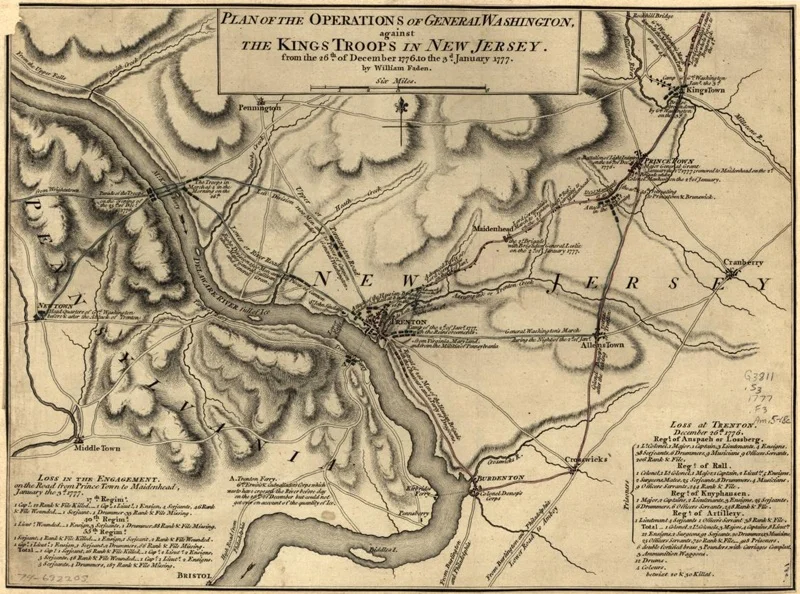
Washington’s plan called for three crossings. Two of them failed: the ice and current stopped General James Ewing’s force below Trenton and Colonel John Cadwalader’s force farther south. Only Washington’s main body of about 2,400 men got across, ferried by Colonel John Glover’s Massachusetts sailors and directed by Henry Knox, who managed the artillery.
The crossing ran hours behind schedule. Instead of attacking in darkness, the army reached Trenton around 8 a.m., an hour after sunrise. Washington split his men into two columns, under Nathanael Greene and John Sullivan, and struck the town from the north and along the river road.
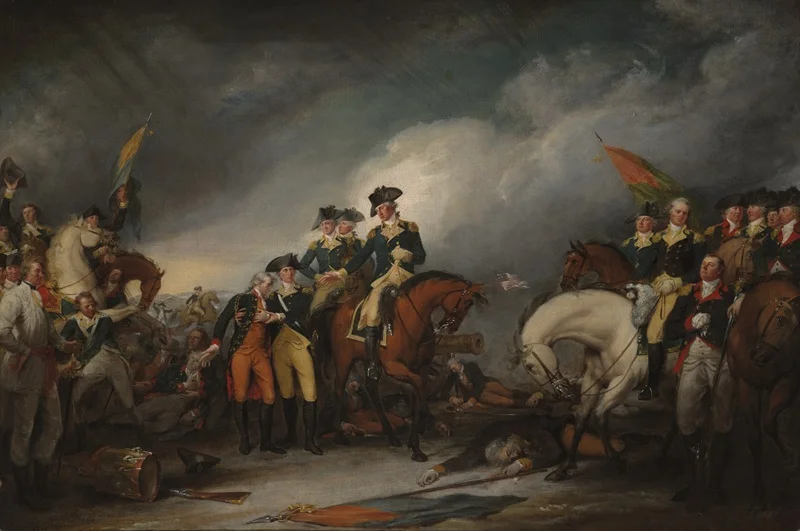
American cannons placed at the head of King Street swept the streets. Hessian regiments tried to form up and were broken. Rall was shot twice and mortally wounded. Within about 45 minutes, most of the garrison had surrendered.
What Happened to the Hessians at Trenton?
Numbers vary by source, but the outline is clear:
- Killed: about 22, including Colonel Rall, who died of his wounds
- Wounded: roughly 83–92
- Captured: roughly 870–920 (sources give 868, 896 or 918, depending on how they count the wounded and late captures)
- Escaped: several hundred slipped away toward Bordentown
The prisoners were marched back across the river and paraded through Philadelphia. Many were later held in Pennsylvania and Virginia — and some of them never went home.
On the American side, no one was killed in the fighting. Two soldiers froze to death on the march, and a handful were wounded, among them Captain William Washington and a young lieutenant named James Monroe — the future fifth president.
Why Did Trenton Matter So Much?
Militarily, Trenton was small. Politically, it was enormous. It proved the Continental Army could beat professional European troops and gave Washington the argument he needed to persuade many soldiers to stay beyond their enlistments. A week later, on January 3, 1777, he struck again and won at Princeton.
The two victories revived recruiting, encouraged Congress and caught the attention of France, which was watching to see whether the rebellion could survive.
Frequently Asked Questions
Did George Washington actually cross the Delaware?
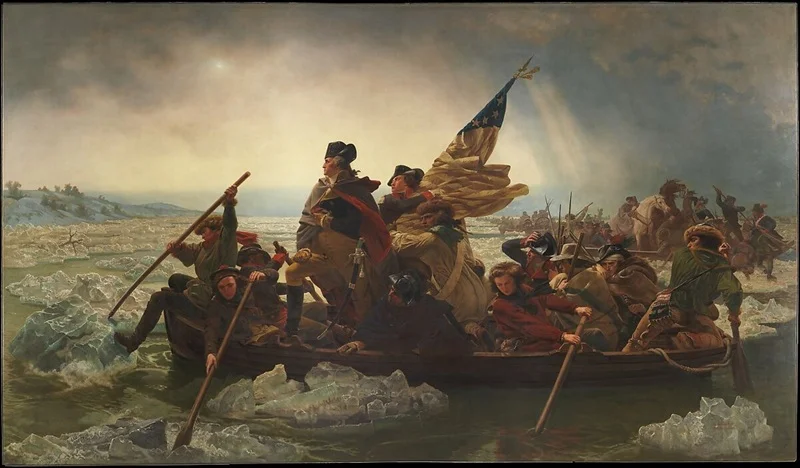
Yes. He crossed with his army at McConkey’s Ferry, now Washington Crossing, Pennsylvania, on the night of December 25–26, 1776. Leutze’s famous painting, though, was made in 1851 and is not accurate in its details — the boats, the flag and Washington’s standing pose are artistic choices.
How many people died when Washington crossed the Delaware?
No one drowned in the crossing. Two American soldiers died of exposure during the freezing march to Trenton.
Was the crossing on Christmas Eve?
No. It began on the evening of Christmas Day, December 25, and the battle was fought on the morning of December 26.
Why It Still Matters
The drunk-Hessian myth makes Trenton sound easy. It wasn’t. It was a desperate gamble by a beaten army, carried out in a storm, against a professional garrison that had simply been pushed past its limits. Two hundred and fifty years later, every Christmas Day, reenactors cross the Delaware again at Washington Crossing — and the true story is the one worth remembering.
Sources
- David Hackett Fischer, Washington’s Crossing (Oxford University Press, 2004)
- Washington Crossing Historic Park — “Were the Hessians drunk when Washington attacked Trenton?” and “Myths and Legends About the Crossing”
- American Battlefield Trust — “Trenton”
- Emerging Revolutionary War Era — “Victory or Death” (December 26, 2018)
- History.com — “Battles of Trenton and Princeton”
- George Washington’s Mount Vernon — “10 Facts about Washington’s Crossing of the Delaware River”
- Encyclopedia.com — “Trenton, New Jersey” (Encyclopedia of the American Revolution)