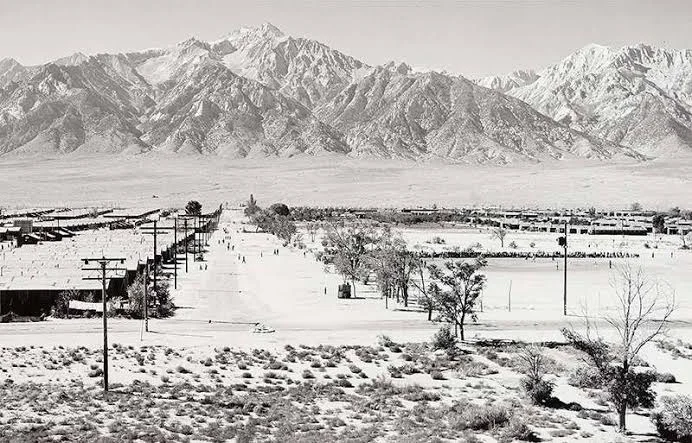
When the camps closed in 1945 and 1946, about 120,000 Japanese Americans — roughly two-thirds of them U.S. citizens — were released with a small amount of cash and a train ticket. Many came home to find their farms, businesses and homes sold, stolen or vandalized, and thousands resettled in cities like Chicago and Denver instead. A 1948 law paid back only a fraction of their property losses. It took more than 40 years for the government to admit the camps were wrong: in 1988, Congress passed and President Ronald Reagan signed the Civil Liberties Act, which formally apologized and paid $20,000 to each surviving person who had been held.
Leaving the camps was the beginning, not the end, of the story for most families.
Key Facts
- Executive Order 9066: signed February 19, 1942
- People held: about 120,000 Japanese Americans from the West Coast, about 62% of them U.S. citizens
- Exclusion from the West Coast ended: January 2, 1945
- Last camp closed: Tule Lake, March 1946
- Official apology and redress: Civil Liberties Act, August 10, 1988 — $20,000 each to about 82,000 survivors
A note on words: the government called the camps “relocation centers,” and many Americans still search for “internment camps.” Many historians and Japanese American organizations today prefer “incarceration,” since most of those held were U.S. citizens who were never charged with a crime. This article uses both.
Why Were Japanese Americans Sent to Camps?
After Pearl Harbor, fear of a Japanese attack or of sabotage on the West Coast ran high. In February 1942, President Franklin D. Roosevelt signed Executive Order 9066, which allowed the military to remove people from designated areas. It was used to force everyone of Japanese ancestry out of California, western Washington and Oregon, and southern Arizona.
The government’s reasoning at the time was “military necessity.” Four decades later, a federal commission reviewed the evidence and concluded that the decision had not been justified by military necessity, but by “race prejudice, war hysteria and a failure of political leadership.”
What Happened When the Camps Closed?
| Date | What happened |
|---|---|
| December 1944 | The Supreme Court ruled in Ex parte Endo that the government could not keep holding loyal citizens; the Army announced the end of West Coast exclusion |
| January 2, 1945 | Japanese Americans were again allowed to return to the West Coast |
| Late 1945 | Most camps closed; people were given about $25 and a train ticket |
| March 1946 | Tule Lake, the last camp, closed |
Coming home was hard. Many families had been forced to sell houses, farms, cars and businesses in a few days in 1942, often for a fraction of their value. Property left in storage or with neighbors was sometimes stolen. Some returning families met signs telling them they were not welcome, and a number of homes and farms were shot at or set on fire.
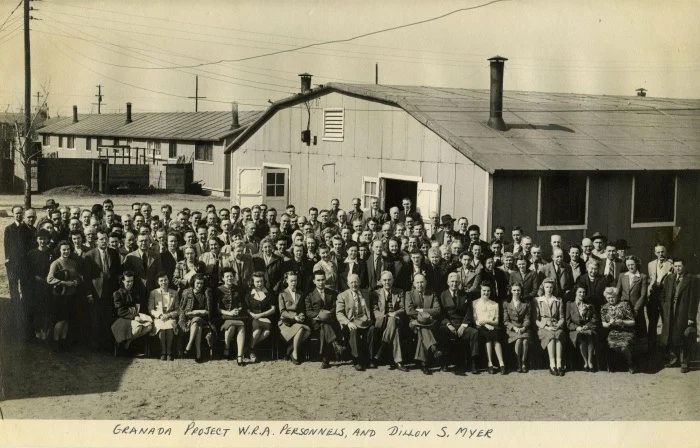
Not everyone went back. Thousands resettled in the Midwest and East, especially Chicago, Denver, Cleveland and New York, where jobs were available and prejudice was sometimes less intense. Others crowded into hostels run by churches while they looked for work.
Did Japanese Americans Get Their Property Back?
Mostly not. In 1948, President Harry Truman signed the Japanese American Evacuation Claims Act, which let people file claims for lost or damaged property. But it required proof such as receipts and records that many families had lost in the rush of 1942, it did not cover lost income or emotional harm, and claims were settled slowly over the next 17 years. Payments covered only a small part of what had been lost.
Researchers working for the federal commission in the 1980s estimated the community’s total economic losses at billions of dollars in 1980s values. Farms in California’s rich valleys, small businesses in Los Angeles’s Little Tokyo and fishing operations on Terminal Island were never recovered.
Did America Apologize for the Internment Camps?
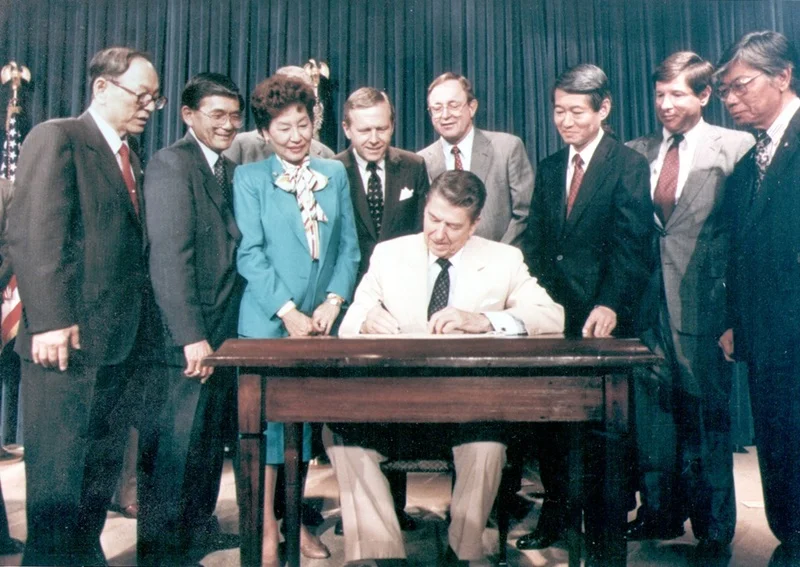
Yes, but it took decades and a long campaign by Japanese American activists, lawyers and members of Congress:
- 1976: President Gerald Ford formally ended Executive Order 9066 and called the removal “a setback to fundamental American principles.”
- 1980–1983: Congress created the Commission on Wartime Relocation and Internment of Civilians (CWRIC). After hearings in 20 cities with more than 750 witnesses, it published Personal Justice Denied and recommended an apology and payments.
- 1983–1987: Federal courts overturned the wartime convictions of Fred Korematsu, Gordon Hirabayashi and Minoru Yasui, who had defied the orders, after lawyers found that the government had hidden evidence in the 1940s.
- August 10, 1988: President Reagan signed the Civil Liberties Act, granting a formal apology and $20,000 to each surviving person who had been held.
- October 9, 1990: the first checks were handed to nine elderly survivors, some in wheelchairs.
In all, about 82,219 people received payments, totaling more than $1.6 billion. Many had already died before 1988 and received nothing.
The decision was not unanimous. Some members of Congress opposed the payments on grounds of cost or argued that a past generation’s actions should not be paid for by today’s taxpayers. Supporters answered that the government had violated the rights of its own citizens and that an apology without action would mean little.
Keep Reading
- What Happened to Easy Company After WWII? The Real “Band of Brothers” After the War
- What Happened to the Nazi Scientists Brought to America? Operation Paperclip Explained
- What Happened to the Doolittle Raiders Captured by Japan? The Fate of the Eight
- Why Did Japanese Soldiers Refuse to Surrender in WWII? From Iwo Jima to Hiroo Onoda
- Why Did It Take So Long to Rescue the USS Indianapolis Survivors?
Frequently Asked Questions
When did the Japanese internment camps close?
Most closed in late 1945 after West Coast exclusion ended on January 2, 1945. The last, Tule Lake in California, closed in March 1946.
Were German and Italian Americans interned too?
Some were, but on a very different scale. Several thousand German and Italian nationals and some U.S. residents were held as individuals considered security risks. There was no mass removal of German or Italian American communities.
Is the Korematsu decision still law?
The 1944 Supreme Court ruling that upheld the removal was never formally overturned by a later case. However, in 2018 the Supreme Court stated that Korematsu had been “gravely wrong the day it was decided.”
Why It Still Matters
The story of what happened after the camps is a story about how long it can take a country to face its mistakes. Japanese American families rebuilt their lives with little help, sent sons to fight for the country that had imprisoned them, and then spent 40 years pressing for recognition. Every February 19, the Day of Remembrance, communities across the U.S. mark the anniversary of the order that began it.
Sources
- Commission on Wartime Relocation and Internment of Civilians, Personal Justice Denied (1983; reprinted University of Washington Press, 1997)
- Civil Liberties Act of 1988, Public Law 100-383
- U.S. National Archives — “Japanese American Internment: Redress” (Office of Redress Administration figures)
- Densho Encyclopedia — “Civil Liberties Act of 1988”
- The National WWII Museum — “Redress and Reparations for Japanese American Incarceration”
- History.com — “How Japanese Americans Fought for—and Won—Redress for WWII Incarceration”
- National Park Service — Manzanar and Tule Lake National Historic Sites
- Roger Daniels, Prisoners Without Trial: Japanese Americans in World War II (Hill and Wang, revised 2004)