
The boy had no shoes.
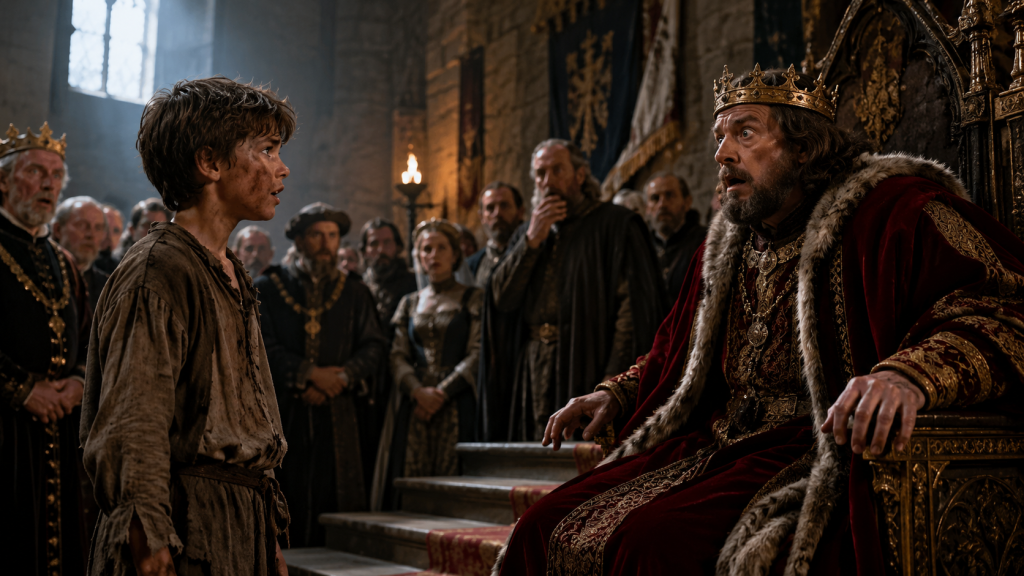
That was the first thing anyone noticed — not his face, not his rags, not even the mud streaked across his hollow cheeks like war paint. It was his bare feet against the cold marble of the great hall, slapping softly with each step, impossibly loud beneath the chandeliers and the silk and the silence that had swallowed the entire room whole.
He had walked through the palace gates at sundown. The guards would later claim they had no idea how. The outer wall was twelve feet high and manned at every post. The inner corridor was sealed with iron bolts. And yet there he was — a child of perhaps nine or ten, wearing what appeared to be the remains of a grain sack stitched together with cord, stepping into the middle of the Grand Banquet Hall of Alderath as if he had been invited.
Three hundred nobles sat frozen at their tables. Candles flickered in the sudden draft from the open doors behind him. Crystal goblets caught the light and scattered it across the stone ceiling in fractured pieces.
No one spoke.
No one moved.
The boy walked straight down the center aisle — past the lords of the Eastern Provinces, past the generals in their medals, past the foreign dignitaries who had traveled weeks for this occasion — and stopped six feet from the royal dais.
He knelt.
Not clumsily. Not the stumbling bow of someone who had never been taught. He knelt with the kind of precision that came from intention — back straight, head lowered, hands flat against his thighs.
Then he raised his face toward the throne.
Toward the blind king.
"Your Majesty," the boy said, his voice trembling but carrying — somehow carrying — across every inch of that enormous room. "I can help you see again."
The gasps came from everywhere at once.
Chairs scraped back. A woman near the far wall pressed her hand to her mouth. Two of the king's personal guards drew their swords before the captain raised a fist and stilled them with a single gesture.
At the center of it all, King Aldric sat perfectly still on his throne of carved obsidian, his silver-streaked hair swept back from a face that had once been called the most commanding in the known world. His eyes were open — they always were — but they saw nothing. Three years of nothing. Three years since the fever had taken his sight and left behind only milky white, searching, empty.
His hand, resting on the arm of the throne, began to shake.
Slowly, the king reached out toward the sound of the boy's voice.
The Boy Who Should Not Have Been There
Lord Edwyn Haverstock was the first to recover his voice. He was the king's chief advisor, a lean man of sixty with a jaw like carved flint and the permanent expression of someone who had spent forty years deciding who mattered and who did not. He stood from his seat at the head table and leveled one long finger at the boy.
"Seize him," he said.
But the king's hand — still trembling, still extended — rose an inch higher.
One gesture. That was all. But no one in Alderath disobeyed that gesture.
The guards stopped.
Haverstock's jaw tightened so hard a vein surfaced at his temple. He sat back down slowly, never taking his eyes off the child.
"Come closer," the king said.
His voice was quiet. That surprised people too. They expected rage or ridicule — the reaction of a powerful man mocked by a beggar child at his own feast. Instead, the king's voice carried something else. Something unreadable. Something that made the silence in the hall deepen rather than break.
The boy rose from his kneel and stepped forward until he was close enough to touch the edge of the dais. He looked up at the king without flinching. Without performance. Just looking, the way children look at things they have already decided to trust.
"What is your name?" the king asked.
"Emric," the boy said.
"And where do you come from, Emric?"
A pause.
"The valley," the boy said. "Beyond the Ashwood."
A ripple moved through the room. The Ashwood was not a place people came from. Not anymore. It had been sealed off by royal decree eight years ago following an outbreak of the gray sickness — a quarantine that had never officially been lifted. Anyone who had lived within its boundaries had either died of the illness, fled before the sealing, or simply… ceased to be spoken of.
Haverstock's eyes narrowed.
"The Ashwood," he repeated, his voice quiet but sharp. "The king's quarantine zone. Fascinating."
He let that hang in the air. Let it do its work. Around the room, the softening expressions that had begun to form — the tentative sympathy for a starving child — shifted back toward suspicion.
The boy did not react to Haverstock's tone. He kept his eyes on the king.
"I know what took your sight," Emric said. "And I know what can bring it back."
"That is a remarkable claim," the king said. "Every physician in the kingdom has told me the damage is permanent."
"They were looking for the wrong cause," the boy replied simply.
The room erupted. Not in chaos — in noise. The kind of collective murmur that means half the room is outraged and the other half is intrigued and no one wants to admit which half they belong to.
The king raised his hand again. Silence.
"Explain yourself," he said.
The boy reached into the folds of his ragged clothing and withdrew something that caught the candlelight immediately — a small glass vial, no larger than his thumb, stoppered with black wax, filled with liquid the color of a winter dawn. Pale silver, faintly luminous, drifting slowly inside the glass like something alive.
Three of the physicians seated at the far table rose to their feet at once.
"Your Majesty, I must strongly advise—" the head physician, a man called Dorovar, began.
"Sit down, Dorovar," the king said.
Not unkindly. But finally.
Dorovar sat.
The king extended his hand fully now — palm open, face tilted upward in the way he had learned to orient himself toward sound, toward presence, toward the shape of a world he could no longer see.
"Show me," he said to the boy.
Emric stepped up onto the first step of the dais.
A guard moved instinctively.
The king shook his head once. The guard stopped.
The boy uncorked the vial. A scent released into the air — not unpleasant, but strange. Like cold water over hot stone. Like something ancient disturbed from long sleep.
He placed the vial carefully in the king's open palm and closed the king's fingers around it.
"One drop on each eye," the boy said. "Then count to three."
"And if it fails?" the king asked.
The boy looked at him steadily.
"It won't."
King Aldric sat for a long moment — the full weight of the hall pressing down on that one suspended breath. Then, with the careful deliberateness of a man who had learned to navigate the world without sight, he tipped the vial and let one small drop fall against his right eye. Then his left.
He closed them.
Counted.
"One."
The candle flames bent sideways without wind.
"Two."
The hall shuddered — not violently, not like an earthquake, but like a deep chord struck on an enormous instrument, felt in the chest more than heard with the ears.
"Three."
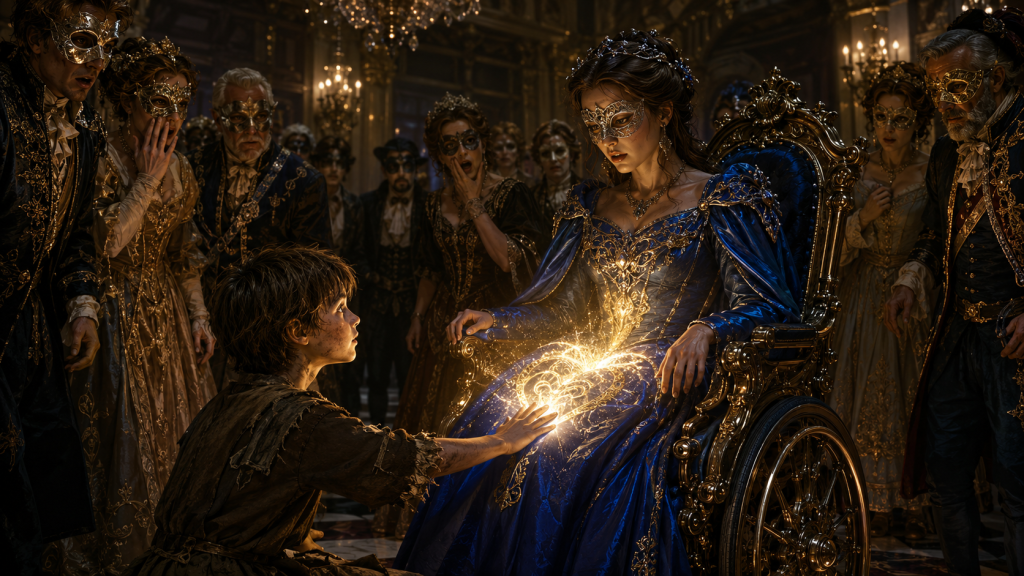
Light flooded the throne.
Not from the chandeliers. Not from the windows. From no visible source at all — just a warm, clean brilliance that pressed outward from the king himself and then faded, gentle and final, like a breath released.
The king opened his eyes.
For the first time in three years.
The first face he saw was the boy's.
What Was Already Known in the Ashwood
No one in the hall breathed for a full three seconds. Then the king blinked — slowly, deliberately, like someone relearning a habit — and his gaze moved. Across the room. Across the faces. Across three years of darkness become suddenly, impossibly, light.
His mouth opened.
Closed.
Then — barely above a whisper — "I can see."
The hall broke. Not into celebration, not right away — into a kind of stunned, cresting wave of noise that hadn't yet decided what it was. Shouts and gasps and the percussion of goblets set down too hard and chairs pushed back and people rising to their feet not because they were commanded to but because sitting seemed wrong in that moment.
Lord Haverstock did not stand. He sat completely still, watching the boy with an expression that had gone very carefully blank — the expression of a man rapidly recalculating something important.
The king was still looking at Emric. Really looking now, with eyes that worked, with eyes that could read a face. And what he found in the boy's face seemed to confuse him — or not confuse him, exactly, but knock something loose inside him, some settled arrangement of certainty that had been undisturbed for years.
"What are you?" the king asked quietly. Not unkindly. Almost with wonder.
"I told you," Emric said. "I'm from the valley."
"The valley was sealed," the king said. "There's nothing left in the Ashwood."
"There is," the boy said. "There are people who survived the sickness. They live deeper in, past the burned fields. They know medicines that Alderath forgot."
He said it without accusation. That was the strangest part — the boy wasn't angry. He wasn't demanding anything. He was stating facts with the simple authority of someone reporting a truth that had simply always been true, whether or not anyone had chosen to acknowledge it.
"The fever that took your sight," Emric continued, "wasn't the gray sickness. It was a different strain. One that travels through tainted well water. Your physicians treated you for the wrong illness."
Dorovar, the head physician, was on his feet again. His face had gone the particular shade of red that belongs to men who feel their expertise publicly dismantled.
"The king's water supply was tested extensively—"
"By whom?" Emric asked.
Dorovar stopped.
The question was so simple it sat in the room like a stone dropped in still water, and no one moved until the rings stopped spreading.
"By my staff," Dorovar said finally. "By my trained—"
"The south well," the boy said. "The one that was added three months before the king fell ill. Was that tested separately?"
Silence again. Different this time. Sharper.
Because two or three people in the room — people who had been close to the palace's construction records, close to the logistics of infrastructure — had gone very still.
The king slowly turned his newly restored gaze toward Haverstock.
Haverstock met the look without blinking. Without shifting. The face of a man who had spent decades cultivating stillness as a weapon.
"My Lord Haverstock," the king said slowly. "The south well. Who commissioned it?"
A pause that lasted precisely two seconds too long.
"I believe that would have been the infrastructure committee," Haverstock said. "I can have the records pulled by morning, Your Majesty."
"Do that," the king said.
His voice had changed. It was no longer the quiet wonder of a man reclaiming his sight. It was something older. More deliberate. The voice of a king who has just realized the shape of a thing he was not yet ready to fully name.
He turned back to the boy.
"Where did you learn about my well?"
"My mother told me," Emric said.
The king's expression shifted. Something moved behind his eyes — not quite pain, not quite recognition. Something that lived in the space between them.
"Your mother," he repeated.
"She lived in the palace," the boy said. "Before the quarantine."
Another silence. This one felt different from all the others. More personal. More excavated.
"Her name?" the king asked. His voice was very controlled now. Too controlled.
The boy reached into his clothing again.
And what he produced this time was not a vial.
It was a ring.
Small. Silver. Worn smooth along the band from years of use. A single stone set in the center — not a gem, exactly, but a piece of polished gray slate carved into a shape that anyone who had spent time in the palace would have recognized immediately: the personal seal of the royal house of Alderath. Not the official crest. The private one. The one used only in correspondence between the king and those he trusted absolutely.
Emric pressed the ring into the king's palm.
The king's face drained of color so completely and so fast that the woman closest to the dais reached out instinctively as if to catch him.
"That ring," the king said. Each word careful. Separate. Like something being handled with tremendous caution. "Where did you get that ring?"
The boy held the king's gaze.
"She gave it to me," he said. "The night they took her into the Ashwood."
The Name That Had Been Erased
The king did not speak for a long time after that.
He sat holding the ring with both hands — the grip of a man afraid of what he is touching, unable to put it down. His newly restored eyes moved over the surface of it with an intensity that made the room feel intrusive, like witnesses to something that should have been private.
Haverstock broke the silence first. He had no choice. The silence was doing damage he could feel.
"Your Majesty," he said, rising smoothly, crossing toward the dais with the practiced confidence of a man who had spent decades moving through rooms as if they belonged to him. "The child is clearly well-coached. Someone sent him here. Someone who knew enough about the palace to arm him with convincing details—"
"Her name," the king said, cutting straight through the middle of Haverstock's speech, "was Sera."
The name landed in the room like a dropped blade.
Haverstock stopped walking. Just for a fraction of a step — but he stopped.
Several of the oldest nobles at the table exchanged glances. The kind of glance that means: we remember that name. We remember being told to forget it.
"She was my physician's apprentice," the king continued, still looking at the ring. "Twelve years ago. She was brought from the Ashwood valley as part of a trade agreement with the communities there — knowledge exchange, the council called it." He paused. "I called it something else."
No one asked what.
Everyone understood.
"She disappeared," the king said. "I was told she went back to the valley willingly. That she had grown homesick. That she had left a letter." His jaw tightened. "I was shown a letter."
He finally looked up from the ring.
Directly at Haverstock.
"You brought me that letter," the king said. "You told me she had gone."
Haverstock's expression did not crack. It was remarkable, actually — the discipline of it. The absolute, practiced impenetrability. He had been building that wall for forty years, and it held. Barely.
"She had," he said evenly. "The record is clear."
"The record," the king repeated softly. Then he turned back to the boy. "Emric. Look at me."
The boy looked up without hesitation.
The king studied his face for a long moment. Really studied it — the way he had not been able to study anything for three years. The way sight allows a person to do what memory and instinct cannot fully accomplish alone.
What the king saw in the boy's face made his breath change.
Not dramatically. Not visibly to anyone more than a foot away. But the rhythm of it shifted — something catching, then releasing, then catching again.
"How old are you?" the king asked.
"Ten," Emric said.
The king was quiet for a moment.
Then — carefully, deliberately — he counted back ten years.
Sera had been gone for twelve.
She had disappeared two years before the king fell ill with the fever that stole his sight.
Two years before — which meant she had been alive in the Ashwood when his blindness began. Which meant someone had known where she was and chosen to say nothing. Which meant the well, the tainted water, the illness that no physician had correctly diagnosed — all of it had unfolded while the one person with the knowledge and the medicine to treat it had been locked away behind a royal quarantine that sealed her in as neatly as it sealed everyone else out.
The king's hands closed around the ring so tightly his knuckles whitened.
"Where is she now?" he asked the boy. His voice was very quiet. The quietest it had been all evening.
Emric's expression, which had been steady and composed through everything — the hostility of the guards, the disdain of the nobles, the weight of the entire hall pressing down on him — finally shifted. Something moved through it. Not grief, exactly. Something older than grief. Something a child develops when grief has been present so long it becomes the texture of ordinary life.
"She died," the boy said. "Two winters ago."
The king did not move.
Did not speak.
One of the candles near the far wall guttered and went out in a breath of its own making.
"She died in the valley," Emric continued. "But before she did, she taught me everything she knew. About the medicines. About the plants that grow past the burned field. About the well." He looked at the ring in the king's hands. "And about you."
"What did she tell you about me?" the king asked.
The boy's voice didn't waver.
"That you were a good man," he said. "That you didn't know."
Three words.
That you didn't know.
And something in the king's face broke — not collapsed, not shattered, but opened, the way a fist opens when the thing it has been gripping is finally, finally allowed to go.
He turned to face Lord Haverstock.
And this time there was nothing quiet about his voice at all.
"Pull the records," the king said. "Every record. The south well. Sera's dismissal papers. The quarantine authorization. The letter you brought me. Every document bearing your signature from the year before she disappeared to the year I lost my sight." He stood from the throne — the first time he had stood without assistance in three years, his legs finding their steadiness again with something like defiance. "And I want them pulled tonight."
Haverstock's composure held. But barely. The crack was visible now — not in his expression, but in the stillness of him. The stillness of a man who has stopped moving because movement has become dangerous.
"Of course, Your Majesty," he said.
He bowed. Turned. Walked toward the door.
And the two guards who fell into step behind him — not to escort him out, but to ensure he reached the records hall and nowhere else — was a detail that every person in that room understood completely.
The Architect of Darkness
The records hall of Alderath was a long, vaulted room that smelled of old parchment and lamp oil, its shelves climbing floor to ceiling in columns of bound ledgers and sealed documents dating back two hundred years. Three archivists worked through the night under the watch of the king's personal guard, pulling everything Haverstock had touched in the years surrounding Sera's removal from the palace.
The king did not sleep.
He sat in the chamber adjacent to the records hall — Emric beside him, both of them quiet in the way of people who have found an unexpected peace in each other's company — and waited while the truth assembled itself piece by piece.
It took until just before dawn.
What the archivists found was not hidden. That was the most remarkable part. Haverstock had not buried his trail deep — he had simply made it bureaucratic. Dull. Layers of administrative language wrapped around the reality of what had been done, each document individually meaningless, collectively damning only if someone pulled them all at once and laid them side by side.
Which was, of course, exactly what no one had done for twelve years.
The first document was a personnel transfer order, signed by Haverstock in his capacity as chief of palace administration, reassigning Sera from the physician's office to a position in the outer settlement — standard language, nothing remarkable.
The second document, filed three weeks later, was a voluntary departure notice. Her name. A date. A signature that was almost — almost — identical to the one on her original appointment papers. But not quite. The archivist who had worked in the records hall the longest pointed out the difference without being asked: the curl of the S was wrong. Slightly. The kind of wrong that only appeared when you held both documents directly next to each other under good light.
The third document was the authorization for the quarantine of the Ashwood valley.
Signed by Haverstock.
Dated — and this was the piece that made the senior archivist set the document down and take a slow breath before delivering it — three days before Sera's voluntary departure notice. The quarantine had been authorized before she officially left. Which meant she could not have departed willingly. Which meant she had been inside the sealed zone before the gate closed, not after.
She had not left.
She had been locked in.
The fourth document was the one that made the king go very still when it was placed in his hands. It was a record of a commission — a construction commission for the south well, authorizing its placement at a specific location in the palace's lower courtyard, drawing from a water table that ran directly beneath a drainage channel from the old silver refinery. The refinery had been decommissioned twenty years earlier, but its underground contamination had never been fully cleared. Lead compounds. Mercury traces. Slow-acting, accumulating in the body over months, causing precisely the kind of neurological and ocular damage that the palace physicians had diagnosed as an inexplicable fever.
The commission was signed by Haverstock.
It was dated six months after the quarantine was established. Six months after Sera — the only person in the palace's circle with knowledge of the Ashwood's medicinal traditions, the only person who might have recognized the contamination symptoms before they progressed — had been sealed away.
The king read the documents in order.
Then he read them again.
Then he sat back and was quiet for a long time.
"He needed me blind," the king said eventually, to no one in particular.
Emric was sitting cross-legged on the floor nearby, his bare feet tucked under him. He did not answer. But his expression suggested he had understood the shape of this story long before tonight.
"If I could not see the documents I was signing," the king continued, working through it aloud, "then I could not read them. I relied on what was read to me. By him." A pause. "For three years, every decree, every trade agreement, every legal appointment, every military commission that passed through this palace—"
He stopped himself.
The full scale of it settling in like water finding every crack.
"How much did she know?" the king asked the boy. "Your mother. What did she understand about why she was sent away?"
Emric thought for a moment.
"She understood enough," he said carefully. "She knew Haverstock had wanted her removed. She didn't know about the well until people in the valley started showing similar symptoms from water sources near the old mine channels. She put it together slowly." He paused. "She said she tried to send word. Three times."
"I received nothing."
"She knew that," the boy said. "She assumed the messages were intercepted." He looked at the king directly. "That's why she sent me. She said a letter can be burned. A person is harder to ignore."
The king looked at the boy for a long time.
"She was right," he said.
He rose from his chair. Moved to the window. Outside, the sky was beginning to pull away from pure black into the deep blue that precedes dawn — a color the king was seeing for the first time in three years, and for one quiet moment he simply stood there, looking at it, saying nothing, letting the sight of the sky do what words could not.
Then he turned back to the room.
"Where is Haverstock now?"
"In the east wing, Your Majesty," the captain of the guard replied from the doorway. "Under watch."
"And has he been given opportunity to send word to anyone outside the palace?"
The captain paused. Just briefly. But the king's newly working eyes caught it.
"Seal the gates," the king said immediately. "No one in or out until I say otherwise."
"Yes, Your Majesty."
"And bring me the list of every appointment, every commission, every trade signature that passed through this court in the last three years. I want to know exactly what I signed without being able to read it."
The archivist who had been standing silently by the shelves cleared his throat quietly. "Your Majesty… I believe that will be a very long list."
"Then we had best start now," the king said.
The First Morning
Lord Edwyn Haverstock was brought before the king at midmorning, in the lesser audience chamber rather than the grand hall — a deliberate choice. The grand hall was theater. This room was business.
He entered with the bearing of a man who had decided, between the records hall and this moment, that his best remaining option was composure. He wore it well. He always had. Forty years of palace life had taught him that the man who appears unshaken is often treated as though he has reason to be.
But the king was standing.
And the king could see.
Both of those things together — and the documents laid out on the table between them — stripped away the advantage of composure before Haverstock had spoken a single word.
The king did not begin with accusations. He did not raise his voice. He simply placed one document at a time on the table, in order, and said nothing while Haverstock looked at each one.
The personnel transfer order.
The forged departure notice.
The quarantine authorization dated three days before her departure.
The south well commission.
Haverstock looked at each document with the careful, neutral attention of a man reading things he has never seen before — the performance of innocence rather than its reality. But by the fourth document his breathing had changed. Shallow. Controlled.
"You needed me dependent," the king said. "Not dead. Dependent. A blind king who trusts his chief advisor to read and interpret every word that comes through this court is worth far more to an ambitious man than a dead king, who would simply be replaced."
Haverstock said nothing.
"The trade agreements you negotiated in my name," the king continued. "The military appointments. The titles granted and revoked. The land allocations in the southern provinces." He paused. "I'll need to know which of those benefited your family directly and which ones were sold to other parties. We'll determine that from the records. But I'd like to offer you one opportunity — one — to tell me yourself."
A silence stretched between them.
Then Haverstock, very slowly, looked past the king to where Emric stood near the far wall, watching with steady, dark eyes.
"A child from a quarantine zone," he said. His voice was remarkably even. "A vial of unknown liquid administered to the king's eyes by an unvetted stranger. And now here we are, dismantling forty years of service based on documents that any forger—"
"The handwriting," the king said. "On the departure notice. The archivist identified the discrepancy. That archivist has worked in this hall for thirty-one years and has examined more documents in that time than either of us will ever read. He is not mistaken."
Haverstock looked back at the king.
And finally — after forty years — the composure broke.
Not dramatically. Not in the way stories usually describe it — no explosion, no confession delivered in anguish or defiance. It broke the way ice breaks in spring: slowly, in pieces, with a quiet inevitability that was almost more terrible than sudden collapse.
"She had too much influence over you," Haverstock said. His voice had gone very quiet. Almost conversational. Like a man explaining something he had long considered reasonable. "A woman from a valley settlement. No family of consequence, no political understanding. She had your ear. She had your trust. She was changing the way you thought about the trade agreements, about the southern land policies, about the quarantine restrictions." He paused. "I was protecting the stability of the court."
"You were protecting your access to the court," the king said.
Haverstock did not disagree.
"And when you fell ill," he continued quietly, "and she was the only one who might have known the cause—"
"Yes," Haverstock said. The single word carrying forty years in it. Not remorse. Something colder. Certainty. The certainty of a man who had spent decades convinced that the thing he was doing was the only pragmatic choice available, and who had never, until this moment, been required to say so out loud.
The king looked at him for a long time after that.
Then he turned away.
"Take him," he said.
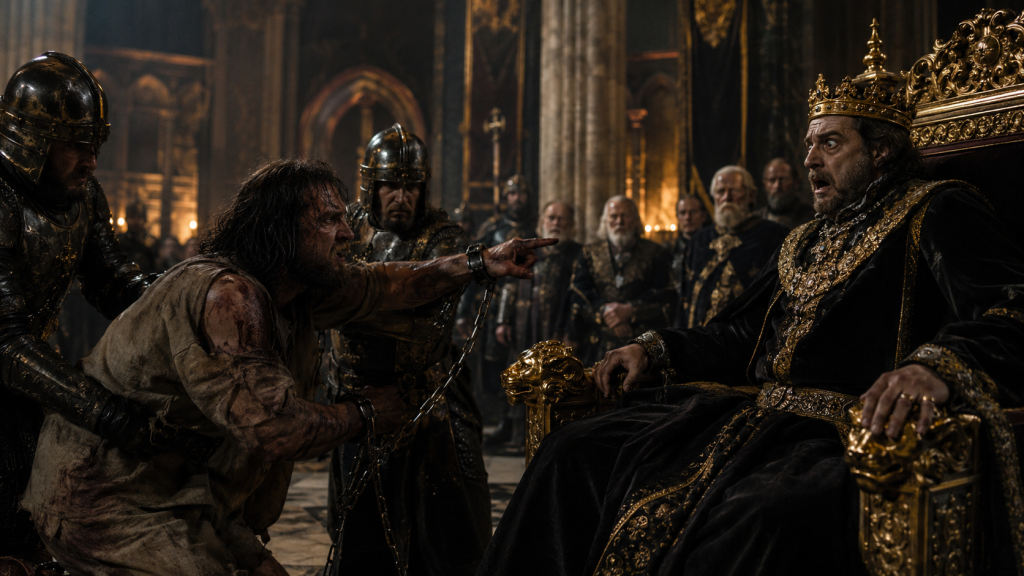
The guards moved. Haverstock did not resist. He walked between them with the same measured step he had always used in these halls, and the doors closed behind him, and the sound of his footsteps faded, and then the room was quiet.
The king stood for a moment with his back to the room, facing the window and the midmorning light — real light, the kind he had not been able to see for three years — and breathed.
Then he turned around.
Emric was still standing by the wall. He had not moved through any of it. Had not reacted to Haverstock's explanation or the guards or the closing of the doors. He stood the way he had stood since entering the palace the night before — with a composure that had nothing to do with training and everything to do with having lived through enough difficulty that additional difficulty no longer surprised him.
The king crossed the room and crouched down in front of the boy — actually crouched, so they were at the same height — which was not a thing kings did, and every person in the room registered it, and no one said anything.
"Your mother," the king said quietly. "Whatever she believed I didn't know — she was right. I want you to know that."
Emric looked at him.
"I know," the boy said simply.
"She deserved better than what happened to her."
"She knew that too," the boy said. "She didn't send me here to punish anyone. She sent me because she thought the people in the valley deserved to have the quarantine lifted. To come back. To be given medicine from the palace stores, not just what they could grow."
The king nodded slowly.
"The quarantine will be lifted by the end of the week," he said. "Supplies will be arranged. And the physicians who will lead the effort—" he glanced toward the door, considering — "will not be Dorovar."
Something flickered in the boy's face. The closest thing to relief he had shown since arriving.
"She would have liked that," he said.
They stayed there for a moment — the king and the boy, in the quiet of the chamber with the morning light coming through the window, each of them carrying something the other could not fully reach, but both of them, in some imprecise and human way, lighter than they had been the night before.
The king reached into his own pocket then, and took out the silver ring — the one he had been holding, with one hand or another, since the moment Emric pressed it into his palm at the banquet. He looked at it for a moment. Then he held it out to the boy.
"Keep it," the king said. "It belongs to you more than it belongs to me now."
Emric looked at the ring in the king's outstretched hand.
Then — slowly — he took it.
He didn't say thank you. He didn't need to. The king didn't expect it.
Outside the window, the morning was fully arrived now — the blue-gray of early light burned off into something clear and warm and ordinary, the kind of day that happens regardless of what has unfolded in the hours before it, the kind of day that insists on itself gently, without ceremony.
The king stood back up and walked to the window.
He stood there for a long while, simply looking out at his city. At the rooftops and the market stalls and the distant treeline and the pale sky above all of it, unchanged, indifferent to kings and conspiracies alike — still and blue and full of light.
Three years of darkness.
And now this.
Beside him, Emric came to stand at the window too — drawn by it the way children are drawn by whatever the person nearest them is looking at. He pressed one hand flat against the glass and peered out, his breath fogging the pane slightly.
"It's a big city," the boy said.
"It is," the king agreed.
"My mother said it was beautiful."
The king looked at the city his mother had described to her son from a valley beyond a sealed forest, from a life that had been taken from her twelve years ago, from the memory of something she had loved and been separated from and never stopped wanting her child to someday see.
"She was right," the king said.
The ring was warm in the boy's hand. The light was steady and real. And somewhere beyond the city walls, the Ashwood waited — not as a place of exile or illness or forgetting, but as a place that was, at last, about to be opened again.
What had been sealed could be unsealed.
What had been taken could not always be returned — but sometimes, if you were patient and brave enough to walk barefoot through palace gates at the wrong hour, you could return something of it.
Enough to make the light feel true.
Enough to make the morning worth the night that came before it.