
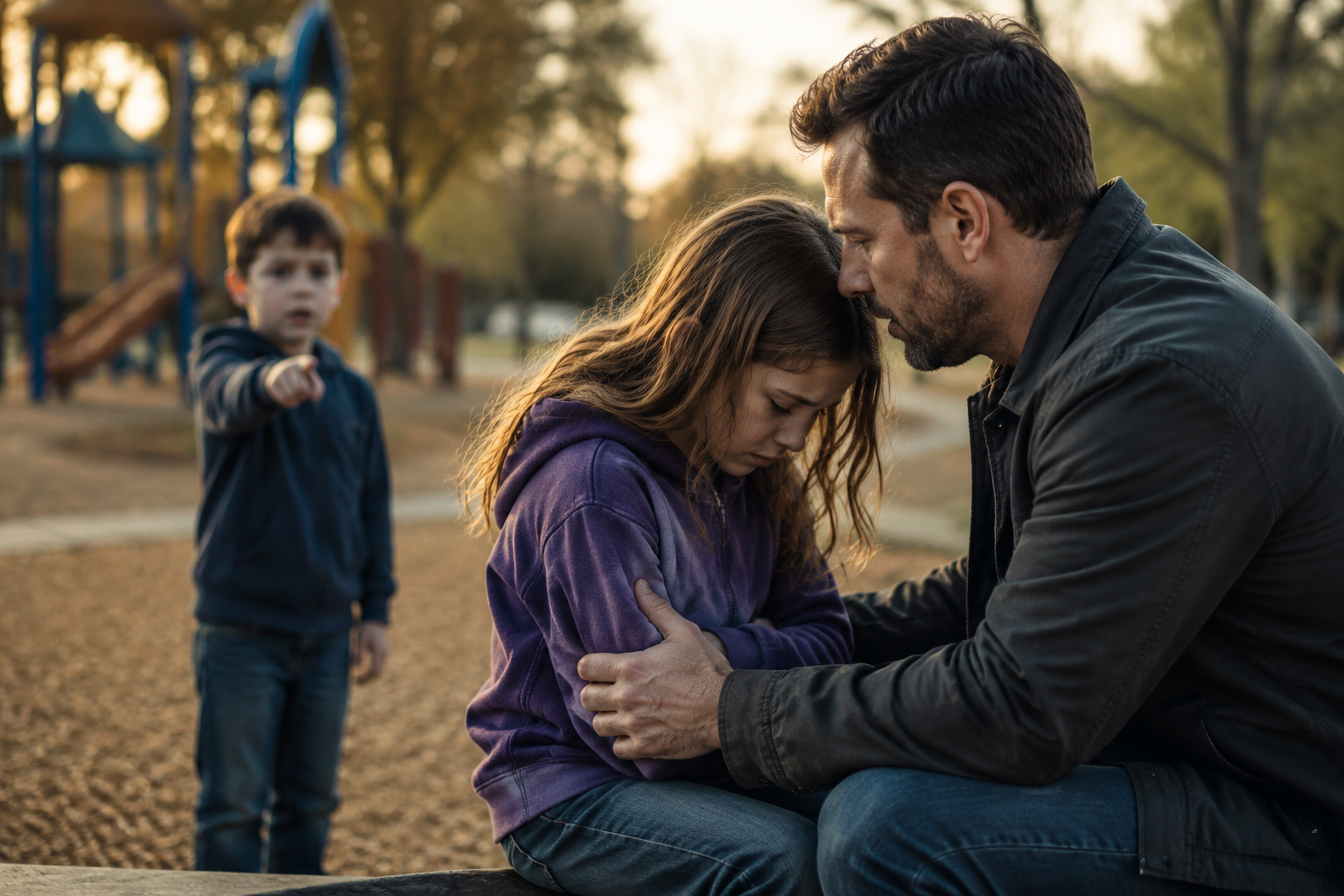
The morning had been quiet — the kind of quiet that tricks you into thinking the world is gentle.
Marcus Hale had been pushing his daughter's wheelchair along the cracked cement path at the edge of Ridgemont Park, a narrow stretch of green on the north side of Clover Hill, Ohio, where the old oaks still grew wide enough to throw real shade. It was early October. The light came in sideways, pale gold, the kind that makes everything look like it's half-remembered. Lily, fourteen, had her hands folded in her lap around a small laminated photograph — her mother, smiling at a beach somewhere in South Carolina, three summers ago. She carried it everywhere. It was creased down the middle from how often she held it.
Then it happened.
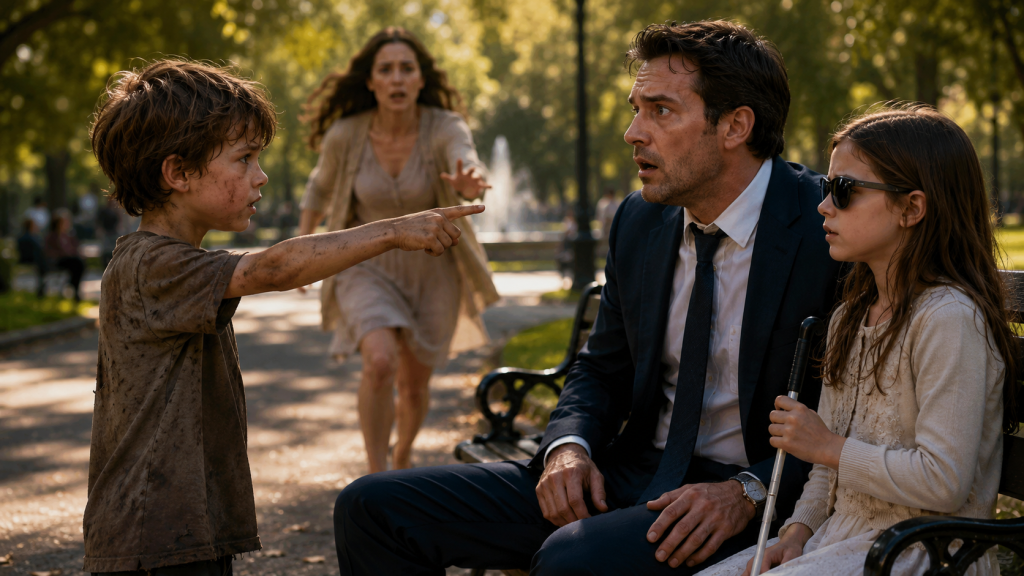
"Dad — I can't feel my legs."
The words didn't sound like a complaint. They sounded like a discovery. Like she was reporting something that had just been confirmed after a long, uncertain wait. Her voice was flat and frightened at the same time, and the birds — three of them, starlings on a low branch — scattered at the sound of it. The silence that followed was heavier than the cry itself.
Marcus dropped to one knee on the path. His hands went to her legs automatically, pressing gently through the denim of her jeans, and he felt her watching him the way she always watched him when she was scared — searching his face for the answer she needed.
"I know, baby," he said, his voice barely holding. "I know. We're going to call Dr. Renner. We'll figure it out."
He reached for his phone. His hands were shaking. Lily's neurologist had warned him about episodes like this — sudden loss of sensation, a possible flare of the spinal inflammation they'd been managing since the car accident eighteen months ago. Eighteen months. He still couldn't say those words without his chest doing something terrible.
The accident that had taken his wife. The accident that had put Lily in this chair.
He was still fumbling with the phone when he heard it. A voice. From behind. Calm in a way that didn't belong to a morning like this.
"I can help her."
Marcus turned. A boy stood near the park's iron gate, maybe thirty feet away. He looked about sixteen, seventeen at most — slight build, dark hoodie, dark hair, hands loose at his sides. He wasn't rushing forward. He wasn't alarmed. He was just watching, with an expression so steady it was almost clinical.
"Stay back," Marcus said. The protective snap in his voice was involuntary. A father's reflex.
The boy didn't flinch. Didn't step back. His eyes moved from Marcus to Lily and stayed there, and then he said the five words that changed the temperature of everything.
"She's not supposed to be like this."
Not I'm sorry this happened to her. Not Is she okay? Not the words a stranger says when they stumble across someone else's pain. These words carried knowledge. A specific, terrible knowledge.
Marcus stood slowly. "What does that mean?"
The boy stepped closer. One step. Deliberate. He looked at Lily directly now, not the way someone looks at a girl in a wheelchair, but the way someone looks at a person they have been searching for.
"This wasn't an accident," the boy said.
Lily's hand tightened around the photograph in her lap. Her knuckles went white. She looked at the boy the way people look at something they're afraid to recognize.
"How do you know that?" Her voice was barely sound. Just breath shaped into words.
The boy held her gaze. Steady. Unshaken.
"Because I was there."
Marcus took one step forward. His voice dropped into that register fathers reach when they are past anger and into something colder and more precise. "Where? Where were you?"
The boy raised one hand — slowly, palm out, not threatening — and turned to point toward the far edge of the park, toward the hill road that curved down toward Route 9. The same road. The same hill. The road where the accident had happened on a wet November evening eighteen months ago.
The photograph slipped from Lily's fingers. It hit the path face-up. Her mother's smile, creased down the middle, looked up at the pale October sky.
Marcus didn't pick it up. He was already listening.
Act 1 — The Boy Who Was There
His name was Caleb Marsh. He lived four blocks from the park, in one of the narrow two-story houses on Fielder Street that all looked the same from the outside. He told Marcus his name standing right there on the path, with Lily watching him and the October wind moving through the oaks above them. He said it plainly, like a person turning themselves in.
Marcus had not called Dr. Renner yet. He would. But not yet. He needed to hear this first.
"I was on my bike," Caleb said. "On the shoulder of Route 9, coming up the hill. It was raining. Maybe around seven in the evening." He paused. His jaw tightened. "I saw the other car. Before it happened. It was sitting on the pullout at the top of the hill — you know the one, by the guardrail — with the lights off."
Marcus went very still. "Lights off."
"I thought it was just someone parked. I didn't think—" Caleb stopped. Something crossed his face that looked like guilt and shame packed into the same two seconds. "Then I saw it pull out. No headlights. It pulled out and it went directly into your lane."
The world did not shake. The trees did not move. The morning just continued being a morning, indifferent and pale, and Marcus stood in the middle of it with a new shape of reality settling over him like something cold and permanent.
"The police report said it was a wet-road accident," Marcus said. His voice was careful. "Mechanical failure. The other driver's rear tire blew."
"I know what the report said," Caleb replied. He was not aggressive. He was just tired — the kind of tired that comes from carrying something alone for too long. "I went to the station two days after. I told them what I saw. The officer who took my statement — his name was Briggs — he told me I was confused. That it was dark and raining and I was a kid on a bike and I couldn't have seen clearly." Caleb's voice didn't waver. "But I saw clearly. I had a headlamp. It was directly in front of me."
Lily was very quiet. Her hand had moved to the armrest of her chair, fingers gripping the edge. She was watching Caleb the way people watch someone say the thing they have spent a year and a half needing to hear.
"Why now?" Marcus asked. "Why come forward now, after all this time?"
Caleb reached into the front pocket of his hoodie and pulled out his phone. He turned the screen toward Marcus. It showed a photograph — blurry, rain-smeared, taken from a low angle. But clear enough. A dark sedan sitting on the shoulder of a hill road. Lights off. A partial license plate visible at the edge of the frame.
"I took this right before it happened," Caleb said. "I always take pictures when I'm out riding. Habit. I didn't realize what I had until a few months ago when I was going through old photos." He looked at Marcus steadily. "I went back to the station. Different officer this time. He told me to come back with a lawyer. That's when I started looking for you."
Marcus stared at the photograph on the phone screen. The partial plate. Three characters visible. He had a memory — buried but immediate — of the accident report. The other driver. A man named Glen Purcell, fifty-two, an independent financial consultant from the town of Mather, twenty miles east. Minor injuries. No charges filed. Clean driving record. The insurance company had settled within three months.
Glen Purcell.
Marcus had not spoken that name in four months. He'd tried to stop saying it, tried to stop waking up at 3 a.m. turning it over in his mind. His grief counselor had called it "blame attachment." He'd been working on letting it go.
He looked at the partial plate on Caleb's phone. He looked at the dark sedan sitting motionless on the shoulder. Lights off. Waiting.
"Can you send me that photo?" Marcus said.
Caleb was already typing in his number.
Marcus bent down and picked up Lily's photograph from the path. He pressed it back into her hand. She gripped it, but she was still looking at Caleb, and her voice, when she finally spoke, was quiet and very certain.
"What was he waiting for?"
Nobody answered. But the question sat in the air between all three of them like something that had been asked a long time ago and was only now finding its moment.
Marcus's phone buzzed. Caleb's photo had arrived.
He stared at the three visible characters of the license plate. G — 4 — R. He stared at the dark shape of the car. And at the edge of the photograph, barely visible in the rain and the headlamp's beam — a bumper sticker. Small. Rectangular. He couldn't read the text. But he could see the colors. Green and gold.
He knew those colors.
Act 2 — The Detail That Didn't Fit
Marcus spent the following three days trying to be a functional father while a separate, parallel version of himself worked a quiet investigation at the kitchen table after Lily was asleep.
He'd started with the photo. He'd enlarged the bumper sticker on his laptop screen, run it through every filter he could find, zoomed and sharpened until the text began to resolve. Two words. Green letters on a gold background. Kessler Financial.
He knew Kessler Financial. Everyone in Clover Hill knew it. It was the oldest investment firm in the county, founded by Harold Kessler thirty years ago, inherited by his son, Dennis Kessler, a decade later. Dennis Kessler was the kind of man who had a photo on the wall of every business he'd ever touched — always smiling, always shaking hands, always with the easy, practiced warmth of someone who had learned long ago that likability was its own form of currency. He sponsored the Fourth of July parade. He was on the school board. He donated to the children's hospital wing.
Glen Purcell, the driver who had crossed into Marcus's lane on Route 9 eighteen months ago, was a financial consultant.
Marcus pulled the insurance settlement documents from the fireproof lockbox in his bedroom closet. He hadn't looked at them since the week he'd signed them. The settlement had come through fast — uncomfortably fast, in hindsight. The insurance company representing Purcell's vehicle was a regional carrier called Arden Mutual. Marcus typed the name into his laptop and cross-referenced it against Kessler Financial.
Arden Mutual's primary institutional investor was Kessler Financial Holdings, LLC.
He sat back from the laptop. The kitchen clock ticked. The house was quiet except for Lily's sound machine down the hall — ocean waves, the same recording she'd slept to since she was seven years old.
He thought about what he knew. What he actually, verifiably knew. His wife, Carol, had worked as a forensic accountant. Small firm, contract work, mostly insurance and corporate clients. In the months before the accident, she had been distracted — staying late, coming home with a closed expression that she called "a complicated case." He had not pushed. He trusted her. He respected the confidentiality of her work.
He pulled out her old laptop — the personal one, not the work computer that had been returned to her employer. It had been sitting in the lockbox too, beneath the insurance papers and the death certificate, because he hadn't been able to open it and hadn't been able to throw it away.
The password was their daughter's birthday. He'd known it without thinking. He typed it in and the screen came to life and he spent forty minutes going through Carol's files with a slow, methodical grief, opening folders he'd never seen, reading drafts of documents he only half understood.
Then he found the folder labeled simply KFH.
Inside were eleven documents. Spreadsheets. Correspondence. A partial audit trail. Carol had been investigating Kessler Financial Holdings on behalf of a client she referred to only as "the unnamed complainant." The documents detailed a pattern of fraudulent fund transfers — money moved from client investment accounts into a series of shell companies over a period of four years. The amount Marcus could calculate from the figures visible in the spreadsheets was somewhere in the range of two and a half million dollars.
The last document in the folder was an email draft, unsent. Addressed to the Ohio Department of Securities. Subject line: Formal Complaint — Kessler Financial Holdings — Evidence of Securities Fraud.
It was dated November 6th. Four days before the accident.
Marcus closed the laptop carefully, the way you close something that has just told you the truth you spent eighteen months telling yourself you were imagining.
He texted Caleb Marsh: I need to meet. Tomorrow morning. Bring everything you have.
Then he sat in the dark kitchen for a long time, listening to Lily's ocean waves through the wall, and he thought about Dennis Kessler — smiling on every wall in Clover Hill — and about Glen Purcell, sitting in a dark car on a hilltop with the headlights off, waiting for a specific pair of headlights to come up Route 9 on a rainy November evening.
Waiting for Carol.
Act 3 — The Pattern No One Was Supposed to See
Caleb Marsh arrived at the Hale house at seven-thirty the next morning with a backpack and a manner that was older than his seventeen years. He sat at the kitchen table across from Marcus and laid out what he had: the photograph, a handwritten account of what he'd witnessed, and a copy of his original statement to Officer Briggs — which Caleb had requested from the department and received, stamped and dated, three weeks ago.
Marcus laid Carol's KFH documents beside them. The two of them sat there looking at the full shape of it the way you look at a map after you've already been lost in the territory.
"I did some research after I found the photo," Caleb said. He opened his backpack and produced a manila folder — the kind of careful organization Marcus associated with people who'd been told their word wasn't good enough and had decided to make it impossible to dismiss. "Glen Purcell. I looked him up. He's been a registered financial consultant in Ohio for twelve years. His primary client of record, listed on his professional registration, is Kessler Financial Holdings."
Marcus nodded. "He worked for Kessler."
"He was the operations manager for the shell accounts," Caleb said. "I found a securities filing — it's public record — from three years ago where Purcell is listed as an authorized signatory for two of the holding companies Carol's documents reference. I found it in the state business registry." He paused. "I'm good at research. I want to be an investigative journalist."
Under any other circumstances, Marcus might have smiled at that. He filed it away instead.
The picture was coming into full, terrible resolution now. Dennis Kessler had been running a long-term fraud operation through Kessler Financial Holdings, siphoning client funds through shell companies that Purcell managed. Carol, in the course of a contract audit, had found the trail and was four days away from filing a formal complaint with the Ohio Department of Securities — a complaint that would have triggered a full investigation, frozen assets, and almost certainly resulted in criminal charges.
Someone had told Kessler. Someone in Carol's orbit — a colleague, a client, someone with access to her work calendar — had told him she was about to file.
And Kessler had sent Purcell to wait on a hill in the rain.
Marcus spent the next week pulling thread after thread. He contacted a former colleague of Carol's — a woman named Diane Ochoa who had worked alongside her for three years and who cried for two full minutes on the phone before she could speak. Diane confirmed that Carol had been working on the Kessler audit. She confirmed the timeline. She also told Marcus something he hadn't known: two weeks before the accident, Carol had received a phone call at the office from a man who identified himself as Dennis Kessler. He had asked to meet her. Carol had declined. She'd told Diane that evening: He knows I'm close. I'm filing Monday. I just need to get through the weekend.
She hadn't gotten through the weekend.
Marcus engaged a private attorney — a woman named Rosalind Park, who had twenty years of experience in financial crime litigation and who, upon reviewing Carol's KFH folder and Caleb's photograph and statement, set her coffee cup down very carefully and said, "Mr. Hale, this is a homicide."
That word. Said plainly, in a quiet office on the fourth floor of a building downtown, by a woman who chose her words the way surgeons choose instruments.
He'd known it. He'd known it since the kitchen table, since the dark folder on Carol's laptop. But hearing it said aloud by someone else made it land in his chest like something falling a very long distance.
Rosalind Park began building the case file. She contacted the Ohio Attorney General's office. She submitted Caleb's photograph and original statement. She submitted Carol's KFH documents. She retained a forensic accountant — not to replace Carol's work, but to verify it, to render it into the formal language that a prosecution would require.
It took eleven days for the Attorney General's office to respond. When they did, it was with a phone call to Rosalind Park that lasted forty minutes. Afterward, she called Marcus.
"They have a parallel file," she said. "Someone else filed a complaint against Kessler Financial Holdings eight months ago. A former client. They've been investigating quietly. What we've given them is the piece they didn't have." A pause. "They're going to move."
Marcus was sitting on the back porch when the call came. The late October light was going flat and gray. Through the kitchen window he could see Lily at the table, doing her physical therapy exercises — small careful movements of her arms, the discipline of a girl who had decided that every recoverable thing would be recovered.
He thought about Kessler. About the ease of him. The photographs on walls, the parade sponsorships, the hospital wing with his name on a bronze plaque. A man who had calculated, with cold financial precision, that the life of a forensic accountant in Clover Hill, Ohio was a manageable liability in a two-and-a-half-million-dollar operation. A man who had made the mistake of believing that a boy on a bike in the rain was simply weather, simply background, simply irrelevant.
That night Marcus got a text from an unknown number. No name. Four words.
Drop it or else.
He forwarded it to Rosalind Park. Then he sat in the dark and understood that Kessler still had reach, still had information, and that moving forward now meant moving fast.
Act 4 — The Counterattack
The threat materialized with a speed that told Marcus Kessler had been preparing for this possibility — that some version of a contingency plan had been sitting in a drawer somewhere, ready to be opened if the past ever came forward.
Three days after the anonymous text, Marcus was contacted by Child Protective Services. A complaint had been filed against him, anonymous, alleging that Lily's medical care was being neglected — that he had refused recommended treatments, that she had missed multiple specialist appointments, that she was being kept in unsuitable home conditions. The caseworker, a young man who looked genuinely uncomfortable, arrived at the house on a Tuesday afternoon and conducted a ninety-minute walkthrough.
Marcus knew it was a setup. He was certain enough of it that he called Rosalind Park before the caseworker even left the driveway. She told him what he needed to do: gather every medical record, every appointment slip, every pharmacy receipt, every piece of documentation that showed Lily's care was meticulous, consistent, and attentive. He spent that night organizing three filing boxes that were already in perfect order because he had always kept them that way.
But the CPS visit was only the surface strike.
The next blow came from a different direction. An article appeared in the Clover Hill Courier — a short piece, online only, attributed to "a source close to the investigation" — suggesting that Marcus Hale was at the center of an attempt to extort Dennis Kessler, a respected local businessman, by fabricating evidence about a traffic accident in exchange for a financial settlement. The article was careful. It used words like "alleged" and "reportedly." It quoted nobody on the record. But it linked Marcus's name to the word "extortion" in a Google search result that would now exist permanently.
He read it at six in the morning, standing in the kitchen in his socks, and felt the floor tilt under him in a way that had nothing to do with balance.
Rosalind Park filed an immediate complaint against the Courier's editor and began tracing the source of the leak. In parallel, she accelerated the timeline with the AG's office — pressing for the move she'd been told was coming, before Kessler could bury more evidence or create more interference.
Then Kessler made his personal move.
He hired a private attorney who contacted Rosalind Park directly, alleging that the photograph submitted by Caleb Marsh had been digitally altered — that the metadata had been manipulated and the partial license plate was not authentic. He submitted a paid expert report to that effect. The AG's office was compelled to pause and evaluate the counter-claim. It bought Kessler time. It was designed to.
Marcus was sitting with Rosalind in her office on a Thursday evening when she told him about the metadata claim, and he felt something close to despair for the first time since the kitchen table. Because he was not a technical expert. Because Caleb was seventeen years old and his photograph, no matter how genuine, was now in the hands of a paid digital forensics expert hired by a man with two and a half million dollars in stolen funds to protect.
Caleb was in the chair across from him. He'd been included in every meeting at Marcus's insistence. He listened to the metadata claim in silence, and then he reached into his backpack — the same backpack from the first morning — and he placed a small object on Rosalind Park's desk.
A GoPro camera. Old model, scratched housing, a strip of electrical tape across the top corner.
"I had this mounted on my handlebars that night," Caleb said. "The battery died about two miles before the accident. I forgot about it until last week — I found it in a box in my closet. I charged it." He looked at Rosalind. "The footage runs from the start of the ride until the battery died. The timestamp is embedded in the camera's original firmware — not editable, not transferable, completely native to the device. It shows me on the shoulder of Route 9. It shows the pullout. It shows the dark sedan." He paused. "And it shows the full license plate."
Rosalind Park picked up the GoPro with both hands like it was something fragile. She looked at it for a long moment. Then she looked at Caleb.
"Why didn't you mention this before?"
"I didn't know I still had it," he said simply. "I thought it was gone."
Marcus stared at the scratched little camera on the attorney's clean desk. He thought about the photograph of Carol in Lily's hands, creased down the middle. He thought about the battery dying two miles before the worst moment. He thought about how close everything had come to staying buried.
Rosalind Park set the GoPro down and reached for her phone. "I'm calling the AG's office right now," she said. "Tonight."
Act 5 — The Fall and What Comes After
The arrest happened on a Friday morning, eighteen days later, at Dennis Kessler's office on the third floor of the Kessler Financial Holdings building on Merchant Street in downtown Clover Hill. Marcus was not there for the arrest itself. He was at home, sitting at the kitchen table with Lily, when Rosalind Park called and said two words: "It's done."
He exhaled. Lily looked at him across the table and read his face the way she had always been able to read him, and she reached across and put her hand over his.
But the public moment — the one that Clover Hill would talk about for years — came four days later, at a press conference held by the Ohio Attorney General in the marble lobby of the Cuyahoga County courthouse. Marcus was there. Caleb was there, standing slightly behind Marcus, hands in the front pocket of his hoodie, the same hoodie from the park. Rosalind Park stood at the podium.
The charges were read. Dennis Kessler: securities fraud, wire fraud, conspiracy to commit murder in the second degree. Glen Purcell: vehicular homicide, conspiracy, obstruction of justice. The man whose name had been on the CPS complaint — a clerk at Kessler Financial named Todd Brieman — had already made a plea deal, providing testimony in exchange for reduced charges. Officer Briggs, who had suppressed Caleb's original statement at Kessler's instruction — Kessler had been a major donor to the department's annual fundraiser for six consecutive years — was under separate internal investigation by the police commission.
The room was full of cameras and journalists and the sound of things shifting that had long been fixed in place. Marcus stood still through all of it. He was not watching the podium. He was watching Dennis Kessler, who sat in the front row in a gray suit with his attorney beside him, and who looked — for the first time in any photograph Marcus had ever seen of him — like a man who had run out of the right expression to wear.
When Rosalind Park said Carol Hale's name — said it clearly, in the context of a woman who had done her job with integrity and had been killed for it — Kessler looked down at the floor. Just briefly. Just for a second. But the cameras caught it. Every camera in the room caught it.
That image would be on the front page of every Ohio newspaper the next morning. Marcus would not look at those papers. But Lily would, and she would fold one carefully and put it in the lockbox in her father's room, because she understood already that keeping things safe was its own kind of work.
Afterward, in the corridor outside the courtroom, Marcus found Caleb standing by a window that looked out over the courthouse steps. The city moved below them. A November sky, gray and wide, the same color as the sky had been eighteen months ago on a hill road that had changed everything.
"How are you doing?" Marcus asked.
Caleb was quiet for a moment. "I keep thinking about what would have happened if the battery hadn't died," he said. "If the camera had kept running. If I'd had the full video from the beginning. Maybe I could have—" He stopped.
"It wouldn't have mattered," Marcus said. "Briggs would have buried it just the same. You were a kid on a bike in the rain. The timing had to be what it was." He looked at the boy. "The battery died when it was supposed to die. And you kept the camera in a box in your closet because you were supposed to."
Caleb looked out at the city. "That's a lot of faith in how things are supposed to work out."
"I have a daughter who woke up this morning and moved her left foot," Marcus said. "And a woman's name was said out loud in a courtroom today, with the truth attached to it." His voice was steady. "That's enough faith for today."
They drove home in the early afternoon. Lily was waiting — not anxiously, not dramatically, but in the way she waited for everything now: present, specific, grounded. She was at the kitchen table with her physical therapy worksheet and a cup of tea, and when Marcus came through the door she looked at him and said, "Well?"
"It's done," he said, for the second time that day. It meant more the second time.
She nodded. She reached into the pocket of her cardigan and placed something on the table between them. The laminated photograph. Carol at the beach in South Carolina, smiling, the ocean behind her catching the light. Creased down the middle from all the times it had been held.
"I think she'd be okay with us putting this somewhere better," Lily said. "Like maybe a frame."
Marcus sat down across from her. He picked up the photograph and looked at his wife's face for a long, unhurried moment. The beach behind her was bright. She was squinting slightly into the sun, laughing at something just off camera, which was almost certainly him.
"Yeah," he said. "I think she would."
He set the photograph down gently, face up, in the middle of the table between them. Through the kitchen window the November sky had broken open and there was actual light coming through — late afternoon, pale gold, the kind that makes everything look like something worth keeping.
Lily reached across the table and straightened the photograph with two careful fingers, the way you straighten something that deserves to stand.
The crease down the middle remained. It always would. But Carol was smiling in it, and the light was warm, and they were both still here.