
The wheelchair made a sound against the cracked garden path — a soft, rhythmic scrape, like something resigned to repetition. Mara Ellison had been doing laps around the backyard since six that morning, the way she always did when sleep stopped being possible. Fourteen years old, and already she'd mastered the art of exhausting herself before the rest of the world had a chance to.
Her father, Daniel Ellison, watched from the kitchen window, both hands wrapped around a mug of coffee that had gone cold twenty minutes ago. The light was still thin and pale, that particular gray-gold of early September in Ashford, Pennsylvania — a mill town that had outlived its mills and didn't quite know what to do with itself afterward. Their yard backed up against a rusted chain-link fence, and beyond the fence, a gravel alley, and beyond that, the rear walls of someone else's ordinary life.
It was the kind of morning that asked nothing of you. That was the cruelest thing about it.
Daniel had moved back to Ashford eighteen months ago, after Mara's accident, after the hospital, after the rehabilitation center in Pittsburgh where the physical therapist spoke in measured sentences and careful silences. He'd left a decent accounting job in Philadelphia and moved into his late mother's two-story on Crescent Hill, because Ashford was slow and flat and the sidewalks could accommodate a wheelchair, and because he needed to feel like he was doing something, even if what he was really doing was just standing still in a different place.
He was refilling the mug — just for something to do — when he heard it.
"Dad — I can't feel my legs!"
Not the first time. Not even the tenth time. But every single time, the words landed in his chest like something thrown hard and fast from a short distance. He was through the back door before the mug finished settling on the counter, down the three wooden steps, onto the path.
Mara had stopped the wheelchair near the old oak at the far end of the yard. Her hands were pressed flat against her thighs, and her face was turned down, and she was breathing the way she breathed when she was trying not to cry — short, controlled, furious at herself for needing to.
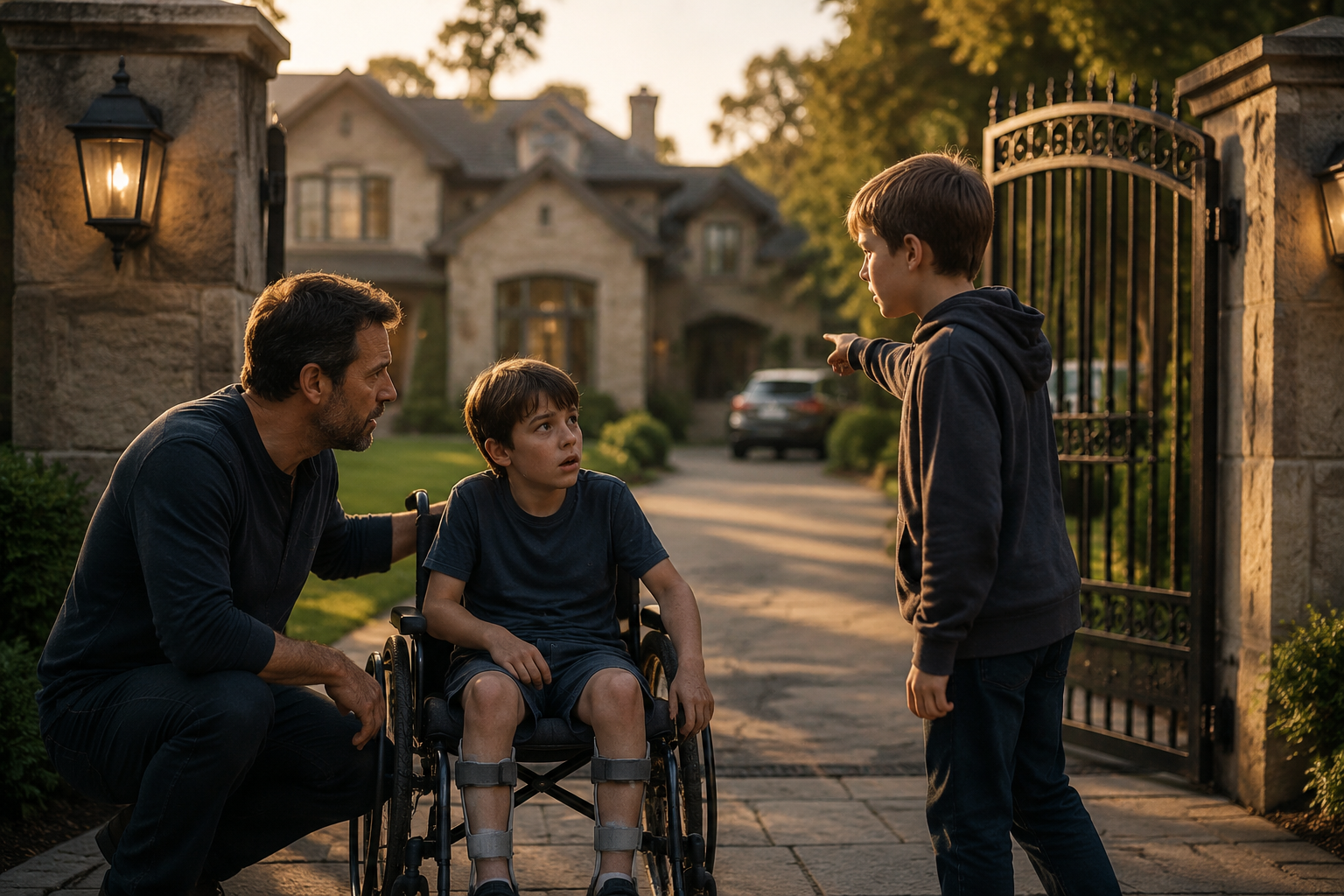
Daniel dropped to his knees beside her. His hands hovered, the way they always did — over her shoulder, over her arm, above her hands — not landing anywhere because there was nowhere to land that would fix this.
"I know," he said. His voice tried to be steady. It almost was. "I know, sweetheart."
She didn't look up. The oak's shadow lay across both of them, and somewhere above the fence line a cluster of starlings exploded into the sky as if startled by something neither of them could see.
That was when the voice came from behind them.
"I can help her."
Calm. Flat. Too certain for a morning this quiet.
Daniel was on his feet before he'd made the decision to stand. He turned. A boy stood near the gate in the chain-link fence — the gate that was always rusted shut, that nobody ever used. He was maybe fifteen, sixteen at most, lean in a gray hoodie that was too large for him, with dark eyes that didn't flicker the way eyes usually did when they were caught staring.
"Stay back." Daniel's voice was short. Protective in the way that bypasses politeness entirely.
The boy didn't step back. He didn't flinch. He looked past Daniel at Mara, and something moved in his expression — something that wasn't quite pity, wasn't quite knowledge, but sat uncomfortably between the two.
"She's not supposed to be like this."
Daniel went still. Because that was the thing — it wasn't the words themselves, it was the certainty behind them. The way someone says the train is late because they checked the schedule. Not a guess. Not a wish. A fact that had been sitting somewhere, waiting to be said.
"What do you mean?" The question came out quieter than Daniel intended.
The boy stepped closer, slow, deliberate, and the gate swung open behind him with a sound like a sigh. He had something in his left hand — a folded piece of paper, worn at the creases, the way paper gets when it's been handled many times in private.
"This wasn't an accident," the boy said.
Mara looked up. Her eyes went to the boy's face and stayed there. Daniel heard her breath change.
"How do you know?" she asked. Her voice was barely loud enough to carry across the yard. But it carried.
The boy held her gaze. "Because I was there."
The name he gave was Marcus Hale. He was sixteen. He lived three blocks north, in a house that backed against the same alley. And for the next four hours, sitting at Daniel Ellison's kitchen table with a glass of water he didn't touch, Marcus Hale took apart the story that Daniel had been living inside for eighteen months — and showed him what the walls were actually made of.
The Morning Everything Became A Question
Eighteen months before that September morning, on a Wednesday in March, Mara Ellison had been struck by a car while crossing the intersection of Deller Street and Route 9 on the east side of Ashford. She'd been walking home from school. It was 3:47 in the afternoon, overcast, dry pavement. The car — a dark blue Volvo — ran the red light. The driver, a man named Glenn Pirie, pulled over immediately, called 911, and remained at the scene. He had a valid license, no prior violations, and was visibly distraught. His insurance company processed the claim within six weeks. The settlement, approved through a mediator in Pittsburgh and signed by Daniel Ellison as Mara's guardian, had been two hundred and forty thousand dollars — drawn from Glenn Pirie's personal liability policy and a secondary umbrella policy attached to his homeowner's coverage.
Daniel had thought it was over. He had not wanted to think about it any longer than necessary. His daughter was alive. She was in a wheelchair, yes, but she was alive, and her mind was intact, and the doctors said the spinal contusion was severe but incomplete — there was sensation, there was some motor function, there was possibility, even if nobody would say that word too loudly. He had signed the documents because the attorney — a man named Richard Goss out of the Goss & Hartwell offices on Merchant Street — had told him it was a fair number, given the circumstances, given the driver's demonstrated remorse, given that extended litigation would consume years of Mara's life. Daniel had believed him. Richard Goss had a framed photograph on his office wall of himself shaking hands with a state senator. His cufflinks were silver and flush-fitted. His firm had represented the Ellison family for three generations, going back to Daniel's grandfather's workman's compensation case in 1974.
Trust, Daniel had learned the hard way, is sometimes just familiarity wearing a better suit.
Marcus Hale sat at the kitchen table and put the folded piece of paper down between them. Daniel unfolded it carefully, the way you handle something you're not sure you want to see.
It was a printout — low resolution, like a screenshot taken in a hurry — of a parking lot camera still frame. The timestamp read 15:44:07 on the date of the accident. It showed a dark blue Volvo. It showed a man standing beside it, outside the driver's door. And it showed a second man — shorter, in a tan jacket — leaning against the passenger side, hands in his pockets.
"The driver didn't run that light by accident," Marcus said. His voice was still flat, still certain, but something underneath it was working hard to stay in control. "Someone told him to. Someone who needed that intersection, that afternoon, that exact moment."
Daniel set the paper down. His hand was steady. Somewhere deeper, nothing was.
"How do you have this?"
"My uncle owns the laundromat on Deller. He had a camera on the parking lot. The police never asked him for it. Nobody asked." Marcus paused. "I only saw it last month. I've been trying to figure out what to do since then."
"Who is the man in the tan jacket?"
Marcus's jaw moved once before he answered. "His name is Warren Ellison," he said. "I looked him up. He's your brother."
The kitchen was very quiet. Outside, a car moved slowly up Crescent Hill. Mara was still in the backyard. Daniel could see her through the window — she'd moved back to the center of the yard, and she was sitting with her face turned up toward the sky in that way she had when she was thinking about something she hadn't yet decided to feel.
Daniel hadn't spoken to his brother Warren in four years.
He picked up the photograph again and looked at the man in the tan jacket for a long time, the way you look at something familiar that has rearranged itself into something monstrous — slowly, against your will, piece by piece.
He recognized the jacket. He recognized the posture. He recognized the particular way Warren Ellison stood with his hands in his pockets, weight shifted slightly left, like a man who always expected to move on quickly.
"Why?" Daniel's voice came out smaller than he intended. Just the one word. Just the weight of it.
"I don't know everything yet," Marcus said. "But I found something else."
He reached into the pocket of his hoodie and produced a second piece of paper. This one was older, heavier stock — the kind used for formal correspondence. It was a letter, dated eleven months before the accident, from a probate attorney's office in Harrisburg. The subject line referenced the estate of one Eleanor Diane Ellison.
Daniel's mother. Who had died, according to the death certificate, of cardiac arrest, six months before Mara's accident.
His mother, who had — according to what Daniel had always been told — left her estate, valued at approximately two hundred thousand dollars in property and savings, equally between her two sons.
The letter referenced a revised will. Filed eight weeks before Eleanor Ellison's death. Leaving the estate, in full, to her younger son, Warren Douglas Ellison.
Daniel had never seen this letter before in his life.
What The Lawyer Knew And Never Said
The offices of Goss & Hartwell occupied the second floor of a narrow brick building on Merchant Street that had once been a dry goods warehouse. The elevator was unreliable, so most people used the stairs. The carpet in the waiting room was burgundy and had been there since approximately 1991. On the day Daniel Ellison climbed those stairs for the second time in his adult life, he carried a manila folder, a phone with the camera application already open, and the specific, controlled quietness of a man who has not slept and has made peace with that fact.
He had spent two days before this visit doing what he was trained to do. Daniel Ellison was a CPA. Not a detective, not a lawyer, not someone accustomed to thinking in terms of fraud and collusion. But he understood documents. He understood how numbers were moved, how paper trails were constructed, and — more importantly — how they were obscured. He pulled his mother's probate records through the county courthouse online portal. He cross-referenced the filing dates. He located the original will, filed in 2014, and the revised will, filed eighteen months later, and he compared the signatures.
His mother's hands had developed a tremor in her final two years. The signature on the 2014 document showed it — a slight unsteadiness in the upward stroke of the capital E. The signature on the revised will was smooth. Controlled. Even.
It wasn't his mother's signature. Or rather, it was a very good imitation of his mother's signature from a decade earlier, before the tremor.
Someone had forged it. Someone who had access to older documents — older checks, older letters — to use as reference. Someone with both the motive and the proximity to pull it off.
Warren Ellison had been living in their mother's house for the final eighteen months of her life. He'd presented it as devotion. He'd called himself the caretaker. Eleanor had told Daniel, in their phone calls, that Warren was "being so good." Daniel, who had been managing a career and a daughter in Philadelphia, had been grateful and slightly guilty about the gratitude.
Now he sat across from Richard Goss, in the office with the framed photograph and the silver cufflinks, and he put the revised will document on the desk between them and asked a simple question.
"Did you know about this before you recommended I accept the settlement?"
Goss didn't answer immediately. He did the thing that experienced men in difficult situations often do — he reached for a pen and moved it from one side of the desk to the other, as if the act of touching something familiar might help him navigate what was happening.
"Daniel—"
"The settlement was two hundred and forty thousand dollars," Daniel said. "My mother's estate, under the original will, was approximately two hundred thousand. Under the revised will, that money went entirely to Warren. If the original will had been properly contested — which would have happened if I'd known about the revision — the estate would have been tied up in probate. Warren needed that not to happen. He needed me focused on something else. Something that would consume my attention, drain my energy, and generate just enough money to keep me from asking questions about what I'd been cut out of."
Goss set the pen down.
"The driver," Daniel continued. "Glenn Pirie. I looked him up properly this time. His mortgage was refinanced fourteen months ago. The lending institution is a subsidiary of Caldwell Property Holdings. Warren Ellison is listed as a managing partner of Caldwell Property Holdings on the Pennsylvania business registry."
The room was very quiet now in a different way than the kitchen had been quiet. This was the quiet of something breaking along a fault line that had been forming for a long time.
"Warren paid Pirie to hit my daughter," Daniel said. "Or at the very least, paid him to be somewhere he shouldn't have been, to create a distraction — a crisis — that would land me in a settlement negotiation while the probate window closed. And you, Richard, knew about the revised will. Because your firm filed it. Your name is on the notary stamp."
Goss opened his mouth. Closed it. His face had done something complicated and irreversible.
"I'm going to need you to call someone," Daniel said. He put his phone on the desk, face up, and pressed the stop button on the voice recorder application. "Or I will."
The Ground Shifts
Warren Ellison was the kind of man who had always been underestimated, which was exactly how he preferred it. Three years younger than Daniel, he had grown up in the specific shadow of an older sibling who did everything correctly — good grades, steady employment, the kind of patient decency that made family gatherings comfortable but boring. Warren had learned early that the best place to operate was just outside the range of scrutiny. Not invisible — invisibility attracts its own curiosity — but simply unremarkable. The middle shelf. The background of photographs.
He had been managing properties in and around Harrisburg for eleven years through a series of small holding companies that were technically separate but operationally linked. None of them were large enough to attract regulatory attention. Collectively, they controlled approximately four million dollars in residential and commercial assets. The revised will, if uncontested, would have added Eleanor Ellison's property — which had appreciated significantly since purchase — to that portfolio. The house alone, by the time of Eleanor's death, was worth slightly over three hundred thousand dollars. Total estate value, properly calculated: closer to three hundred and eighty thousand.
Enough to matter. Enough to plan for.
When Daniel didn't immediately challenge the probate, Warren had assumed the plan was clean. He'd given Daniel the settlement — arranged through Goss, arranged through Pirie — as both a distraction and a kind of payoff. Keep the grieving father financially stable enough not to dig. Keep him emotionally devastated enough not to think clearly. It had very nearly worked.
What Warren hadn't accounted for was a sixteen-year-old boy with access to a parking lot camera and enough conscience to sit at a stranger's kitchen table and say the words out loud.
Daniel spent the three days after his meeting with Goss building the case with the specific, relentless patience of a man who processes financial documents for a living. He worked from the kitchen table, mostly at night, after Mara was asleep. Marcus Hale came by each evening and sat across from him, answering questions, providing what context he had, occasionally just being present in the way that young people sometimes are when they've decided something matters.
The paper trail, once you knew where to look, was not difficult to follow. It never was. Financial crimes leave financial records, and financial records are just numbers in sequence, and Daniel Ellison had spent twenty years teaching himself to read sequences. The mortgage on Glenn Pirie's property. The LLC that held the mortgage. The managing partner of the LLC. The notarized documents from Goss & Hartwell. The date stamps. The payment transfers. A wire of eighteen thousand dollars from a Caldwell Property Holdings account to a personal account in Glenn Pirie's name, made four days before the accident.
He photographed every document. He organized them into a single PDF, timestamped and annotated. He sent copies to three places: a family law attorney in Pittsburgh who specialized in probate fraud, a financial crimes unit at the Pennsylvania Attorney General's office, and — because he was the kind of man who believed in redundancy — a password-protected cloud folder to which only he and his daughter knew the access credentials.
That last detail mattered more than he knew.
Because Warren Ellison, who had been monitoring his brother's digital footprint through a data aggregator he'd been paying for quietly since the day of Eleanor's funeral, noticed the activity. And Warren, who was intelligent and methodical and had spent his adult life being just unremarkable enough to avoid attention, made one decision that transformed him from a man conducting a careful, deniable scheme into a man about to make the single mistake that would define the rest of his life.
He drove to Ashford.
He showed up at the house on Crescent Hill on a Thursday evening, unannounced, with a bottle of wine and a smile that hadn't changed since childhood — slightly sideways, slightly private, the smile of a man who always thought he was the smartest person in the room.
"Daniel," he said, standing in the doorway. "We need to talk."
Mara was in her room. She had been in her room for an hour, and Daniel had told her to stay there, and she had said, with seventeen-year-old certainty, that she would. But she hadn't. She had wheeled herself to the top of the stairs and sat in the hallway, where she could hear everything through the heating vent, the way she'd been doing since she was small.
She heard her uncle walk into the living room. She heard him set the bottle down on the coffee table. She heard him say, in a tone she'd never heard from an adult before — smooth and pressured at the same time, like water just before it finds a crack — "I know what you've been doing. I know you've been pulling records. I know about the folder. And I want you to think very carefully about whether this is a road you want to go down, Daniel. Because I have documentation that puts you at the scene of our mother's death. I have letters — in your handwriting, or close enough — that suggest you were contesting her mental competency in the final months. I have been building this for a long time. I'm not the only one with a backup plan."
Upstairs, Mara Ellison pressed her hand flat against the wall of the hallway and breathed very carefully and did not move.
Her phone was already unlocked. Her thumb was already over the record button.
She had been waiting for this moment since the morning at the gate, when a boy in a gray hoodie had said this wasn't an accident and she had understood, immediately and without explanation, that it was time to stop being afraid of what she might find out.
She pressed record.
The Mask Falls In A Room Full Of Witnesses
The hearing was held in a third-floor conference room of the Harrisburg probate court on a Tuesday in late October, eleven weeks after Marcus Hale had walked through the gate in the chain-link fence. The room had tall windows and a view of the parking structure across the street and fluorescent lighting that made everyone look slightly more tired than they actually were. There were eight people seated at the long table, plus the presiding judge — a compact woman named Honorable Sylvia Crane, who had been on the bench for nineteen years and had the particular stillness of someone who had heard a great deal of lying and was no longer surprised by any of it.
Warren Ellison was seated across from Daniel, with his attorney — not Goss, who had retained his own counsel after the AG's office made initial contact — a man named Parker Krell who wore a very good suit and had the slightly over-rehearsed air of someone who knew he was holding a losing hand.
Glenn Pirie had accepted a cooperation agreement nine days earlier. He had provided a written statement, corroborated by the financial records Daniel had compiled, describing in careful detail the conversation he'd had with Warren Ellison in the parking lot of a Harrisburg hotel in February, fourteen months before Mara's accident. He described the money. He described what he was asked to do. He had been, he wrote, told that the girl would be frightened but not seriously hurt. He had miscalculated his speed. He had lived with that every day since.
Richard Goss had resigned from Goss & Hartwell the week after Daniel left his office with the voice recording. He had, through his own attorney, provided testimony about the revised will, the forged signature, and the coordination with Warren Ellison regarding the settlement terms. He had not been the architect of the fraud. He had been, he insisted, coerced by Warren's knowledge of an unrelated professional indiscretion. It was possible this was true. It did not matter very much to the proceedings either way.
Daniel was seated with the probate attorney from Pittsburgh, a direct woman named Sandra Kim who had been handling cases like this one for sixteen years and had the quality of someone who enjoyed the specific satisfaction of watching constructed deceptions come apart under examination. Beside Daniel was Mara, in her wheelchair, in a dark blue dress she'd asked to wear because, she said, she wanted to look like someone who had thought about what day it was.
The recording Mara had made in the hallway on Crescent Hill was the last piece introduced. Sandra Kim played it through a speaker placed at the center of the table. Warren Ellison's voice was clear and unhurried in the recording — he had not bothered to lower it, because he'd believed he was alone with his brother, because he had a lifetime's habit of underestimating the people in his periphery. You could hear the particular quality of the living room in the audio — the slight echo off the hardwood, the distant sound of a car on Crescent Hill outside — and you could hear Warren laying out, with the patient clarity of a man who'd rehearsed it, exactly what he had and exactly what he intended to do with it.
He had not known he was confessing. He had thought he was negotiating.
When the recording ended, Judge Crane removed her glasses, set them on the table, and looked at Warren Ellison for a moment that lasted long enough to be uncomfortable.
"Mr. Krell," she said, to the attorney in the good suit. "I'd suggest a brief recess."
Warren Ellison was arrested in the hallway outside the conference room forty minutes later, after the recess, after his attorney had a private conversation with the AG's representative that did not go the way Parker Krell had hoped. The charges were fraud, forgery, conspiracy to commit assault, and two counts related to the financial manipulation of the probate proceedings. The bailiff who handled the handcuffing was a large, quiet man who did it with professional efficiency and no drama, which somehow made it more real than drama would have.
Warren said nothing. He looked, for a moment, at Daniel — and whatever he was looking for in his brother's face, he didn't find it.
Daniel didn't look away. He didn't speak. There wasn't anything to say that the room hadn't already said more clearly.
Outside, in the marble corridor with the tall windows and the October light coming in sideways and gold across the floor, Daniel sat down on a bench along the wall and put his hands on his knees and breathed. Mara wheeled up beside him. Neither of them said anything for a while. Down the corridor, people moved with the usual courthouse business — voices, footsteps, the electronic click of a door.
"Are you okay?" Mara asked finally.
"I don't know yet," Daniel said. "Are you?"
She thought about it. "I think I'm something that's not okay yet but is going to be."
He put his arm around her shoulders and she leaned her head against his arm, just briefly, the way she had when she was small and tired and the world was manageable.
Sandra Kim appeared at the end of the corridor and walked toward them with the steady gait of someone who has already moved on to the next thing but wanted to make one stop first. She told them what they already knew — the probate fraud findings would trigger a full review of the revised will, the estate would be properly redistributed, there would be civil proceedings alongside the criminal. Warren Ellison would not be managing properties for a long time. Glenn Pirie's cooperation agreement had provisions attached. Richard Goss's disbarment was already in process.
"The medical review board is going to want access to Mara's records as part of the civil filing," Sandra said. "The theory is that an independent spinal specialist, without the financial constraints of the original settlement, might have a different view of her prognosis and her care options."
Mara looked up at that. "Different how?"
Sandra Kim was not a woman who made promises. But she chose her next words carefully. "There are two facilities in Pittsburgh that have been getting results with incomplete spinal injuries that weren't available eighteen months ago. You haven't had access to them because the settlement figure was never designed to give you access to anything beyond basic maintenance care." She paused. "It was designed to be just enough."
Just enough. Daniel thought about that on the drive back to Ashford — the two of them in the car with the late afternoon light going amber over the Pennsylvania hills and the radio off and Mara looking out the window at something private. Just enough to stop him asking questions. Just enough to keep Mara alive and stable and not thriving. Just enough to protect a real estate portfolio and a forged signature and the specific, ugly comfort of a man who believed his family would always find him unremarkable enough to trust.
Marcus Hale was sitting on the front step of the house on Crescent Hill when they pulled into the driveway. He had his backpack, and he'd left a paper bag from the deli two blocks over on the step beside him — sandwiches, chips, two bottles of water. He stood up when the car pulled in, and he put his hands in the pocket of the gray hoodie — a different one this time, but the same color, the same oversized fit — and waited.
"Well?" he said.
"Well," Daniel said.
Mara wheeled herself up the path, past Marcus, and stopped at the front door and looked back at both of them.
"Are you staying for dinner?" she asked Marcus. It was the same tone she used for factual questions, not polite ones.
Marcus looked at Daniel. Daniel nodded once.
"Yeah," Marcus said. "Okay."
Inside, while Daniel put the kettle on and Marcus arranged the sandwiches on the kitchen table, Mara reached into her bag and produced the folded photograph she'd asked Daniel to let her carry — the parking lot still frame that Marcus's uncle's camera had captured, that low-resolution image of a dark blue Volvo and two men and a timestamp and the forty-six seconds before everything in their lives became something that required surviving.
She put it on the corner of the table, face down, and set a coffee cup on top of it. Not to hide it. Just to put it somewhere it didn't have to be the center of things anymore.
Outside, the September light had gone completely now, and the yard was dark, and the old oak at the far end stood in silhouette against the sky the way it always had. Somewhere in the alley beyond the chain-link fence, something ordinary was happening — a neighbor, a car, a door closing on a house where no one was carrying a secret that had cost a child the use of her legs.
Mara looked at the door to the yard for a long moment. Then she turned back to the table, where a boy in a gray hoodie was dividing chips into three equal portions with the focused concentration of someone who believed that small fair things mattered, and her father was making tea with his back to both of them and his shoulders, finally, not quite so high.
"Pass me one of those," she said, and Marcus did, and the evening settled around them like something that had been waiting, for a long time, to be allowed to be quiet.