
"Dad, I Can't Feel My Legs." When A Strange Boy At The Gate Said "This Wasn't An Accident," A Father Uncovered A $2 Million Secret Someone Had Buried For Years.
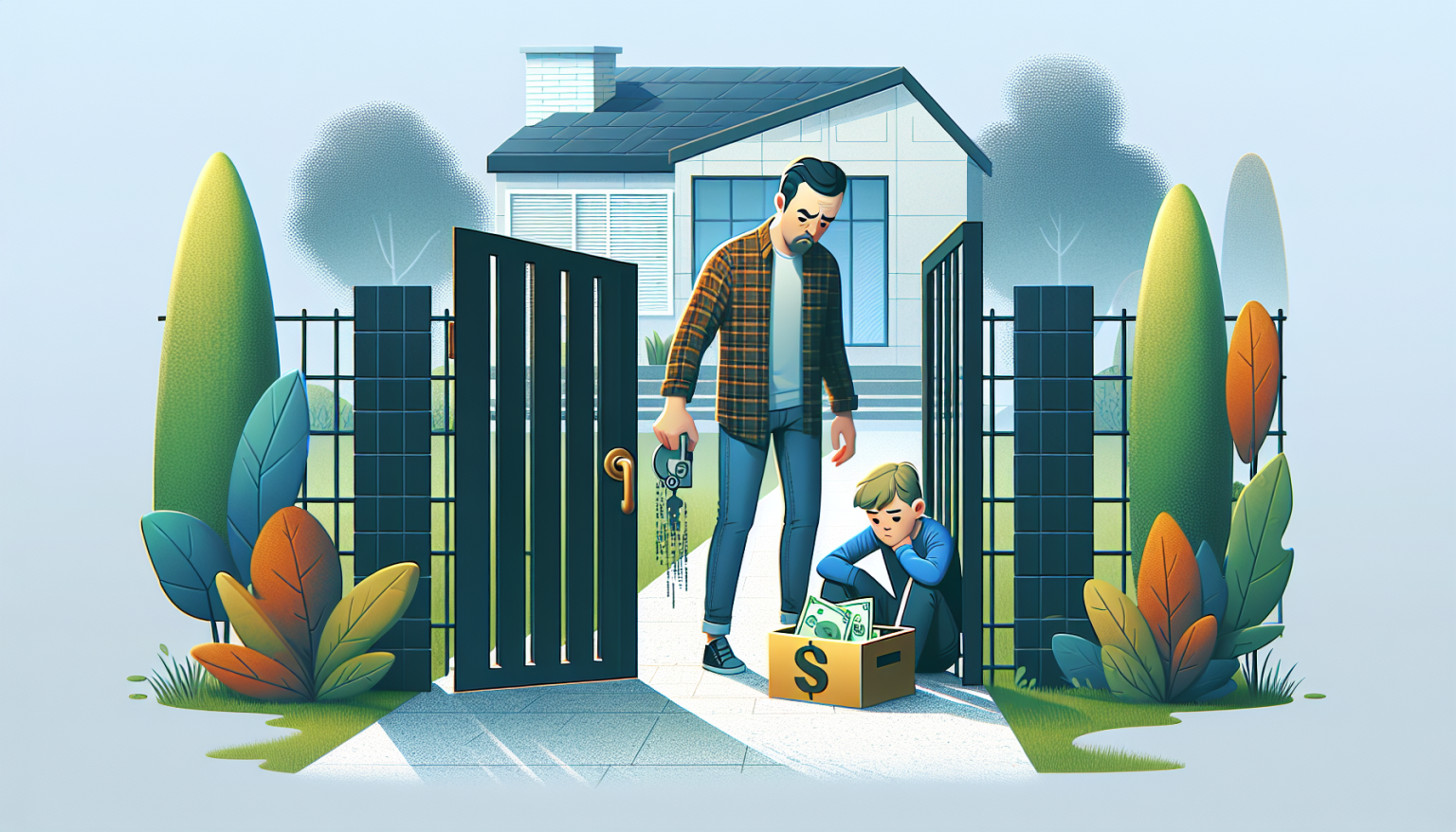
The morning had been quiet the way October mornings in Clover Hill, Virginia are supposed to be quiet — gold light through maple trees, the distant sound of a lawnmower three streets over, dew still clinging to the iron gate at the edge of the Mercer property.
Marcus Mercer had been pushing his daughter's wheelchair along the garden path they walked every Saturday — the same cracked slate path, the same turn past the hydrangeas, the same pause at the birdbath where Lily liked to watch the sparrows argue over water. Fourteen years old, and she still loved that birdbath the way she had at seven.
He had his coffee in one hand and his phone in his pocket and a Saturday stretching open before them, and for a moment — just one — he let himself believe the day would stay ordinary.
Then she said it.
"Dad — I can't feel my legs."
Not a new complaint. Not even a surprising one, medically speaking. Lily had been in the wheelchair for two years, ever since the accident on Route 9 that the doctors at Fairfax General had called a tragic alignment of speed and wet pavement and bad luck. Paralysis from the waist down, they said. Permanent, they said, quietly and with such professional certainty that Marcus had stopped asking second questions somewhere around the fourth follow-up appointment.
But the way she said it this morning was different.
Her voice cracked at the wrong place. Not the soft, matter-of-fact observation she usually made when she meant the numbness was especially heavy today. This was higher. Closer to panic. Her hands gripped the armrests of the chair and her knuckles went white and her eyes dropped to her lap as if looking down hard enough might force some signal through.
Birds scattered from the maple above them.
The silence that followed had weight to it.
Marcus dropped to his knees on the cold slate, coffee abandoned, phone forgotten. His hands hovered above her — above her knees, her hands, her face — the helpless, frantic choreography of a parent who cannot locate the thing he needs to fix.
"I know," he said, which was not what he meant. He meant: I'm here. He meant: don't be afraid. He meant: I would take it from you right now if there was any way at all. "I know, I know, I'm right here —"
"Dad." Her voice steadied, just slightly. She was looking past his shoulder.
He turned.
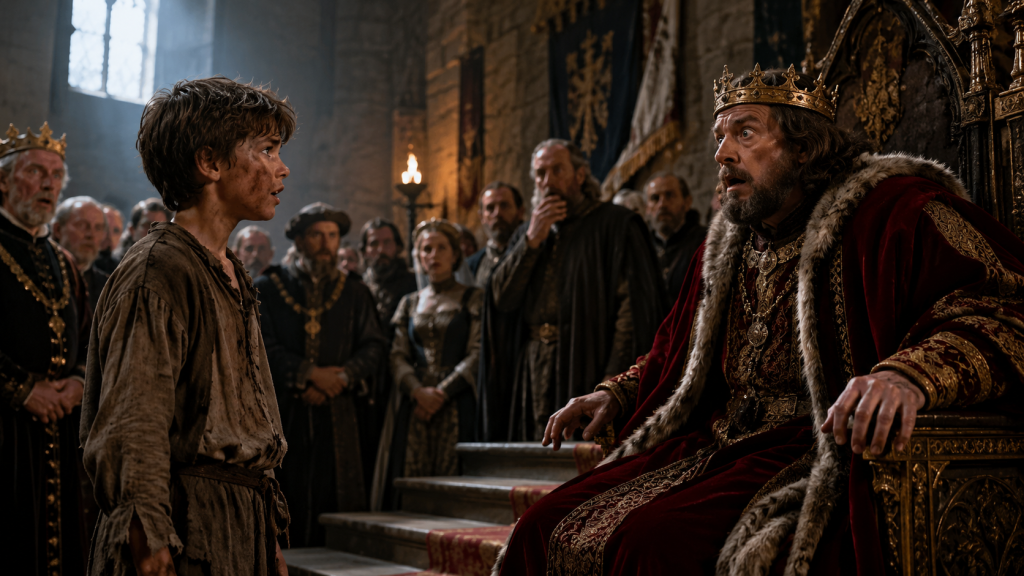
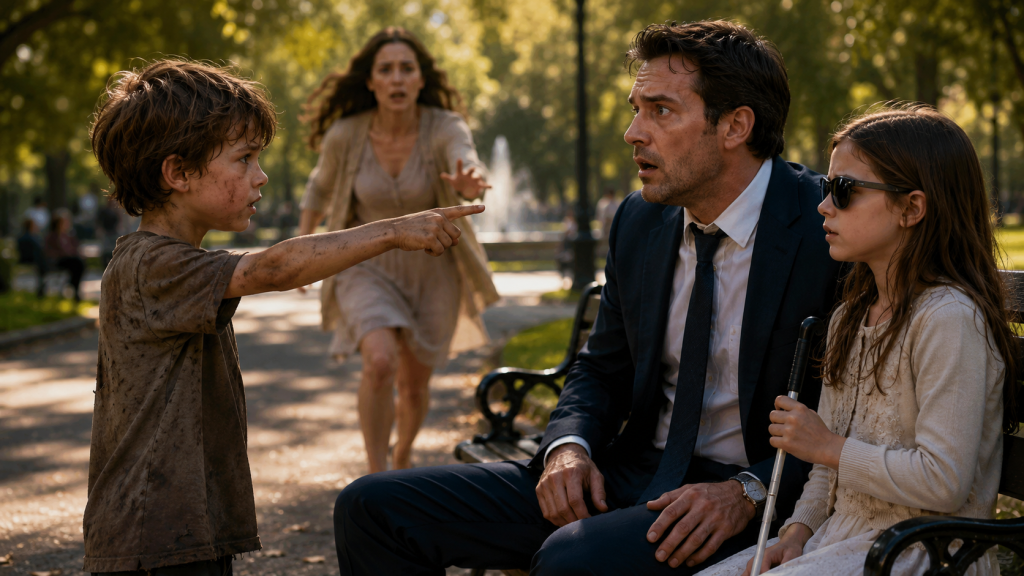
A boy stood near the gate. Twelve, maybe thirteen, in a gray hoodie and muddy sneakers, a dark green backpack hanging off one shoulder. He was not from the neighborhood — Marcus knew every kid on Clover Hill Drive and this was not one of them. He stood with his hands at his sides and his chin slightly raised, watching them with a stillness that did not belong on a child's face.
"I can help her," the boy said.
The calm in his voice was the wrong kind of calm. Not kind. Not nervous. Certain, the way a person is certain about something they have been carrying a long time.
"Stay back." Marcus rose to his feet, and the protective edge in his voice was absolute.
The boy did not move. Did not blink. "She's not supposed to be like this."
Five words. Simple syntax. And yet they landed in Marcus's chest like something thrown from a height.
Not I'm sorry she's like this. Not the sympathetic stumble of a kid who didn't know what to say. This was declarative. This was someone stating a fact they had known before this morning.
"What do you mean?" Marcus took one step forward, and his voice was no longer protective — it was something else entirely. Something frightened.
The boy took one step closer. Slow. Deliberate. Unafraid of the man twice his size now moving toward him.
"This wasn't an accident."
Everything stopped — the lawnmower three streets over, the sparrows, the light itself. Lily's hands released the armrests. She stared at the boy.
"How do you know?" she whispered.
He met her eyes. Steady. Unshaken.
"Because I was there."
Marcus's hand shot out and caught the iron gate post for balance he didn't know he needed. His daughter was staring at a boy neither of them had ever seen, and this boy was claiming to have been present at the accident that had taken Lily's ability to walk, and he was saying it the way you say a thing you have rehearsed — carefully, with the knowledge of what comes next.
The boy lifted his hand, slowly, and began to point toward the far end of the street — toward something, toward someone — and his mouth opened —
And a black SUV turned the corner at the end of the block, moving too fast for a residential street, and the boy's face changed for the first time. Not calm anymore. Scared.
He dropped his hand, pulled his backpack tight, and said three more words before he ran.
"Find the tablet."
Act 1 — The Boy Who Should Not Have Known
Marcus stood at the gate long after the boy had disappeared around the corner of Beech Street, long enough for the black SUV to slow, creep past, and continue on as if it had never been hunting anything at all. His hand stayed on the iron post. The metal was cold through his palm. He noted that the way you note something that helps you stay in your body when your mind has started coming apart.
Lily said nothing. She was looking at the place where the boy had been, her expression doing something complicated that Marcus recognized — she was assembling pieces, the way she always had, quietly and with more precision than anyone gave her credit for. She'd been doing that since she was four years old. Before the wheelchair, before Route 9, before two years of his life rearranged entirely around physical therapy appointments and insurance appeals and the specific grief of watching your child accept something as permanent that you refused to accept yourself.
"Dad." She said it softly. "He knew about the accident."
"He didn't know anything." The words came out automatically — the parental reflex to contain alarm. But they tasted wrong the moment he said them, and Lily's expression told him she'd noticed.
"He said he was there." She turned the chair to face him. "Someone who was twelve years old two years ago. Who was ten. Who was at an accident scene on Route 9 at six-fifteen in the morning in October, in the rain, and remembered it well enough to come find us." She paused. "That's not nothing."
No. It was not nothing.
Marcus came inside and poured his cold coffee down the drain and stood at the kitchen sink looking at the backyard for a long time. He knew what the official record of the accident said. He had read it enough times to have pieces of it memorized, the way you memorize things you can't stop returning to. Lily had been in the back seat of his sister Renata's car. Renata had been driving. A delivery truck had drifted into the oncoming lane on the wet two-lane stretch of Route 9 heading out of Middleburg. The truck clipped the rear driver's side. The car had spun, hit the guardrail, and rolled down a twenty-foot embankment. Renata had walked away with a broken collarbone and a laceration above her left eye. Lily had not walked away at all, and would not walk again — or so every physician who reviewed the scans had confirmed.
Renata. His younger sister. Who had cried at every single one of Lily's follow-up appointments she attended, and who had paid for six months of in-home physical therapy out of her own pocket, and who had told Marcus twice — once at Thanksgiving, once in June — that the guilt of surviving without consequence while Lily suffered was something she would carry forever.
He had believed her. Had believed every word. Because Renata was family, and because the alternative had never seemed worth the cruelty of considering.
He pulled out his phone and scrolled to the accident report he'd saved in his files — the one from the Virginia State Police, filed forty-one days after the collision. He had read it so many times the document had become visual wallpaper. But now he forced himself to read it differently. Slowly. Looking for a ten-year-old boy in gray sneakers at the side of the road at six-fifteen in the morning in October rain.
There were two witness statements attached to the report. He'd read them before. An elderly man named Gerald Foote who lived at the Route 9 address nearest the embankment, who had called 911 and described hearing the impact from inside his house. A woman named Carol Denny who had been driving in the opposite direction and pulled over after the car went off the road.
No third witness. No child. No mention of anyone else at the scene before emergency services arrived.
But Gerald Foote. Marcus stared at the name for a moment. He had never followed up. He had never had a reason to. Gerald Foote had called 911. That was the beginning and end of his relevance in the official story.
Marcus looked up Gerald Foote's address — still on file in the report — and wrote it on the back of a grocery receipt he found on the counter. Then he folded the receipt and put it in his front pocket.
He found Lily in the hallway, already with her jacket on.
"I want to come," she said, before he said anything.
He looked at his daughter — at the set of her jaw, the same jaw she'd had at four years old when she'd decided something was happening and she was part of it — and he did not argue.
They drove out to Route 9 in silence. The fall trees were doing their full performance, orange and red all the way out of Clover Hill and into the open country stretches toward Middleburg. Marcus watched the road. Lily watched the treeline.
Gerald Foote's house was a white clapboard place set back from the road, a vegetable garden mostly done for the season, a satellite dish on the roof, a truck in the driveway with a bumper sticker that said Korean War Veteran. Marcus knocked.
The man who answered was eighty-something, built like he'd once been formidable and still remembered it. He looked at Marcus, then at Lily in the wheelchair behind him, and something shifted in his face — not surprise. Recognition.
"I figured someone would come eventually," Gerald Foote said.
He stepped back and held the door open.
Inside, on his kitchen table, he poured two cups of coffee without asking and sat down heavily and said: "There was a third vehicle. Before the truck came around that bend." His voice was the kind of flat that old soldiers use when they want to say something difficult without flinching. "A dark blue sedan. It came up behind your sister's car maybe forty seconds before impact. It was close. Too close for that road in that rain. And then it backed off, and then the truck came, and then —" He stopped. Set his cup down. "I didn't put it in my statement because the trooper who took it seemed already to have the picture in his head before I finished talking. He steered me toward the truck. The skid marks. The rain. He was polite about it. But he steered."
Marcus felt the receipt in his front pocket like it had developed heat.
"Did you see the sedan's plates?"
Foote reached into his shirt pocket and placed a folded piece of paper on the table. "I wrote them down the same day. Kept waiting for someone to ask."
Marcus unfolded the paper. Virginia plates. Seven characters. And below them, in Gerald Foote's careful retired-soldier handwriting: dark blue Volvo, 2019 or 2020, female driver, passenger side child visible in rear — approximately 10 years old, male.
A ten-year-old boy in the back seat of a dark blue Volvo, at the scene of the accident that had taken his daughter's legs.
That boy had come to find them this morning.
Marcus drove home with one hand on the wheel and the other pressed flat against the paper on his thigh, and the thing he couldn't stop thinking about was the last thing the boy had said before he ran.
Find the tablet.
Act 2 — What Was In The Green Backpack
Marcus spent Sunday morning running the plate through every channel available to a man who was not law enforcement and had no official standing but had spent eighteen years as a commercial real estate attorney and knew how to find things that existed in public records if you knew where to look.
The plate came back registered to a 2019 Volvo XC60, dark blue, owner: Renata Claire Mercer, 44 Holloway Court, Falls Church, Virginia.
He read it three times.
His sister's car had been present at his daughter's accident before his daughter's accident.
He set the laptop on the kitchen counter and walked to the window and stood there for a long time watching the birdbath in the backyard where the sparrows were fighting over the last of the Saturday morning water, and he thought about Renata's face at the accident scene — he had arrived twenty minutes after the ambulance, and she'd been wrapped in a mylar blanket by the guardrail, and the first thing she'd said to him was I'm so sorry, Marcus, I don't know what happened, it came from nowhere — and he had held his sister while his daughter was being airlifted to Fairfax General and he had not, not once in two years, asked Renata a single hard question about the thirty seconds before that truck appeared.
He closed the laptop.
He needed to think about this in order. Methodically. Like a case. Not like a brother.
Lily found him in the kitchen at noon. She'd been on her computer all morning, and she had the look she got when she'd located something — a thread that went somewhere.
"I ran the boy," she said.
"You — what do you mean you ran the boy?"
"I posted on three different local Facebook groups saying I'd found a green backpack near the gate on Clover Hill Drive and asking if anyone had lost one. I put in enough detail that the right person would recognize it." She set her tablet on the counter and turned it to face him. "Forty-five minutes ago, someone responded. His name is Devon. He's twelve. His mother is named Patricia Hale." She paused. "Patricia Hale used to work for Renata."
The kitchen was very quiet.
"When?"
"Until about eight months after the accident. She was Renata's personal assistant for six years. She resigned. No reason stated publicly." Lily's voice was steady, and Marcus recognized the effort it took. "Devon would have been ten years old when the accident happened."
"He was in Renata's car."
"He was in Renata's car."
They sat with that for a moment.
"What does she want?" Marcus asked. "Patricia Hale. What does she want by sending her son to our gate?"
"I don't think she sent him," Lily said quietly. "I think he came on his own. I think he's been carrying something for two years and decided to do something about it." She looked at her father. "He said find the tablet, Dad. I don't think he meant my tablet. I think he meant one that exists somewhere in Renata's world."
Marcus pulled out his phone. He did not call Renata. Instead, he called his own office, and left a message for his paralegal, a methodical woman named Dana Ortiz who had been with him for eleven years and who he trusted more than most people he'd known twice as long. He asked her to pull anything publicly filed in the last three years connected to Renata Mercer — corporate filings, property transfers, anything.
Dana called back in an hour and forty minutes.
Renata had filed paperwork eighteen months ago incorporating a private holding company: Clover Capital LLC. Registered in Delaware. Single member. The stated asset base at time of filing listed a property in McLean valued at $1.4 million and investment holdings of approximately $600,000.
Two million dollars.
And the date of the LLC's formation was eleven months after the accident. Eleven months after Lily had been placed in a wheelchair permanently. Eleven months after the insurance settlement from the delivery truck company had been paid out — not to Marcus, not to Lily, but to Renata as the driver of record, on the grounds that she had suffered physical and emotional damages in the collision.
Marcus sat at his desk and pulled up the settlement documentation he'd signed two years ago, the one his sister had brought to him at the hospital while Lily was still in a halo brace, the one he had signed because Renata had said the attorney said they needed a unified filing and it would be faster and better for everyone, and he'd trusted her because she was his sister and she'd seemed as broken as he was and it had never occurred to him to read the fine print about disbursement.
Lily had been the primary injured party. Lily's settlement should have gone into a protected medical fund for her ongoing care. Instead, somewhere in those documents, Renata had been designated as financial custodian of Lily's portion until Lily turned eighteen, on the grounds that Marcus had been deemed temporarily incapacitated by grief during the initial filing period.
He had signed that document. He had not read that clause. He did not remember agreeing to it.
He found the signature page and looked at his name. The letters were right. The pen pressure was right.
But something was wrong with the date beside the signature.
The date was three days before Marcus had been released from the sedatives they'd given him at the hospital when he'd collapsed in the waiting room the second night. He had been medicated and documented as non-responsive for seventy-two hours. He could not have signed anything on that date. He had not been conscious on that date.
Someone had signed for him.
He photographed the page. He photographed all forty-two pages. He emailed them to Dana with a single line: I need a forensic documents examiner who handles fraud cases and can start this week.
Then he sat very still and thought about his sister — and about a boy in a gray hoodie who had carried two years of something he'd seen from a back seat into a stranger's garden gate — and about a tablet somewhere in Renata's world that someone wanted him to find.
His phone buzzed. A text from an unknown number.
She keeps it in the office at Holloway Court. Second drawer. She doesn't know I know. — D
Devon Hale was twelve years old and smarter than everyone who had failed to look at this for two years.
Act 3 — What The Tablet Remembered
Marcus did not go to Renata's house. Not yet. He was a lawyer, and he understood better than most people the difference between evidence gathered correctly and evidence that gets thrown out on a technicality, and the last thing he could afford was to give Renata any legal handhold to grab when this came apart.
Instead, he called Patricia Hale.
She answered on the second ring, and the first thing she said was: "Devon texted me. I know he came to your house. I'm sorry — he's been asking me since last year when we were going to do something, and I kept saying I needed to be sure, and I think he got tired of waiting."
"What did he see?" Marcus asked.
Patricia Hale was quiet for a moment. When she spoke again, her voice was very controlled — the voice of someone who has rehearsed this conversation enough times that the emotion has been pressed down to a hard, still center.
"I drove Renata most mornings," she said. "She didn't like to drive when she was working on her phone. Two days before the accident, I was helping her organize her files — she had a Samsung tablet she used for everything, contracts, personal documents, calendar — and I saw an open note. She closed the screen when she noticed me, but not before I'd read the top line." She paused. "It said: Route 9, Middleburg stretch, 6:15 a.m., D. Karo — confirm pass."
Marcus wrote down every word.
"D. Karo," he repeated.
"Dmitri Karo. He drove a truck for a regional freight company. I found him after the accident, before I resigned. I think — I'm almost certain — that Renata paid him to be on that road at that time. To drift into the lane. To cause an impact." Patricia's voice tightened. "I didn't know what the target was going to be. I thought maybe she was trying to hit the truck driver for something personal. I had no idea she was going to be in the car."
"She was in the car with my daughter." Marcus heard his own voice from a distance. "She engineered it. She put herself in it."
"Because she needed to be an injured party to control the settlement." Patricia's answer came immediately — she had clearly worked this through. "If the accident happened without her in the car, you would have been the one talking to the insurance attorneys. You would have read the documents. She needed to be present and injured and sympathetic and available to manage the paperwork while you were falling apart."
He thought about Renata wrapped in the mylar blanket. Her broken collarbone. The performance of it.
He thought about his daughter being airlifted.
"She knew Lily was going to be paralyzed?" His voice had gone very flat.
"I don't know if she knew the extent. I don't know if she calculated that specifically. But she needed Lily injured badly enough that you'd be incapacitated by it, and she needed control of the settlement before you recovered." Patricia paused. "The truck driver, Karo — I found out six months ago that he died. Car accident. Eighteen months after your daughter's accident. Single vehicle, icy road, rural highway. The case was closed as accidental."
Marcus put the phone down for a second. He pressed both hands flat on the desk and breathed.
He picked it back up. "The tablet. Devon said second drawer."
"She still has it. She carries it between the office and the house. I saw it three weeks ago when I ran into her at the Whole Foods on Chain Bridge — she had it in her bag, I recognized the case." A pause. "Devon saw her use it to open something that looked like encrypted notes the day before your daughter's accident. He was in the back seat. He's twelve now. He was ten then. But he's always had a very precise memory for things he's seen. He remembered the screen."
Marcus needed the tablet. He needed it legally. He needed it in a way that would stand up when this went to a prosecutor's desk.
He spent Monday making calls. He reached out to a former client, a private investigative firm in Alexandria that had worked financial fraud cases for him before, a man named Carl Weston who was licensed, careful, and understood the difference between aggressive and illegal. He briefed Carl on what he had — the forged signature, the LLC timeline, the plate records, Foote's account of the third vehicle, Patricia Hale's statement.
Carl listened without interrupting. When Marcus finished, Carl said: "I can get a civil investigator on the financial trail and we can build toward a subpoena for the device. But that takes time. Weeks, maybe months." He paused. "Unless she uses it somewhere it becomes accessible through a third party. A cloud account. A shared filing system. Does she have any business accounts connected to your family? Any joint filing? Any shared medical portal?"
Marcus thought. And then he remembered something he hadn't thought about in more than a year. Lily's medical portal at Fairfax General — the one that tracked her ongoing neurological assessments and physical therapy records. Marcus was the primary account holder. But at some point in the first frantic months, he had added Renata as a secondary authorized party so she could coordinate appointments on days he was working. He had never removed her. He had never had a reason to.
And the portal required a linked device to be registered on the account. Any linked device could be audited if there was cause to suspect misuse of a minor's medical records.
Renata's tablet was registered on his daughter's medical account.
Carl Weston said quietly: "That's your door."
Marcus filed a complaint Monday afternoon with Fairfax General's patient privacy office, citing concern about unauthorized access to his minor daughter's medical records by a previously authorized party who he now had reason to believe had a conflict of interest. He requested a full audit of all device access on the account and the immediate removal of secondary access.
The privacy office told him the audit would take five to seven business days.
On the evening of the third day, Dana Ortiz called him back with the forensic documents examiner's preliminary assessment: the signature on the settlement disbursement authorization was not Marcus's. The ink composition and pen pressure patterns were consistent with someone else mimicking his signature under good lighting with reference material available. The date beside the signature was applied after the document was otherwise complete — a different ink batch, identified through spectroscopic analysis.
Forgery. Two counts, minimum. On a document controlling nearly a million dollars of his daughter's settlement funds.
And then, on the fifth day, the hospital privacy audit came back.
Renata's tablet had accessed Lily's medical files forty-seven times over the past two years. Standard, on its face. But eleven of those accesses had come from a location that was not Renata's house and not Fairfax General. The IP address traced to an office building in McLean — the same address as Clover Capital LLC.
And one of those accesses, fourteen months ago, had included a file upload. Someone had added a document to Lily's record that had not been generated by any Fairfax General physician. A document that, when Marcus finally saw it, described a neurological assessment conducted by a Dr. Robert Fenn at a private clinic — an assessment that concluded Lily's paralysis was permanent, irreversible, and not eligible for any further surgical intervention.
Dr. Robert Fenn did not appear in any Virginia medical licensing database.
The assessment had been added to Lily's file to support an insurance extension application — one that had generated an additional payout of $340,000 to Clover Capital LLC for long-term care management.
Three hundred and forty thousand dollars, paid out because of a fake doctor's assessment that lived in his daughter's medical record.
And below the fake assessment, buried in the uploaded file, was a single line Marcus almost missed — a calendar note that had been left in the document's metadata when it was uploaded from the tablet.
It said: Route 9, Middleburg stretch, 6:15 a.m., D. Karo — confirm pass.
The same note Patricia Hale had seen two days before the accident. It had lived in the tablet. Renata had uploaded the wrong file — or had not known the metadata traveled with it. One mistake, in two years of meticulous control.
Marcus printed it. He printed everything. He put it all in a manila folder and drove to the U.S. Attorney's office in Alexandria the next morning and asked for a referral to the financial crimes unit, and he sat down, and he opened the folder on the desk, and he started from the beginning.
Act 4 — The Counterattack
Renata found out on a Thursday.
Marcus didn't know how — later, he would learn that she had a contact inside Fairfax General's administrative office, a former colleague who owed her a favor and had flagged the privacy audit request the same day Marcus filed it. She'd had almost a week to prepare, and she had used it.
The call from his family law attorney came at 7:48 a.m. on a Thursday. "Marcus, I have to tell you something before you hear it from anyone else. Renata has filed an emergency petition in Fairfax County Circuit Court. She's claiming that you are psychologically unfit to serve as Lily's sole guardian and that your recent erratic behavior — specifically, your quote, 'harassment' of a federal building employee, contacts with Renata's former staff, and your failure to maintain Lily's medical appointments in the last quarter — constitutes cause for the court to appoint a temporary co-guardian until a full fitness evaluation can be completed."
The missed medical appointments. Marcus had rescheduled two in the last six weeks because of work commitments. He'd rescheduled them, not cancelled — but on paper, to someone reading a medical calendar, they appeared as gaps.
"She's going for guardianship." He said it flatly.
"She's going for co-guardianship temporarily, which as a petition goes, is harder to fight fast. The hearing is set for next Wednesday. Marcus, if she can establish cause and get a temporary order —"
"She controls Lily's medical decisions." He heard his voice go very quiet. "And she controls access to Lily's medical record. And if anyone looks at what's been uploaded to that record, the first person with access is —"
"You," his attorney said. "Because you're the primary account holder. She will argue you planted the fake assessment. That you are the one who fraudulently altered the documents."
It was elegant, in the way that a trap designed by someone smart and patient is elegant. She had spent two years building a structure where every piece of compromising evidence touched Marcus's name first. He was the primary account holder. He had signed the disbursement documents — or so the forgery claimed. He was the one who had accessed the U.S. Attorney's office, which she would frame as a desperate act by a man trying to preemptively deflect blame.
And if she gained even temporary co-guardianship, she would petition to have Lily's medical record sealed pending investigation, which would bury the metadata note, the fake assessment, and the timeline Marcus had built — potentially for months while attorneys argued jurisdiction.
Marcus sat at his kitchen table that Thursday morning with the phone in his hand and the manila folder open in front of him and the birdbath visible through the window and one thought moving through everything else like a current: there was one thing she had overlooked. One thing she could not have accounted for.
She didn't know about Gerald Foote's piece of paper.
She didn't know that a retired Korean War veteran had written down her license plate in his careful soldier's handwriting and kept it in his shirt pocket for two years waiting for someone to ask. She didn't know that the physical paper existed outside any digital system she could access or alter. She didn't know that Gerald Foote was prepared to testify to what he saw, because Marcus had called him two days ago and asked directly, and the old man had said: "Son, I've been ready to say it out loud since the morning it happened. Just tell me where to go."
And she didn't know that Devon Hale — twelve years old, with a precise memory and a gray hoodie and the moral clarity that sometimes only a child still carries — had texted Marcus two days ago with one more piece of information. His mother's tablet. Not Renata's tablet — Patricia Hale's personal device, on which, six years ago, Patricia had photographed a screen during one of the document sessions she'd helped Renata organize. Not knowing what it meant at the time. Keeping it in a photo archive that she hadn't touched since.
A photograph of Renata's notes. The Route 9 notation. The time. The name D. Karo. And below it, in Renata's own handwriting because she'd been annotating a printed document on camera: R9 — incapacitate, not fatal. Lily enough to hold M 6+ months. Payout to RC LLC per schedule.
Incapacitate, not fatal.
Lily, enough to hold M — Marcus — for six months.
Renata had planned it with the precision of a project timeline. Her own niece. She had decided how injured was useful and how injured was too far, and she had hired a truck driver to execute the calculation.
Patricia Hale had screenshot the photograph to a cloud backup account that had nothing to do with Renata's world. It had lived there for six years, undisturbed, waiting.
Marcus called Carl Weston at eight in the morning on the Thursday the petition was filed. He told Carl he needed the photo preserved, authenticated, and in the hands of the U.S. Attorney's financial crimes unit before the end of the business day.
Then he called Dana Ortiz and told her to pull every public record connected to Dmitri Karo — the truck driver who had died on an icy road eighteen months after the accident — because he needed to know who had owned the road that night, and he needed it in time for a Wednesday court hearing.
Dana found it in four hours. Karo's estate file. A payment of $85,000 deposited into his account thirty days before the accident, originating from a shell company that, when traced back through two layers of Delaware filings, connected to an account held by Clover Capital LLC.
Eighty-five thousand dollars paid to a truck driver. Clover Capital LLC formed with an initial asset base of $600,000. A $340,000 follow-up insurance payout. And a signature that wasn't Marcus's, on a document that had redirected nearly a million dollars of his daughter's settlement into his sister's control.
The financial crimes unit called Marcus back at four-thirty Thursday afternoon. They had reviewed everything he'd submitted. They were issuing a preservation subpoena for all devices associated with Clover Capital LLC's registered accounts, effective immediately. They were also requesting an emergency delay of the Wednesday guardianship hearing on grounds of active federal investigation.
The Fairfax County Circuit Court granted the delay Friday morning.
Marcus sat in his car in the courthouse parking lot after getting the notification, and he put his head against the steering wheel, and for the first time in two years he let the thing he'd been holding shut finally open, just for a moment, in private, in the car, before he drove home to his daughter.
Act 5 — The Unmasking, and After
The federal arrest came on a Tuesday morning in November, six weeks after the guardianship petition was filed and four weeks after Renata's attorneys had stopped returning calls from the U.S. Attorney's office.
Marcus was not there when it happened. He learned about it the way most people learn about things these days — from his phone, a news alert from the Fairfax County news site: Falls Church woman arrested on charges of wire fraud, document forgery, and conspiracy to commit assault in connection with 2021 Middleburg traffic collision that left minor child paralyzed.
He set the phone face-down on the kitchen counter.
Lily was in the living room. She'd heard the alert too — the same notification, different phone, and when he came through the doorway she was already looking at him with the complicated expression she'd had in the garden the morning Devon appeared at the gate, except that now the assembling was done, all the pieces were in their places, and what was left on her face was something quieter and harder to name.
"Okay," she said.
Just that one word. He sat on the couch beside her chair and they didn't speak for a few minutes. Outside, a neighbor was raking leaves. The birdbath was empty — too cold now for sparrows.
Three weeks later, Marcus sat in a federal courthouse in Alexandria and watched Renata Mercer plead not guilty to six counts including wire fraud, forgery of a legal document, and conspiracy to commit assault causing serious bodily injury. Her attorney was expensive and calm. Renata, when she turned briefly in the direction of the gallery, was wearing a gray blazer and her hair was precise and she looked like what she had always looked like to the world — composed, competent, unimpeachable.
She did not look at Marcus.
She did not look at the section of the gallery where Patricia Hale sat with Devon beside her, the boy in a clean collared shirt, his hands folded in his lap, watching the proceedings with the careful attention of someone who had been waiting a long time for this room.
The trial took eleven days. The prosecution's case was meticulous — the forensic signature analysis, the IP audit from Fairfax General's records, the metadata note, Patricia Hale's photograph, Gerald Foote's handwritten license plate notation, the Karo payment trail, the Clover Capital LLC timeline. Each piece was introduced in sequence, building the architecture of what Renata had done: a controlled collision, a forged signature on a sedated man, a fake physician's report, eighteen months of redirected funds, and a truck driver who had died on an icy road before he could be asked anything.
The defense argued the evidence was circumstantial and digitally manipulated. They called a single expert witness who questioned the forensic signature methodology and was cross-examined for two hours and left the stand having conceded every meaningful point.
On the tenth day of testimony, a federal agent named Reyes played an audio recording for the court. It had been recovered from a cloud backup associated with Renata's tablet — the same backup the preservation subpoena had captured before she could revoke the sync. The recording was a voice memo, dated four days before the accident, in Renata's voice: a phone call, one side of it, in which she confirmed a time and a road with someone whose number the FBI had matched to Dmitri Karo's carrier records.
The courtroom was very quiet while the recording played.
Renata's attorney requested a recess. It was denied.
The jury deliberated for seven hours. They returned a guilty verdict on five of the six counts. The conspiracy to commit assault count — the one that connected her directly to Lily's paralysis — carried the longest sentence. The judge, at sentencing two months later, gave Renata eleven years and ordered the liquidation of Clover Capital LLC's assets to fund a restitution account in Lily's name, totaling $1.97 million, to be administered for her ongoing medical care and any future treatment options that emerged.
After the sentencing, Marcus walked to the parking garage with Lily beside him, the wheelchair humming on the concrete, leaves skittering across the ground in the November wind. He didn't talk for the first half of the walk. Neither did she.
Then Lily said: "I want to see that new spinal specialist. The one in Pittsburgh that Dr. Yuen mentioned."
Marcus looked at her. Her chin was up. Her jaw was set. She was fourteen and she was serious.
"We have an appointment in three weeks," he said. He had made it the day after sentencing was scheduled.
She looked at him. "You already called."
"I already called."
She made a small sound that was not quite a laugh but was in that neighborhood. "Okay," she said. "Good."
They were almost at the car when Marcus saw Devon Hale and his mother crossing the garage toward a silver Honda. Devon had the green backpack on, the same one from the morning at the gate, and when he saw Marcus and Lily he stopped. His mother stopped beside him.
Marcus walked over. He held out his hand to Devon and Devon shook it, which he did with a seriousness that Marcus suspected he'd practiced.
"You were braver than the adults," Marcus told him. "You should know that."
Devon looked at the floor for a moment, then back up. "I just got tired of waiting," he said. Which was exactly what his mother had told Marcus he would say.
Marcus nodded. Patricia Hale thanked him, and he thanked her, and they exchanged the kind of look that people exchange when they've been through something that doesn't reduce to ordinary social language.
On the drive home, Lily had her window down a little even though it was cold, and the air coming in smelled like leaves and exhaust and the end of autumn. Marcus drove. Lily watched the trees.
Somewhere past the Beltway, she said: "The birdbath will need to be covered for winter."
"I'll do it this weekend," he said.
"The sparrows will come back in spring."
"They always do."
She reached across the center console and put her hand over his on the gear shift, the way she used to when she was small and they drove somewhere at night and she didn't want to fall asleep before they got there. He turned his hand over and held hers, and kept his eyes on the road, and neither of them said anything else for a long time.
There was no erasing what had been taken. The two years were what they were, and the eleven years his sister would serve were what they were, and the question of whether the Pittsburgh specialist would have anything to offer would be answered in three weeks and not before.
But here, in the car, with his daughter's hand in his and the November trees going by and home twenty minutes ahead of them, Marcus thought about a boy in a gray hoodie standing at an iron gate with the weight of something too large for a child's shoulders — and how he'd stood there anyway, unafraid, and said the words that needed to be said.
When they pulled into the driveway, Lily looked at the birdbath in the corner of the yard. Empty. Cold. Waiting for a season to change.
"Same time Saturday?" she asked.
Marcus looked at her. "Same time Saturday," he said.
He opened the car door, and they went inside.