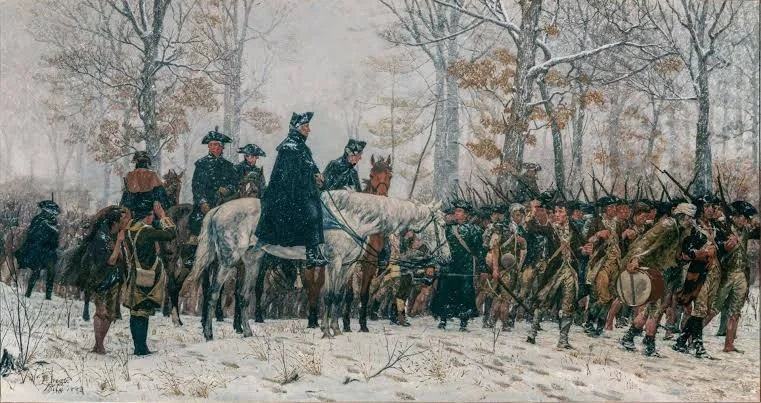
Valley Forge was so bad mainly because of disease and a broken supply system — not because it was the coldest winter of the war. Of the roughly 12,000 soldiers who camped there from December 1777 to June 1778, an estimated 1,700 to 2,000 died, most of them from typhus, typhoid, dysentery, influenza and pneumonia. Many died in the warmer spring months. Men lacked shoes, blankets and steady food because Congress’s supply system collapsed. Yet the army that marched out in June 1778 was better trained and more confident than the one that marched in.
Valley Forge is one of America’s most powerful stories. The National Park Service itself notes that its importance rests both on what really happened and on the myths that grew around it.
Key Facts
- Encampment: December 19, 1777 – June 19, 1778, about 18 miles northwest of Philadelphia
- Army size: roughly 12,000 soldiers, plus women and children who followed the camp
- Deaths: about 1,700–2,000, nearly all from disease
- Starvation: food was scarce, but no one starved to death
- Battles fought there: none
Why Did the Army Go to Valley Forge?
In the fall of 1777, the British under General William Howe captured Philadelphia, then the American capital. Washington’s army had lost at Brandywine and Germantown. It needed a winter camp close enough to watch the British in Philadelphia, protect the Pennsylvania countryside and keep Congress reassured — but far enough away to avoid a surprise attack.
Valley Forge, on high ground along the Schuylkill River, fit those needs. The army arrived on December 19, 1777, and began building log huts. By early February about 2,000 huts were finished.
Why Was Valley Forge So Bad?
Here are the main causes, roughly in order of how many lives they cost:
| Cause | What happened |
|---|---|
| Disease | Typhus, typhoid, dysentery, influenza and pneumonia spread through crowded huts and hospitals. Smallpox was a threat too, and Washington ordered inoculations. |
| Supply collapse | The army’s commissary and quartermaster departments broke down. Wagons were scarce, roads were bad, and Congress’s paper money had lost so much value that many farmers preferred selling to the British for hard currency. |
| Clothing and shoes | Many soldiers lacked shoes, blankets and coats. Washington wrote that thousands were unfit for duty because they were “barefoot and otherwise naked.” |
| Sanitation | Thousands of men and animals living close together in a camp without proper drainage or latrines made disease spread faster. |
| Cold and wet | Real, but ordinary for a Pennsylvania winter. Cold made the other problems worse rather than killing large numbers on its own. |
Food was the most visible problem. For days at a time, some units had little more than “firecake” — a paste of flour and water baked on hot stones. But the hunger did its greatest damage by weakening men so disease could take hold.
Was Valley Forge the Coldest Winter of the War?
No. That’s one of the most common myths. National Park Service historians describe the weather at Valley Forge as typical for the region, and the soldiers’ hardship as a harsher version of what the Continental Army suffered almost every winter.
The truly brutal winter came two years later, at Morristown, New Jersey, in 1779–80 — remembered as “The Hard Winter,” with deep snow and severe cold. But only about 100 soldiers died there, compared with roughly 2,000 at Valley Forge. The difference was disease. Valley Forge became the symbol of suffering because of how many men it killed, not because of the thermometer.
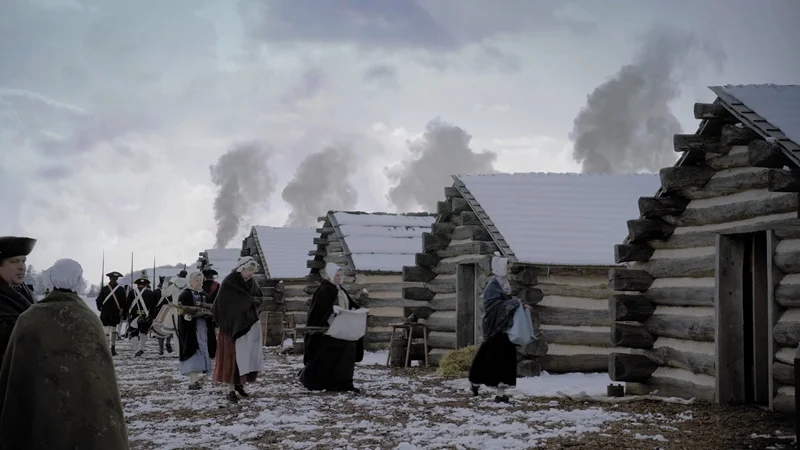
Records show that about two-thirds of the deaths came in March, April and May — the warmer months — when disease was at its worst.
Why Was Valley Forge a Turning Point?
Despite everything, the army that left Valley Forge in June 1778 was stronger than the one that arrived. Three things changed that winter:
- Training: In February 1778, a Prussian officer, Baron Friedrich Wilhelm von Steuben, arrived. He created a simple, standard drill and taught it to a model company, which then trained others. For the first time, the whole army moved and fought the same way.
- Supply reform: Washington persuaded General Nathanael Greene to become quartermaster general in March 1778, and the flow of supplies slowly improved.
- An ally: In May, news reached camp that France had signed an alliance with the United States. The army celebrated with a grand review.
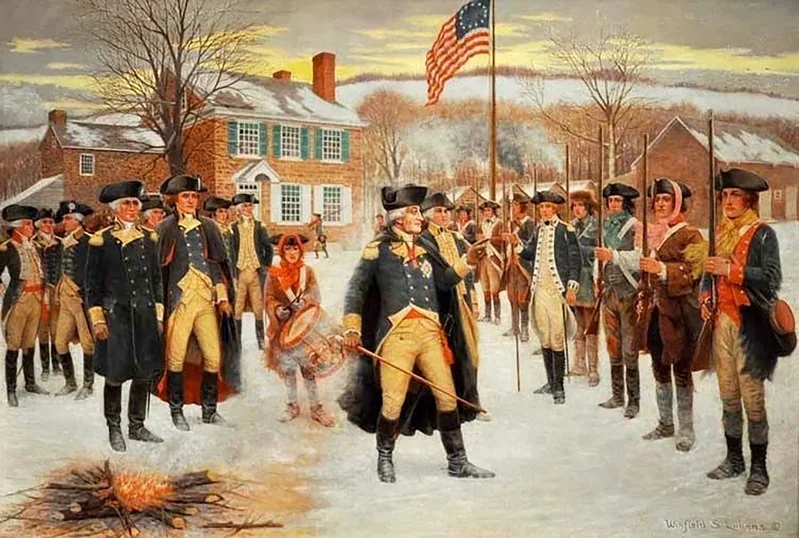
A week after leaving Valley Forge, the Continental Army fought the British to a standstill at the Battle of Monmouth on June 28, 1778 — standing up in open battle to Britain’s best troops.
Frequently Asked Questions
What year was the winter at Valley Forge?
The winter of 1777–1778. The army arrived on December 19, 1777, and left on June 19, 1778.
How many soldiers died at Valley Forge?
The National Park Service estimates about 1,700 to 2,000 deaths, nearly all from disease. Many died in hospitals in nearby towns rather than in the camp itself.
Was there a battle at Valley Forge?
No. Valley Forge was a winter encampment. No battle was fought there.
Why It Still Matters
The real lesson of Valley Forge isn’t that Americans survived a terrible cold snap. It’s that an army survived disease, hunger and a government that could barely pay or feed it — and came out better trained and more united. That’s harder, and more impressive, than the myth. When the army marched out in June 1778, it had become something closer to a professional force.
Sources
- National Park Service, Valley Forge National Historical Park — “What Happened at Valley Forge” and Valley Forge Quick Facts
- National Park Service — “Valley Forge Underfoot: Shoes of the Encampment”
- U.S. Army Heritage and Education Center — “Cold-Hard Training: Winter Camp at Valley Forge”
- Emerging Revolutionary War Era — “‘The Hard Winter’ of 1779–1780”
- Wayne Bodle, The Valley Forge Winter: Civilians and Soldiers in War (Penn State University Press, 2002)
- George Washington to Henry Laurens, December 23, 1777 (Founders Online, National Archives)