During World War II, about 371,000 German prisoners of war were held in camps across the United States. Most worked on farms, in canneries and in forests to fill a wartime labor shortage, were paid 80 cents a day, and were generally well fed and well treated under the Geneva Convention. After the war, all were sent back to Europe by 1946 — though many did not reach home until later. Around 5,000 eventually returned to America to live, and one escapee, Georg Gärtner, hid in plain sight for 40 years.
For many rural American families, the war arrived not as headlines from Europe, but as a truck full of German soldiers pulling up to help bring in the harvest.
Key Facts
- Peak number (May 1945): 425,871 POWs in the U.S. — 371,683 Germans, 50,273 Italians and 3,915 Japanese
- Camps: about 175 main camps and more than 500 branch camps; every state except Nevada, North Dakota and Vermont had at least one
- Pay: 10 cents an hour, up to 80 cents a day, mostly in canteen coupons
- Escape attempts: 2,222 — under 1% — and almost all were caught
- Sent home: by mid-1946
Why Were German POWs Sent to America?
When German and Italian forces surrendered in North Africa in May 1943, Britain had no room for hundreds of thousands of new prisoners. The U.S. had space, food and a pressing need for workers.
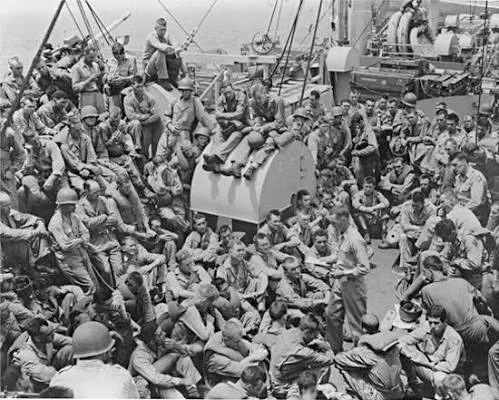
Shipping was the answer. Liberty ships that carried American troops and supplies across the Atlantic returned nearly empty, so they brought prisoners back — at times tens of thousands a month. Most early arrivals were veterans of Rommel’s Afrika Korps; later came men captured in Italy and France.
Where Were German POWs Held?
The Army placed most camps in rural areas, away from cities and war factories, and in mild climates to save on construction. That meant the South and Southwest above all — Texas alone held tens of thousands — but camps also spread across the Midwest and Great Plains.
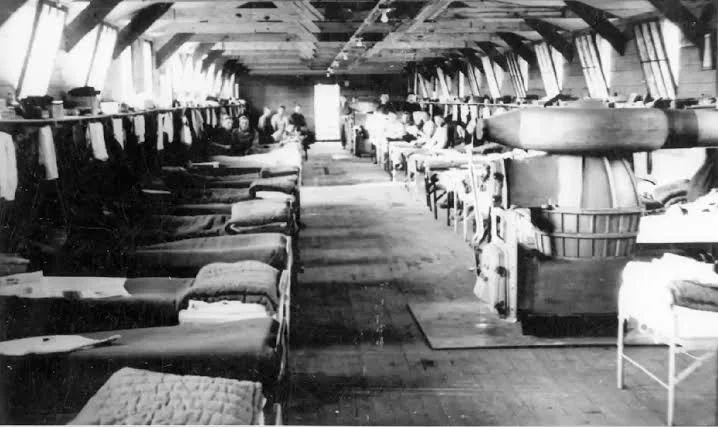
Large base camps such as Camp Hearne and Camp Swift in Texas or Camp Concordia in Kansas fed smaller branch camps, often a few dozen men housed near a farm area, a cannery or a lumber operation.
Were German POWs Treated Well in America?
By the standards of the war, yes — and the United States had a reason beyond kindness. American officials hoped that following the Geneva Convention closely would protect the roughly 90,000 Americans held by Germany.
- Food: prisoners received rations comparable to those of U.S. soldiers in training. Many gained weight.
- Life in camp: libraries, sports, orchestras, theater, and classes — some prisoners earned credits through correspondence courses.
- Mail: regular letters home through the Red Cross.
The picture had darker sides too. In some camps, committed Nazis intimidated and even killed fellow prisoners they considered traitors. In the segregated South, German prisoners were sometimes served in restaurants that refused Black American soldiers — a bitter memory for Black veterans. And food rations were cut in 1945, after Americans learned how their own POWs had suffered in Germany.
What Work Did German POWs Do?
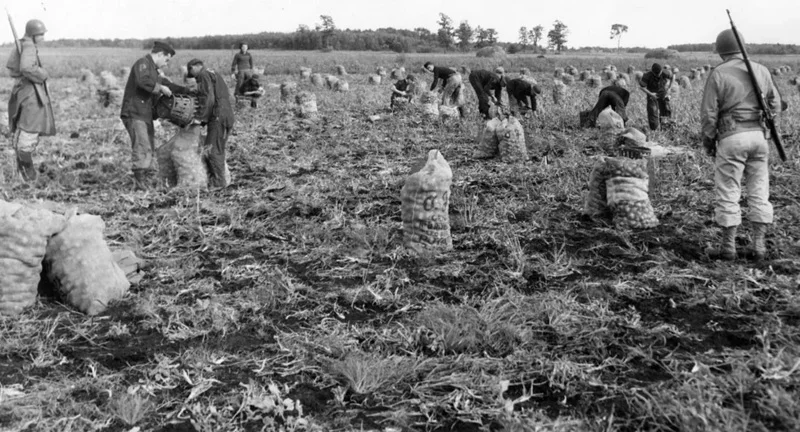
The Geneva Convention allowed enlisted prisoners to be put to work, as long as the work was paid and did not directly help the war effort. With millions of American men in uniform or in war plants, farms were desperate for hands.
| Who paid what | Amount |
|---|---|
| Farmer or employer to the U.S. government | Roughly 40–60 cents per hour per prisoner, depending on area and job |
| Government to the prisoner | 10 cents an hour, up to 80 cents a day — about what a U.S. Army private earned |
| Difference | Helped pay the cost of running the camps |
Prisoners picked cotton, topped sugar beets, harvested tomatoes, cut timber and worked in canneries. In Indiana, some 1,500 POWs are credited with saving a tomato crop that ripened early. Many farm families fed “their” prisoners at the kitchen table, and some friendships lasted for decades.
What Happened to German POWs After the War?
Under international rules, prisoners had to be repatriated once the war ended, and the United States began sending them back in late 1945. By mid-1946 the American camps were empty.
But “back to Europe” did not always mean “back home.” Many prisoners were handed over to Britain and France to work as laborers rebuilding those countries, and some did not reach Germany until 1947 or 1948. Men whose homes were now in the Soviet zone faced an uncertain future.
Did Any German POWs Stay in America?
Not at first — the law required them to leave. But an estimated 5,000 former prisoners later immigrated to the United States legally, often sponsored by the farmers they had worked for or by American friends. Some married local women; others took over the farms they had once worked as prisoners.
The Prisoner Who Hid for 40 Years
Georg Gärtner, an Afrika Korps veteran held at Camp Deming in New Mexico, did not want to return to his hometown, which had become part of Poland. In September 1945 he crawled under the fences and hopped a freight train west. Living as “Dennis Whiles,” he worked as a ski instructor and tennis pro, married, and stayed off the government’s radar for four decades while the FBI kept him on its list. In 1985 he came forward, “surrendering” on NBC’s Today show. He became a U.S. citizen in 2009 and died in 2013.
Keep Reading
- What Happened to Japanese Americans After the Internment Camps?
- What Happened to Easy Company After WWII? The Real “Band of Brothers” After the War
- What Happened to the Nazi Scientists Brought to America? Operation Paperclip Explained
- What Happened to the Doolittle Raiders Captured by Japan? The Fate of the Eight
- Why Did Japanese Soldiers Refuse to Surrender in WWII? From Iwo Jima to Hiroo Onoda
Frequently Asked Questions
How many POW camps were in the United States?
About 175 main camps served more than 500 branch camps, for roughly 700 locations in all.
Did German POWs try to escape?
Rarely. About 2,222 attempted it, under 1% of all prisoners, and almost all were quickly recaptured. Many had nowhere to go in a country thousands of miles from Germany.
Which country treated POWs best in WWII?
Historians generally rank the United States, Britain and Canada as treating German prisoners best. By contrast, of roughly 3 million Germans captured by the Soviet Union, around a million are estimated to have died in captivity.
Why It Still Matters
For many small towns, the German prisoners of World War II are a family story: the young man who built a garage that still stands, the letter that came from Germany every Christmas for 40 years. The camps showed America at its best and at its most uncomfortable — a country that fed its enemies well, while still denying some of its own soldiers a seat at the same lunch counter.
Sources
- Arnold Krammer, Nazi Prisoners of War in America (Stein and Day, 1979)
- Georg Gaertner and Arnold Krammer, Hitler’s Last Soldier in America (1985)
- Smithsonian Magazine — “German POWs on the American Homefront”
- NC State University “Footnote” — “Farming With Prisoners of War” (2024)
- Minnesota Star Tribune — “Did German POWs really work on Minnesota farms during World War II?”
- Office of the Provost Marshal General — prisoner counts, May 1945 (cited in Lewis and Mewha, History of Prisoner of War Utilization by the United States Army, 1955)
- Fold3 History Blog — German POWs in the United States