Last updated:
Yes and no. General George S. Patton’s Third Army broke the German ring around Bastogne on December 26, 1944, when tanks of the 4th Armored Division punched through to the town. But Patton did not hold Bastogne. The 101st Airborne Division and attached armor had already held it for six days while surrounded, and its veterans spent the rest of their lives insisting they never needed to be rescued. The honest answer is that both are part of the story.
The argument has lasted 80 years because it is really two questions: who held Bastogne, and who opened the road to it.
Key Facts
- Battle: Battle of the Bulge, December 16, 1944 – January 25, 1945
- Bastogne surrounded: about December 20–21, 1944
- Defenders: 101st Airborne Division, Combat Command B of the 10th Armored Division, the 705th Tank Destroyer Battalion and stragglers from broken units
- “Nuts!”: Brig. Gen. Anthony McAuliffe’s reply to a German surrender demand, December 22
- Siege broken: late afternoon of December 26, by the 4th Armored Division’s 37th Tank Battalion
- 101st casualties, December 18–27: about 2,000 killed, wounded and missing (per division counts)
Why Did Bastogne Matter?
On December 16, 1944, Germany launched its last major offensive in the West through the thinly held Ardennes forest of Belgium and Luxembourg. The goal was to split the Allied armies and reach the port of Antwerp.
Bastogne sat where seven main roads met. In the hilly, forested Ardennes, armored columns needed roads, and whoever held Bastogne could block or slow the German advance. The 101st Airborne, resting in France after the Netherlands campaign, was rushed there by truck and arrived on December 18–19, many men short of winter clothing and ammunition.
How Was Bastogne Held for Six Days?
By December 20–21, German forces had surrounded the town. Inside were roughly the 101st Airborne plus tanks and tank destroyers from the 10th Armored Division and the 705th Tank Destroyer Battalion. These attached units mattered: paratroopers had little heavy weaponry of their own.
| Who | What they contributed |
|---|---|
| 101st Airborne Division | Held a perimeter around the town in snow and freezing cold, under shelling and repeated attacks |
| Combat Command B, 10th Armored Division | Tanks and armored infantry that fought delaying actions at Noville and elsewhere, then served as a mobile reserve |
| 705th Tank Destroyer Battalion | Anti-tank guns that broke up German armored attacks |
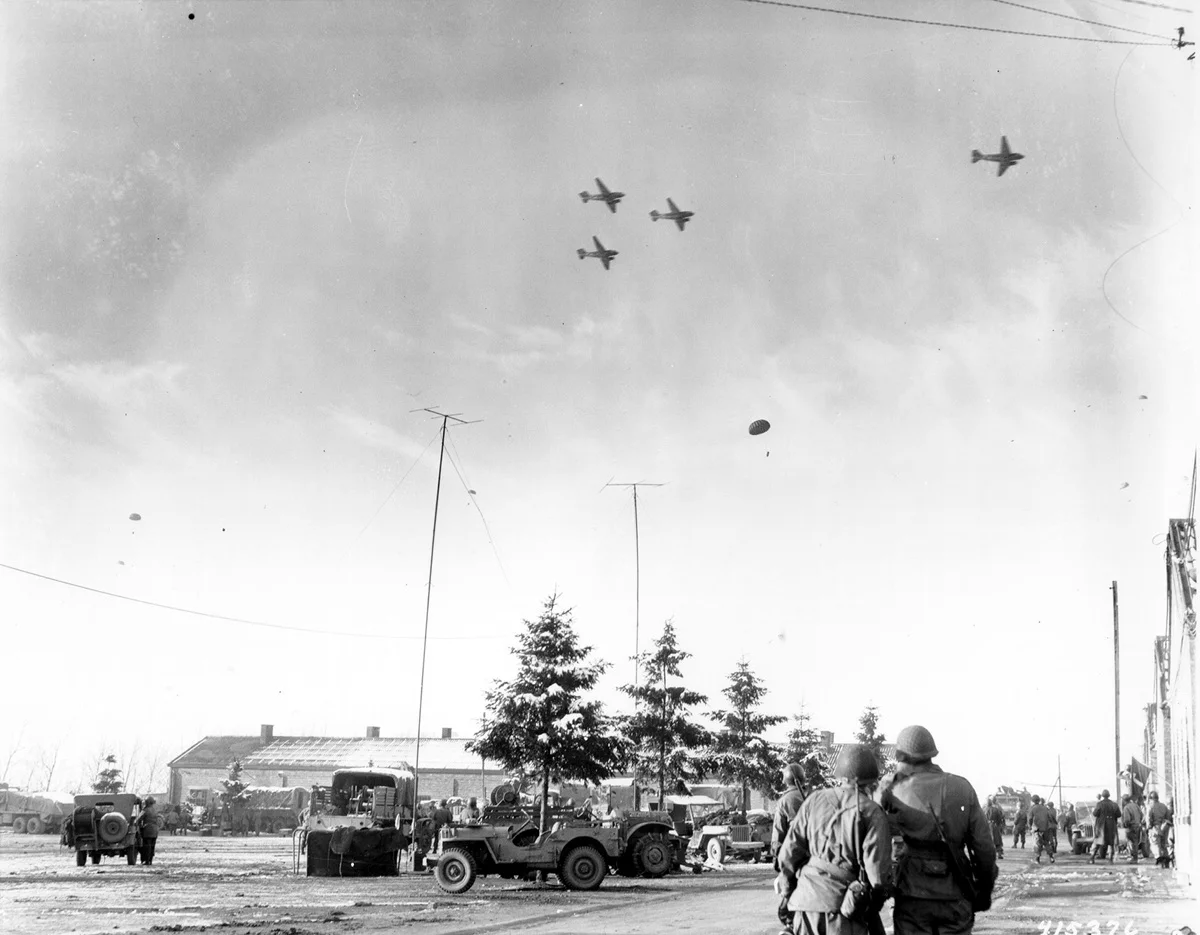
| Aerial resupply | After the weather cleared on December 23, C-47s dropped ammunition, food and medical supplies by parachute |
| Allied fighter-bombers | Attacked German forces around the perimeter once skies cleared |
| 4th Armored Division (Patton’s Third Army) | Fought north for five days and opened a corridor into the town on December 26 |
Medical care was the defenders’ worst problem. A division aid station had been captured early in the siege, and the wounded piled up in buildings across the town.
What Did “Nuts!” Mean?
On December 22, German officers came forward under a white flag with a typed note demanding the town’s surrender. The 101st’s acting commander, Brig. Gen. Anthony McAuliffe, reportedly read it and said, “Aw, nuts.” His staff suggested he use that as the official reply. The Germans did not understand it. An American colonel translated it for them roughly as “Go to hell.”
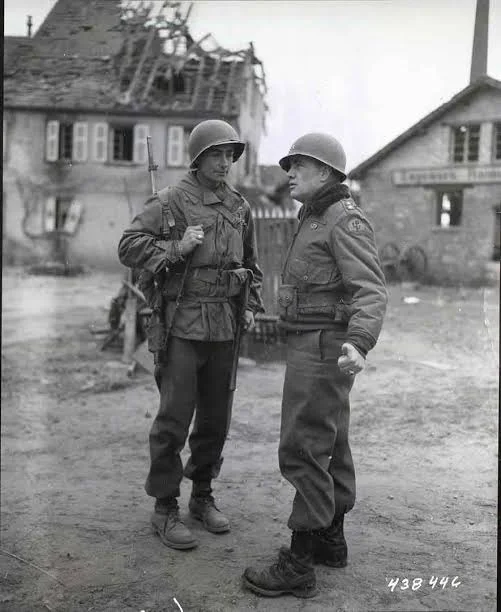
The one-word answer became one of the most famous replies in American military history — and a symbol of the defenders’ attitude: they did not see themselves as trapped.
How Did Patton Get There So Fast?
On December 19, General Dwight D. Eisenhower met his senior commanders at Verdun, France. Patton’s Third Army was facing east, preparing its own attack into Germany. When asked how soon he could turn north to strike the German flank, Patton said he could attack with three divisions within about 48 hours. Other commanders reportedly doubted it.
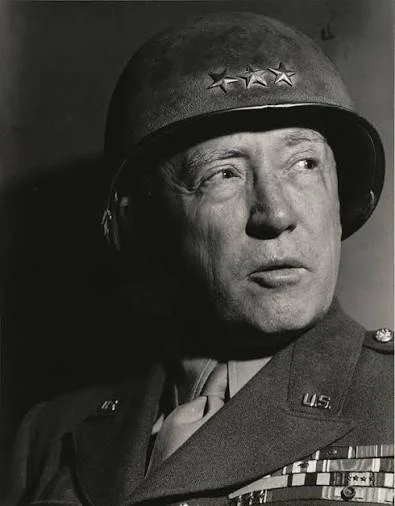
Patton’s staff had already sketched plans for that possibility. The Third Army turned roughly 90 degrees — moving tens of thousands of men, tanks and trucks over icy roads — and launched its attack on December 22.
The advance was slow and costly. German paratroopers and infantry defended villages along the way. The 4th Armored Division took about five days to fight the last stretch to the town.
The Tank That Broke the Siege
On the afternoon of December 26, Lt. Col. Creighton Abrams’s 37th Tank Battalion was down to about 20 working tanks. Rather than follow the planned route, Abrams sent a small column straight up a side road through the village of Assenois.
At the front was a Sherman tank named Cobra King, commanded by Lt. Charles Boggess. Shortly before 5 p.m., Boggess saw soldiers in foxholes ahead. They were men of the 101st’s 326th Airborne Engineer Battalion. The siege was broken. About 20 minutes later, Abrams reached the perimeter and shook hands with McAuliffe.
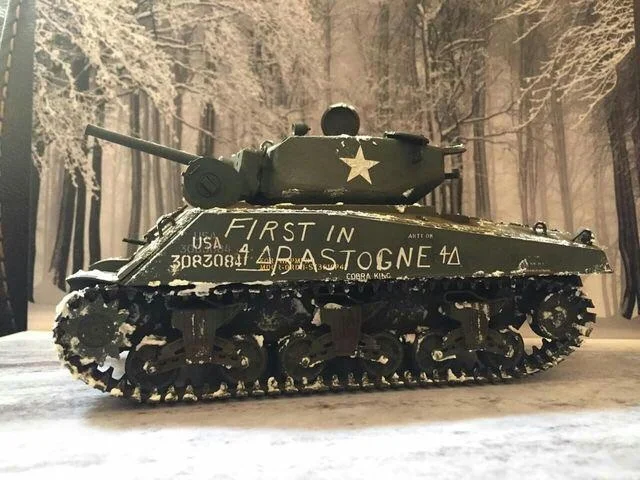
The corridor was narrow, and heavy fighting around Bastogne continued into January. But trucks and ambulances could now get in and out.
Did the 101st Need to Be Rescued?
Ask a 101st veteran and the answer was always no. The division held its perimeter for six days, rejected a surrender demand and was resupplied by air after December 23. Many veterans resented the word “rescued” for the rest of their lives.
Ask a Third Army veteran and the answer is that the defenders were low on artillery shells, short of medical care and surrounded by a stronger force. Without a corridor, the town’s ability to keep fighting would have worn down.
Most historians take a middle position: the 101st was not on the edge of surrender on December 26, but it could not have held forever without the road opened by Patton’s men. The defense held Bastogne; the relief kept it.
What Did Bastogne Cost?
The Battle of the Bulge was the largest battle the U.S. Army fought in World War II. About 610,000 Americans took part, and U.S. Army figures put American casualties at about 89,000, including roughly 19,000 killed. German losses were also very heavy, though estimates vary widely.
The 101st Airborne alone recorded about 2,000 casualties between December 18 and 27.
Keep Reading
- What Happened to Japanese Americans After the Internment Camps?
- What Happened to Easy Company After WWII? The Real “Band of Brothers” After the War
- What Happened to the Nazi Scientists Brought to America? Operation Paperclip Explained
- What Happened to the Doolittle Raiders Captured by Japan? The Fate of the Eight
- Why Did Japanese Soldiers Refuse to Surrender in WWII? From Iwo Jima to Hiroo Onoda
Frequently Asked Questions
Who was the first American to reach Bastogne?
Lt. Charles Boggess, commanding the tank Cobra King of the 4th Armored Division, was the first to reach the defenders’ lines on December 26, 1944. The tank is preserved by the U.S. Army.
Was Patton at Bastogne?
Not during the breakthrough. Patton directed the operation from his headquarters and visited the town afterward.
Was Bastogne the turning point of the Battle of the Bulge?
It was one of them. Holding the crossroads slowed the German advance in the south. Elsewhere, stands at places like St. Vith and Elsenborn Ridge also wrecked the German timetable.
Why It Still Matters
The question “did Patton save Bastogne?” lives on because both stories are true and both are deeply American: a surrounded division that refused to quit, and a general who turned an army around in the snow in a matter of days. Neither would have mattered without the other. That’s why historians often call Bastogne not a rescue, but a link-up.
Sources
- Hugh M. Cole, The Ardennes: Battle of the Bulge, U.S. Army in World War II series (U.S. Army Center of Military History, 1965)
- S.L.A. Marshall, Bastogne: The First Eight Days (U.S. Army, 1946)
- DVIDS / INSCOM — “The relief of Bastogne” (4th Armored Division and 37th Tank Battalion)
- U.S. Department of Defense — history of the tank Cobra King
- Warfare History Network — “The Breakthrough to Bastogne”
- The National WWII Museum — “The Battle of the Bulge” (Keith Huxen, 2019)
- National Park Service — “Eisenhower and the Battle of the Bulge”