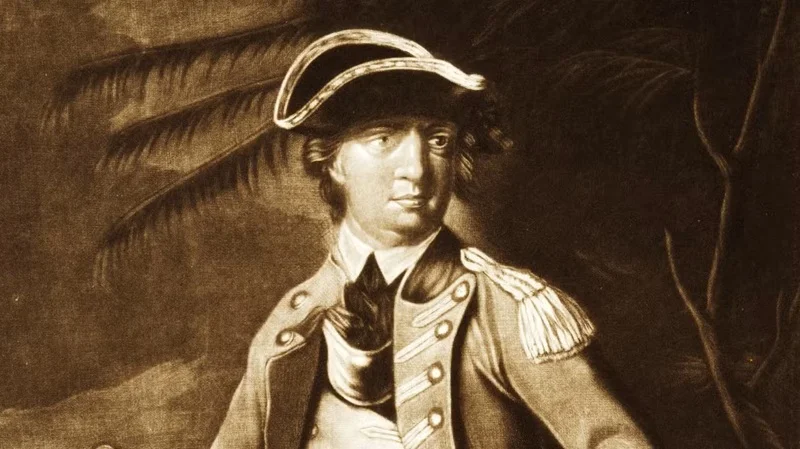
Benedict Arnold was one of the Continental Army’s most daring generals before he became the most infamous traitor in American history. His leadership helped win the Battle of Saratoga in 1777, the victory that brought France into the war. But bitter over being passed over for promotion, buried in debt and facing corruption charges, he secretly offered to hand the fortress of West Point to the British in 1780. The plot was exposed, Arnold fled, and his name has meant “traitor” in America ever since.
Key Facts
- Born: January 14, 1741, Norwich, Connecticut
- Died: June 14, 1801, London, England
- Highest American rank: Major General, Continental Army
- Greatest victory: Battles of Saratoga, 1777
- The betrayal: plotted to surrender West Point to the British, September 1780
- Price promised: £20,000 if the plot succeeded; he received about £6,315 after it failed
- Wife and accomplice: Peggy Shippen Arnold
In the early years of the American Revolution, few officers were braver, or more admired, than Benedict Arnold. George Washington trusted him completely. His soldiers would follow him anywhere. Twice he was badly wounded leading charges from the front.
Yet today his name is an insult. To call someone “a Benedict Arnold” in America is to call them a traitor. How did one of the Revolution’s greatest heroes become its greatest villain?
Early Life: A Fallen Family Name
Arnold was born in 1741 into a once-prominent Connecticut family. His father’s business failed and he turned to drink, leaving the family poor and humiliated. Historians often point to this early fall from respectability as the root of Arnold’s lifelong hunger for status, money and recognition.
He trained as an apothecary, then built a successful career as a merchant and ship captain in New Haven, trading with Canada and the West Indies. When tensions with Britain boiled over, he joined the local militia as a captain.
The Hero of the Revolution
When war broke out in 1775, Arnold rushed to the front. In just two years, he built one of the most remarkable combat records in the army.
Fort Ticonderoga (May 1775). Together with Ethan Allen and his Green Mountain Boys, Arnold captured the British fort on Lake Champlain without a fight. Its cannons were later hauled to Boston, where they helped force the British to evacuate the city.
The march to Quebec (1775). Arnold led about 1,100 men through the Maine wilderness in late autumn. Starvation, freezing rivers and disease cut the force nearly in half, yet the survivors reached Quebec. In the failed assault on the city on December 31, 1775, Arnold was shot in the left leg.
Valcour Island (October 1776). On Lake Champlain, Arnold assembled a small fleet of hastily built gunboats to face a much stronger British squadron. He lost the battle, but the delay pushed the British invasion from Canada back a full year, buying the young army precious time.
The Hero of Saratoga
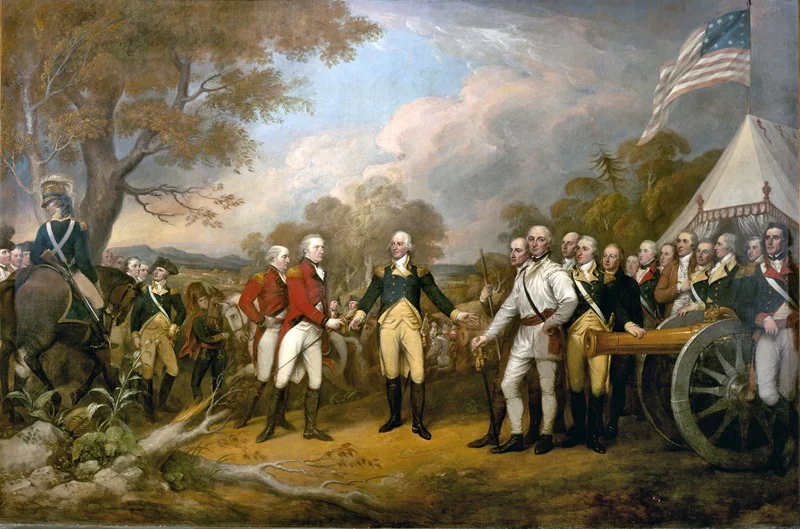
In 1777, a British army under General John Burgoyne marched south from Canada. At the two Battles of Saratoga, in September and October, Arnold was the driving force on the American side. On October 7, after clashing with his commander, General Horatio Gates, he rode onto the battlefield and led a charge against a key German position, the Breymann Redoubt. His horse was shot from under him, and the same leg wounded at Quebec was shattered.
Ten days later, Burgoyne surrendered his entire army. The victory convinced France to formally ally with the United States, a turning point in the war. Gates took most of the credit.
Why Did Benedict Arnold Turn Traitor?
There was no single reason. Historians generally point to several pressures that built up over three years.
Wounded pride. In February 1777, Congress promoted five junior officers to major general ahead of him. Even after he was promoted, his seniority was not restored for months. Arnold, who had bled for the cause, felt deeply insulted.
Debt and accusations. Unable to fight because of his leg, Arnold was made military governor of Philadelphia in 1778. He lived lavishly, ran up large debts, and used his position for private business deals. Pennsylvania officials accused him of corruption. A court-martial cleared him of most charges but convicted him on two minor ones, and Washington issued a mild formal reprimand in 1780. Arnold saw it as a final humiliation.
Political disillusionment. Arnold later claimed he had turned against the cause because of the alliance with France, Britain’s old enemy, and because he believed Congress had become corrupt and incompetent. Many historians treat this as partly sincere and partly a justification after the fact.
Money. Whatever his grievances, Arnold also negotiated hard for payment. His demands to the British make clear that his price mattered a great deal to him.
A Wife, a Spy and a Secret Correspondence
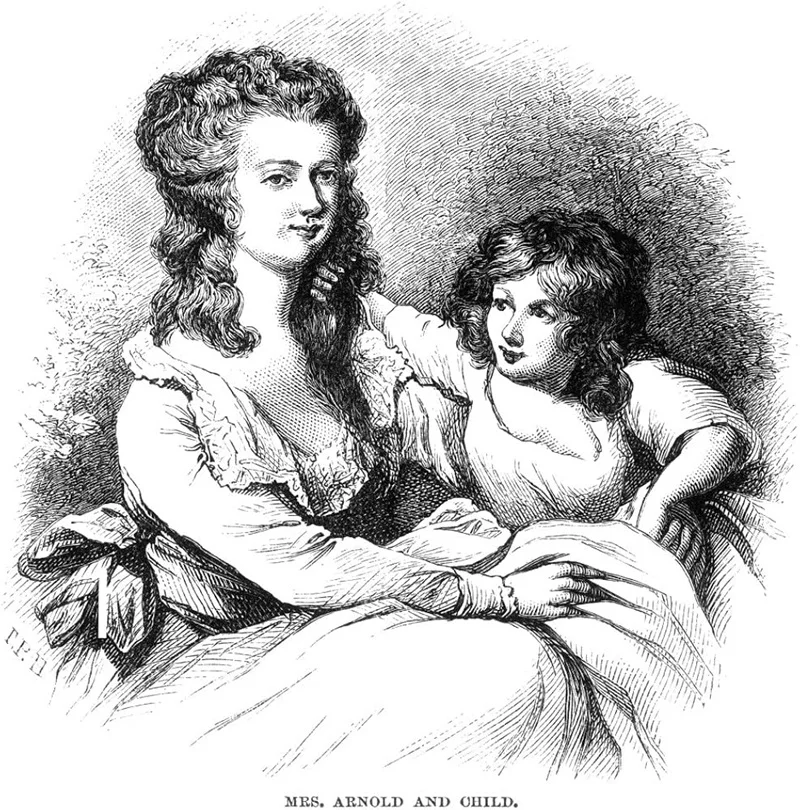
In Philadelphia, Arnold, then 38 and a widower, courted Peggy Shippen, the 18-year-old daughter of a wealthy family with Loyalist sympathies. They married in April 1779. During the British occupation of the city, Peggy had become friendly with a charming young British officer, Major John André.
Within weeks of the wedding, Arnold opened a secret correspondence with the British through a Loyalist go-between. His contact on the other side was André, now head of intelligence for the British commander in New York, Sir Henry Clinton. Messages were written in code and invisible ink. For many years Peggy was seen as an innocent bystander, but historians now widely believe she was an active participant who helped pass messages.
The West Point Plot
West Point controlled the Hudson River, the key route between New England and the rest of the colonies. If the British took it, they could split the rebellion in two.
In the summer of 1780, Arnold asked Washington for command of the fortress, and Washington agreed. Arnold then offered to surrender West Point and its garrison for £20,000 and a general’s commission in the British Army. Quietly, he began weakening its defenses, scattering troops and delaying repairs.
On the night of September 21, 1780, André came ashore from the British warship Vulture to meet Arnold secretly near the Hudson. Arnold handed him plans of the fortress hidden in his stockings.
The Plot Unravels
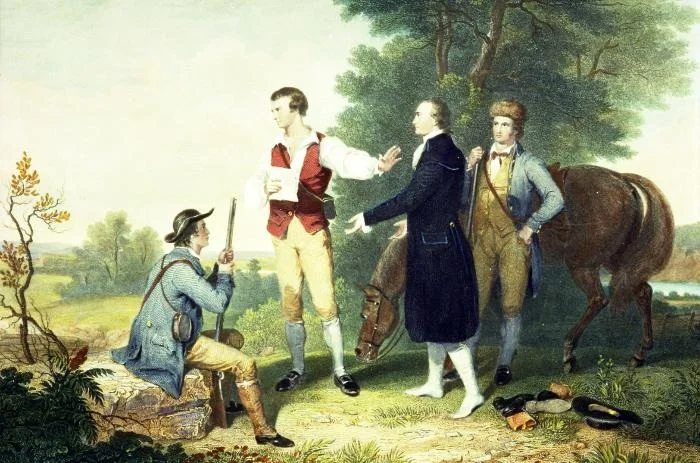
André’s return trip went wrong. With the Vulture forced downriver by American cannon fire, he had to travel overland through no-man’s land wearing civilian clothes. On September 23, near Tarrytown, New York, three American militiamen stopped him, searched him, and found the papers.
On the morning of September 25, Arnold was at breakfast, waiting for Washington to arrive for an inspection, when a messenger brought word of André’s capture. Arnold rushed out, rowed down the Hudson and escaped to the Vulture. Washington arrived shortly afterward to find his trusted general gone. Upstairs, Peggy put on what many historians now consider a performance of hysterical grief that convinced Washington she knew nothing.
Washington offered to exchange André for Arnold. The British refused. On October 2, 1780, André was hanged as a spy at Tappan, New York. Even many Americans, including some of Washington’s officers, mourned the likable young officer, while Arnold, who had escaped, became the object of nationwide fury.
Life on the Other Side
Because the plot failed, the British paid Arnold only about £6,315, plus an annual pension, along with a commission as a brigadier general. He never received the £20,000 he had hoped for.
Determined to prove his value, he led British raids against his former countrymen. In January 1781 his troops captured and burned parts of Richmond, Virginia. In September 1781, he led an attack on New London, Connecticut, just miles from his birthplace. Much of the town was burned, and at nearby Fort Griswold dozens of American defenders were killed, many of them after the fort had fallen. The raid made him even more hated at home.
Weeks later, the British surrendered at Yorktown, and the war was effectively lost. In December 1781 Arnold sailed for England.
A Lonely End
Britain never fully embraced him. Officers distrusted a man who had betrayed his own side, and he was never given another important command. He tried business ventures in Canada and the Caribbean with mixed results, and his debts kept growing.
Benedict Arnold died in London on June 14, 1801, at the age of 60. Peggy died three years later. A popular legend claims that on his deathbed he asked to be dressed in his old Continental Army uniform, saying “God forgive me for ever putting on another.” Historians have found no reliable evidence that this happened.
How America Remembers Him
Few Americans have been so thoroughly erased from places they once helped make famous.
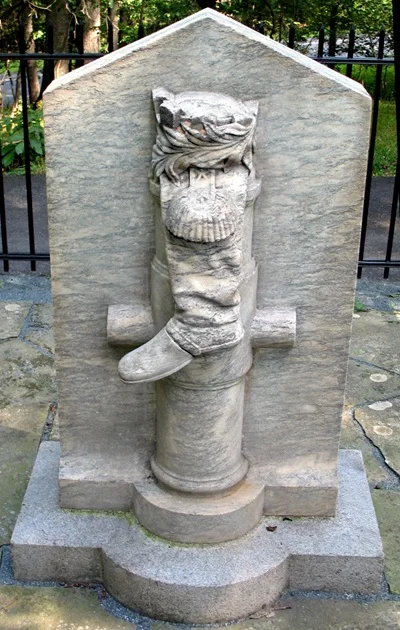
At Saratoga National Historical Park stands the Boot Monument, erected in 1887. It shows a cavalry boot and honors “the most brilliant soldier” of the Continental Army, wounded on that spot. Arnold’s name appears nowhere on it. On the tall Saratoga Battle Monument nearby, niches hold statues of the American commanders; the fourth niche, meant for Arnold, is empty.
Hero or Villain? The Historians’ View
Nobody seriously disputes that Arnold committed treason. The debate is about how to understand him.
Some historians stress that his grievances were real. He was repeatedly passed over and attacked by politicians while serving with great courage, and he was not the only officer who felt mistreated by Congress. In this view, Arnold was a brilliant soldier who was pushed toward a terrible choice.
Others argue that ambition, vanity and money drove him from the start, and that many officers endured similar slights without betraying their country. His willingness to haggle over his price and then lead raids against Americans, they say, reveals his true character.
Most agree on one irony: had Arnold died of his wounds at Saratoga, he would almost certainly be remembered today as one of the greatest heroes of the American Revolution.
Benedict Arnold Timeline
| Date | Event |
|---|---|
| Jan 14, 1741 | Born in Norwich, Connecticut |
| May 1775 | Helps capture Fort Ticonderoga |
| Dec 31, 1775 | Wounded in the leg in the failed attack on Quebec |
| Oct 1776 | Battle of Valcour Island delays British invasion by a year |
| Feb 1777 | Passed over for promotion by Congress |
| Oct 7, 1777 | Leads the decisive charge at Saratoga; badly wounded |
| 1778 | Becomes military governor of Philadelphia |
| Apr 1779 | Marries Peggy Shippen; begins secret talks with the British weeks later |
| Aug 1780 | Takes command of West Point |
| Sept 23–25, 1780 | André captured; Arnold flees to the British |
| Oct 2, 1780 | John André hanged as a spy |
| Sept 1781 | Leads British raid on New London, Connecticut |
| Dec 1781 | Leaves America for England |
| June 14, 1801 | Dies in London |
Keep Reading
Frequently Asked Questions
Why did Benedict Arnold betray America?
A mix of reasons: anger at being passed over for promotion, resentment over corruption charges and a court-martial, heavy debts, opposition to the alliance with France, and the promise of money and rank from the British. His wife, Peggy Shippen, is also believed to have encouraged and helped him.
How much was Benedict Arnold paid?
He asked for £20,000 if West Point was surrendered. Because the plot failed, the British paid him about £6,315, plus an annual pension and a commission as a brigadier general.
What happened to Benedict Arnold after the war?
He moved to England in 1781, where he was distrusted and never given a major command. He tried several business ventures, struggled with debt, and died in London in 1801.
What happened to John André?
The British officer who handled Arnold’s treason was captured with the West Point plans and hanged as a spy on October 2, 1780. In 1821 his remains were moved to Westminster Abbey in London.
Is there a monument to Benedict Arnold?
Yes, but it does not name him. The Boot Monument at Saratoga National Historical Park honors his wounded leg and his role in the 1777 victory, describing him only as “the most brilliant soldier” of the Continental Army.
Sources
- Saratoga National Historical Park, National Park Service (nps.gov/sara)
- George Washington’s Mount Vernon — “Benedict Arnold” (mountvernon.org)
- Library of Congress — American Revolution primary sources
- Nathaniel Philbrick, Valiant Ambition: George Washington, Benedict Arnold, and the Fate of the American Revolution
- Willard Sterne Randall, Benedict Arnold: Patriot and Traitor
- Stephen Brumwell, Turncoat: Benedict Arnold and the Crisis of American Liberty