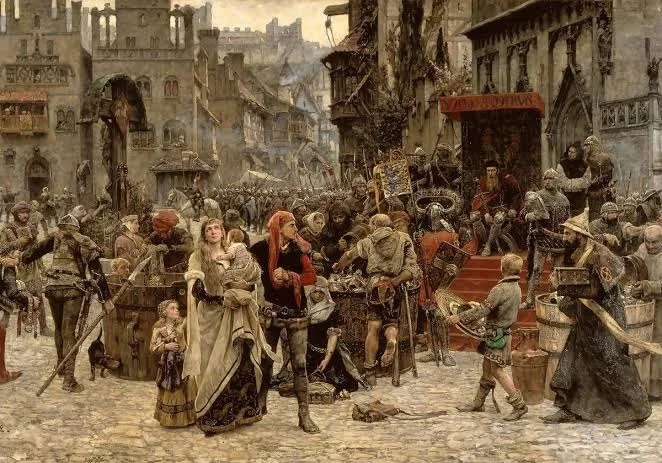
The Visby soldiers were buried in their armor mainly because of the July heat and the sheer number of dead. After the battle on July 27, 1361, about 1,800 Gotland defenders lay outside the walls of Visby; within days the bodies were swelling and decaying, and stripping them was both slow and sickening. Historians add other reasons too: much of the armor was old, some was badly damaged, and burying it may have helped the Danish king disarm the island.
Key Facts
- Battle: Visby, island of Gotland (today Sweden), July 27, 1361
- Sides: King Valdemar IV of Denmark vs. Gotland’s farmer militia
- Dead: about 1,800 Gotlanders (medieval records); around 300 Danes
- Graves: mass graves at Korsbetningen, excavated 1905, 1912–13 and 1928–30
- Remains recovered: at least 1,185 individuals
- Armor found: about 25 coats of plates, 185 mail hoods, 12 mail shirts, parts of 20 gauntlets
- Where to see it: Swedish History Museum (Stockholm) and Gotland Museum (Visby)
Why Armor Was Almost Never Buried
In the Middle Ages, armor was expensive. A mail shirt took weeks of a smith’s work, and a good set of plates could be worth as much as a farm animal or more. After a battle, the winners and local scavengers normally stripped the dead of everything useful: armor, weapons, boots, even clothes.
That is why medieval battlefields rarely leave armor in the ground. At Visby, archaeologists found the opposite — hundreds of men buried with their mail hoods still on their skulls. It is one of the largest collections of medieval battle dead ever found, and one of the very few where the armor went into the grave with the men who wore it.
So what made Visby different?
How the Battle of Visby Happened
In the 1340s and 1350s, King Valdemar IV of Denmark rebuilt a kingdom that had been pawned off piece by piece to German lords. By 1360 he was ready to expand, and he took Scania, across the strait from Copenhagen.
His next target was Gotland, an island in the middle of the Baltic Sea. Its main town, Visby, was one of the richest trading ports of northern Europe and a member of the Hanseatic League, the powerful network of German merchant towns.
On July 22, 1361, the Danish fleet landed on Gotland’s west coast. The island had no professional army, only a militia of farmers. They fought the Danes at least twice on the march north, including near Mästerby, where archaeologists have since recovered hundreds of battlefield finds.
On July 27, the Gotlanders made a last stand in front of Visby’s town wall. The townspeople, mostly merchants, kept their gates shut and stayed out of the fight. The farmers were cut down outside the wall. The next day, Visby surrendered to Valdemar without a siege.
What Archaeologists Found Under the Meadow
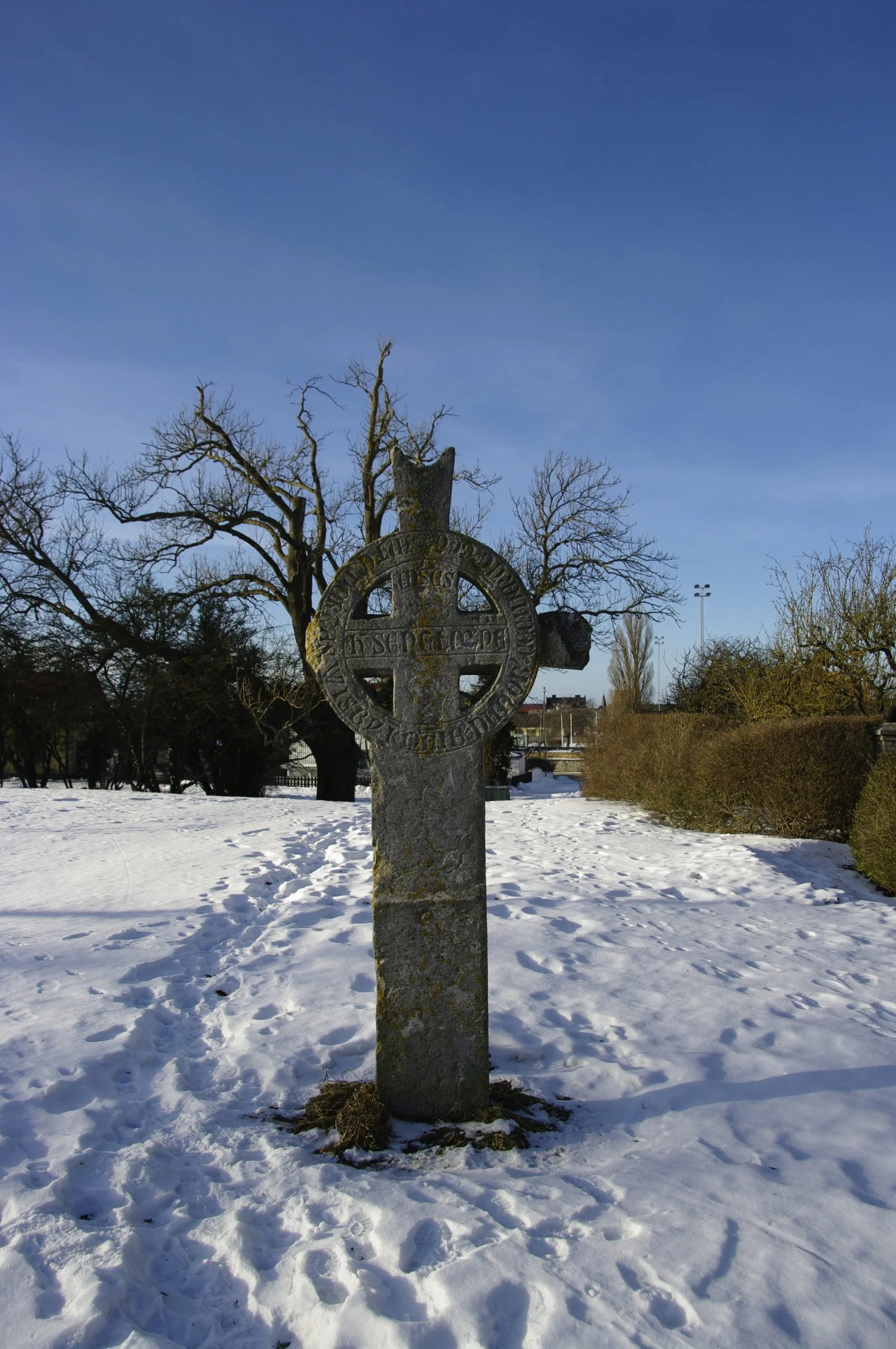
For more than 500 years, the dead lay in a meadow just outside the wall, marked only by a medieval stone cross. Its inscription says the Gotlanders fell before the gates of Visby “at the hands of the Danes” and asks passersby to pray for them.
In 1905, workers digging near the cross found the first mass grave. Two more were excavated in 1912–13 and 1928–30, the last led by Swedish archaeologist Bengt Thordeman. Together they held the remains of at least 1,185 people. At least one more grave in the area has never been fully excavated.
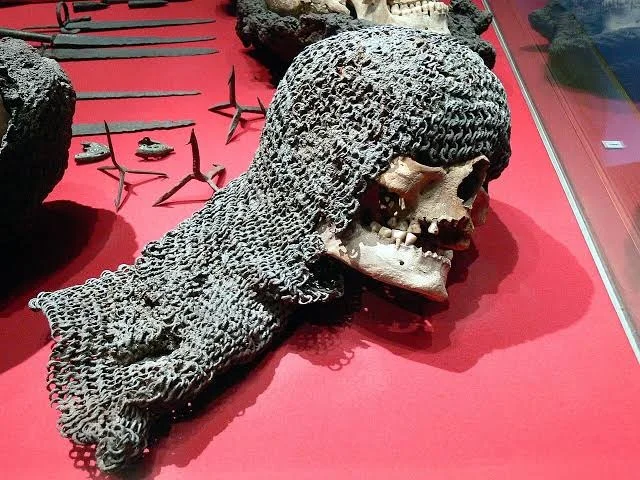
The bodies had been thrown in fast. Skeletons lay tangled together, some face down, some on top of each other. And many were still wearing armor:
- about 25 coats of plates — iron plates riveted inside a cloth or leather jacket
- 185 mail hoods (coifs), some still around the skulls
- 12 mail shirts and parts of about 20 armored gloves
Thordeman’s 1939 book about the finds, Armour from the Battle of Wisby, is still one of the most important works on medieval armor ever written.
Why Leave the Armor? The Main Theories
No written record explains why the armor stayed on the dead. Historians piece it together from the graves themselves. These are the main explanations — and several were probably true at once.
1. The summer heat
The battle was fought in late July. Within a day or two in summer heat, bodies swell, begin to rot and smell. The Swedish History Museum notes that the armor may have been stuck to swollen, blood-soaked bodies, so that anyone hoping to loot it was simply too repulsed to try.
2. Too many dead, too little time
Around 1,800 men died in a few hours. Burying that many bodies quickly — before disease spread around a town full of people — was a huge job. Removing riveted armor and mail from each corpse would have taken far longer. Military historian John Keegan pointed to exactly these two things: the heat and the number of bodies.
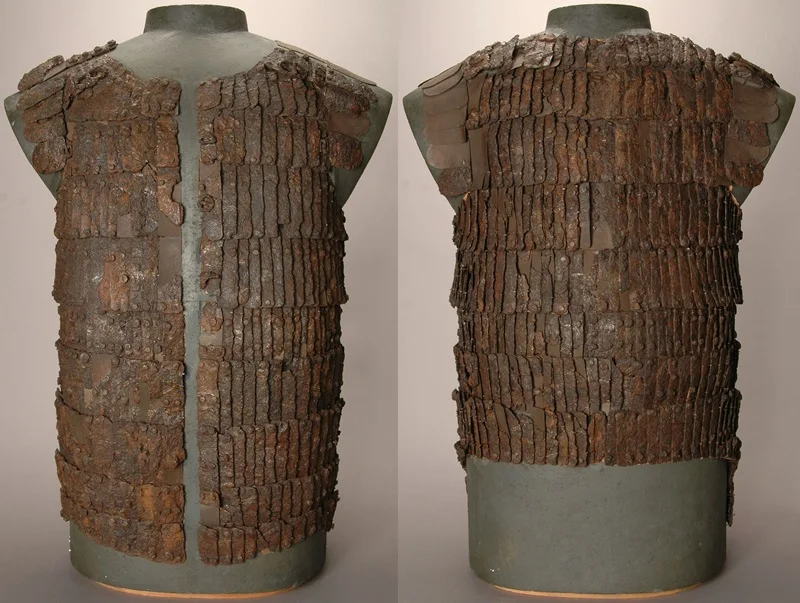
3. The armor was old or damaged
Much of the Visby armor was out of date by 1361. Many coats of plates were older designs, and some had been cut, crushed or torn in the fighting. A victorious professional army may not have thought it worth the trouble.
4. Disarming the island
Another theory is political. Burying the defenders’ armor along with them was a simple way to make sure Gotland could not quickly rearm against its new Danish ruler.
5. Not everything was left
The graves were not untouched. Archaeologists found almost no weapons — no swords, axes or spears to speak of — and many bodies had no armor at all. So the winners did take what was easiest and most valuable. The heavier, messier armor was what got left behind.
| Theory | Evidence for it | How strong? |
|---|---|---|
| Summer heat made bodies impossible to strip | Battle date (July 27); hasty, tangled burials | Strong — widely accepted |
| Too many dead to process | About 1,800 killed; at least 1,185 found in a few pits | Strong |
| Armor was old or damaged | Older coat-of-plates styles; battle damage | Likely a factor |
| Deliberate disarming of Gotland | Logic of conquest; no written proof | Possible, unproven |
| Only valuable gear was looted | Almost no weapons in the graves | Strong — shows selective looting |
Who Were the Dead?
The bones tell a brutal story. Most wounds are on the arms, legs and skulls, because chest armor and shields protected the body. Many shin bones show deep cuts from behind, blows that would have dropped a man to the ground. In one grave, a skeleton was found with both lower legs cut off in a single stroke.
For decades, the standard story was that the defenders were mostly old men, boys and the sick — whoever was left to fight. That view came from studies of the skeletons published in 1939, which found men of many ages and some with old injuries or illnesses.
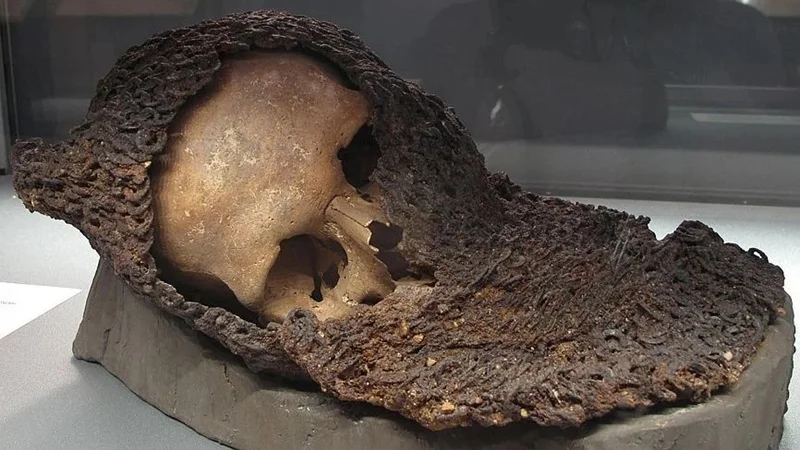
New research in 2026: a spiked club and a different picture
In August 2026, a team led by biological anthropologist Patrick Randolph-Quinney of Uppsala University presented new work on the Visby skulls. Several skulls have mysterious square holes. Earlier researchers blamed arrows or lance heads.
The team scanned seven skulls in 3D and tested replica weapons on cow bones covered with gelatin and replica armor. A crossbow and a spiked axe did not match the wounds. A spiked war club did. They suggest attackers worked in groups, first disabling a man with blows to the legs, then finishing him with the club.
The researchers also question the “old men and boys” story. The defenders may not have been a standing army, but they may still have had real training. The work has not yet been published in a peer-reviewed journal, so its conclusions may change.
Why Visby Still Matters
A decision made in a hurry on a hot July day in 1361 — leave the armor, dig the pits, cover them fast — became one of archaeology’s greatest gifts. Without it, historians would know far less about what ordinary soldiers wore and how medieval battles really killed people.
The victory did not last forever. Valdemar’s attack helped start a war with the Hanseatic League, which forced Denmark into a humiliating peace at Stralsund in 1370. Visby itself survived. Its medieval wall still stands, and the town is now a UNESCO World Heritage Site.
Frequently Asked Questions
Why were the Visby soldiers buried in their armor?
Mainly because of the July heat and the large number of dead. The bodies decayed quickly, making it slow and repulsive to strip them, so they were buried fast. Old or damaged armor, and possibly a wish to disarm Gotland, also played a part.
Who won the Battle of Visby?
Denmark won. King Valdemar IV’s army destroyed the Gotland militia outside Visby on July 27, 1361, and the town surrendered the next day.
Why did the Battle of Visby happen?
Valdemar IV wanted Gotland and the rich trading town of Visby to strengthen Denmark’s control of Baltic trade and to raise money after rebuilding his kingdom.
How many people died at the Battle of Visby?
Medieval records say about 1,800 Gotlanders were killed, and around 300 Danes are thought to have died. Archaeologists have recovered at least 1,185 individuals from the mass graves.
Why didn’t the town of Visby help the defenders?
Visby’s merchants kept the gates shut and stayed neutral, apparently hoping to save the town and its trade. They surrendered the day after the battle and paid Valdemar a large sum.
Can you see the Visby armor today?
Yes. Armor and skeletons from the graves are displayed at the Swedish History Museum in Stockholm and the Gotland Museum in Visby. The memorial cross still stands at Korsbetningen, just outside the town wall.
Sources
- Swedish History Museum — “Medieval Massacre” exhibition: “Unique discoveries of armaments” and “Four mass graves” (massakern.historiska.se)
- Swedish History Museum — “3D: Skull from the Battle of Visby” (historiska.se)
- Thordeman, Bengt. Armour from the Battle of Wisby, 1361. Stockholm, 1939
- Live Science — “Archaeologists solve mystery of medieval soldiers with gruesome square holes in their skull” (August 2026)
- Archaeology Magazine (archaeologymag.com) — “Spiked club delivered the final blow in the 1361 Battle of Visby” (August 2026)
- Uppsala University, Campus Gotland — symposium “Visby 1361 Revisited” (2025)
- “Battle of Visby,” Wikipedia (citing military historian John Keegan on the burials)