After the Vietnam War, most Amerasian children — the sons and daughters of American servicemen and Vietnamese women — were left behind in Vietnam, where many faced poverty and open discrimination. Only a few thousand left in 1975. The real exodus came after the Amerasian Homecoming Act of 1987, which brought roughly 23,000–25,000 Amerasians and about 60,000–70,000 of their relatives to the United States. Many are still searching for their American fathers today.
Key Facts
- Who: children born in Vietnam to Vietnamese mothers and American fathers, mostly 1962–1975
- How many: no exact count — estimates range from about 15,000 to 40,000 (see table below)
- Left in 1975: a few thousand, some during Operation Babylift (April 1975)
- Key U.S. laws: Amerasian Immigration Act (1982); Amerasian Homecoming Act (1987, effective March 21, 1988)
- Came to the U.S. under the 1987 law: about 23,000–25,000 Amerasians plus 60,000–70,000 relatives
Who Were the Amerasian Children?
“Amerasian” is the term U.S. law uses for children born in Asia to an American father and an Asian mother. In Vietnam, most were born during the years of large-scale American presence, from the early 1960s to 1975. Their fathers were soldiers, sailors, airmen, contractors and diplomats. Their mothers were wives, girlfriends, office workers, bar workers — every kind of relationship existed.
When American forces left in 1973, and when South Vietnam fell in 1975, most fathers were gone. Some did not know they had a child. Some knew and could not or did not bring the child home. Under U.S. law at the time, a child born abroad to an unmarried American father usually had no automatic right to American citizenship.
How Many Amerasian Children Were There?
Nobody counted. Births were not registered with the U.S. government, many fathers were never named, and after 1975 having an American father was something families often hid. The estimates vary widely depending on who made them and when:
| Source | Estimate | Notes |
|---|---|---|
| U.S. government (Reagan administration memo, late 1980s) | 10,000–15,000 still in Vietnam | Count of those remaining, not all ever born |
| U.S. government estimate reported by the press, 1990 | About 15,000; other estimates “more than double that” | Roanoke Times report on the program |
| Researchers and advocacy groups | About 25,000–30,000 in Vietnam | Most often quoted range today |
| Some scholars (all of Southeast Asia, 1962–1975) | Up to about 40,000 | Includes Thailand, Laos, Cambodia |
The honest answer is “tens of thousands.” The number of those who eventually reached the U.S. is better documented than the number who were born.
What Was Operation Babylift?
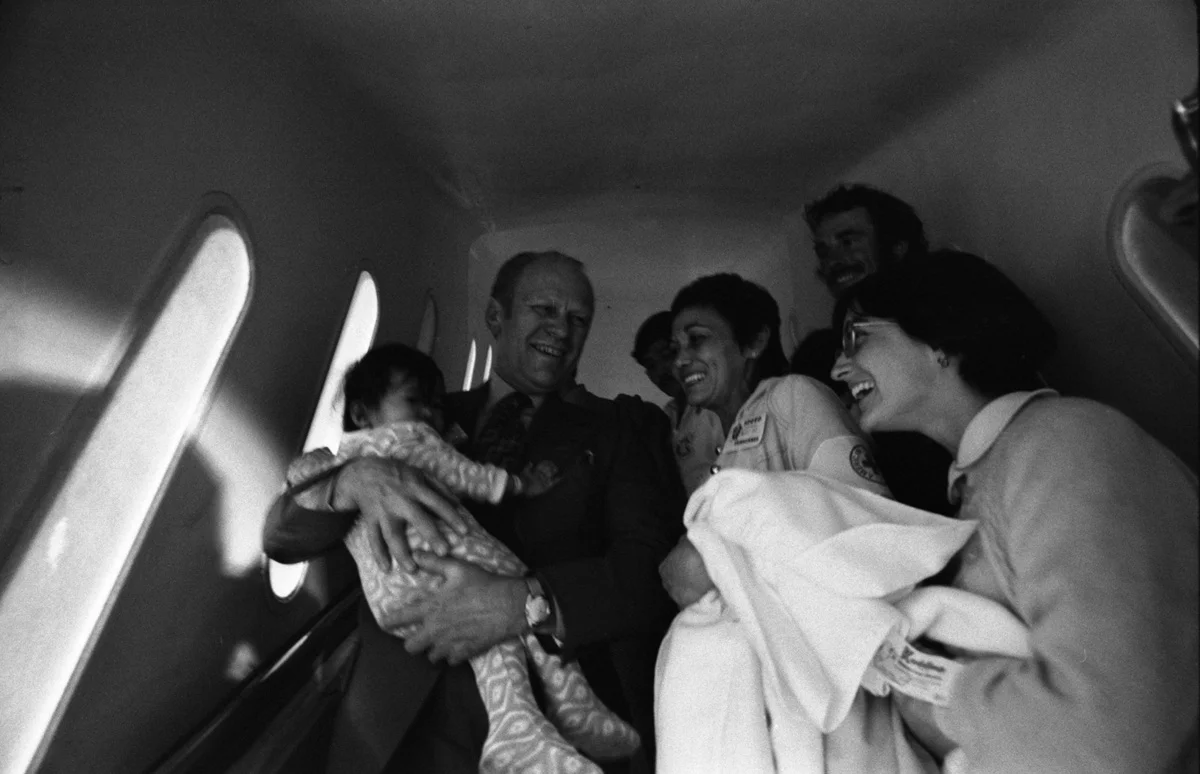
Operation Babylift was a U.S. evacuation of children from South Vietnam in April 1975, announced by President Gerald Ford as Communist forces closed in on Saigon. More than 3,300 infants and children were flown to the United States and other Western countries for adoption. Some were Amerasian; many were full Vietnamese.
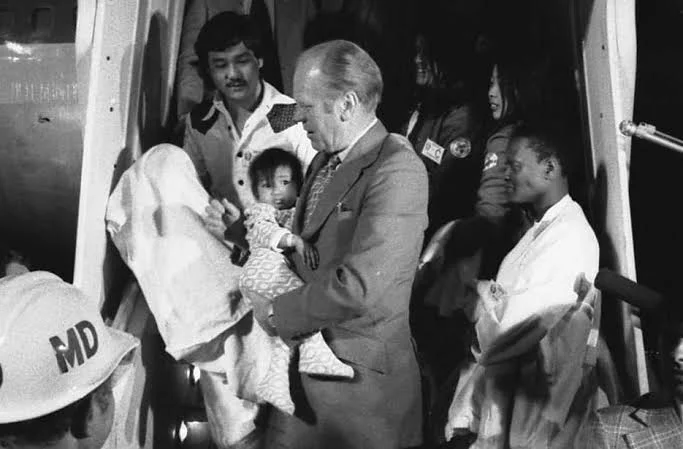
It began in tragedy. On April 4, 1975, the first flight — a U.S. Air Force C-5A Galaxy — suffered a failure of its rear cargo door minutes after takeoff from Saigon and crashed in a rice paddy. According to the Defense Intelligence Agency, 138 people died, including 78 children and 35 staff of the U.S. Defense Attaché Office. The flights continued, and Ford personally met a Babylift plane in San Francisco the next day.
Babylift remains controversial. Critics, then and now, pointed out that not all the children were orphans; some had parents who had placed them in orphanages for safety or out of poverty. Lawsuits followed in U.S. courts. For many adoptees, the question of who their Vietnamese families were remains unanswered.
What Happened to Amerasians Left in Vietnam After 1975?
For most, life became harder. After the war, the new government treated close ties with Americans with suspicion. Mothers who had been with American men were often seen as collaborators. Many burned photos, letters and birth papers — the very documents their children would later need to prove an American father.
Amerasian children stood out in a way no document could hide: lighter or darker skin, curly hair, light eyes, height. Many were taunted at school, and some dropped out. Children with African American fathers often faced the harshest prejudice. Some were raised by grandparents or aunts; some ended up in orphanages or on the street.
Two Vietnamese words follow this story everywhere. Con lai simply means “mixed child.” Bụi đời — usually translated in English as “children of the dust” or “dust of life” — actually describes anyone living rough on the streets, a drifter’s life blown about like dust. It was not invented for Amerasians, but so many of them ended up living that way that American reporters began using it as their name.
The First U.S. Law Did Little: 1982
In 1982, Congress passed the Amerasian Immigration Act. It gave preference to children fathered by U.S. citizens in Korea, Vietnam, Laos, Cambodia and Thailand. On paper it was a breakthrough. In practice, it helped very few Vietnamese Amerasians.
- It required proof of an American father — papers many families had destroyed.
- It did not cover mothers or siblings, so a child would have to leave alone.
- The U.S. had no embassy in Hanoi, so cases went through a slow channel called the Orderly Departure Program.
Through that program, about 6,000 Amerasians and 11,000 relatives reached the U.S. before 1988. Then, in 1986, Vietnam stopped processing new cases, objecting to Amerasians being classed as refugees. By then, it said, more than 25,000 cases were waiting.
How a Newspaper Photo Changed U.S. Law
The turning point came from a photograph. Newsday photographer Audrey Tiernan photographed Le Van Minh, an Amerasian teenager disabled by polio who moved through the streets of Ho Chi Minh City on his hands and begged to survive.
When the picture ran, students at Huntington High School on Long Island decided to do something. They gathered signatures and pressed their congressman, Robert Mrazek, to help. Mrazek arranged for Minh to come to the United States; in June 1987, the congressman carried him off the plane himself. Then he wrote a law to help the others.

On August 6, 1987, Mrazek introduced the Amerasian Homecoming Act. It drew 204 House co-sponsors from both parties, and Senator John McCain backed it in the Senate. It was signed in December 1987 and took effect on March 21, 1988.
What Did the Amerasian Homecoming Act Do?
The new law fixed the old one’s biggest problems:
| 1982 Amerasian Immigration Act | 1987 Amerasian Homecoming Act | |
|---|---|---|
| Countries | Korea, Vietnam, Laos, Cambodia, Thailand | Vietnam only |
| Proof of father | Required documents | Appearance could be enough |
| Family | Child alone | Mother, spouse, children and some relatives could come |
| Status in the U.S. | Immigrant, placed with sponsors | Immigrant with refugee benefits |
| Result | A few thousand Vietnamese Amerasians | About 23,000–25,000 Amerasians plus 60,000–70,000 relatives |
The law worked — and it was abused. Because an Amerasian could bring family, some were “adopted” or “married” by unrelated people who paid or promised to take care of them in America. One estimate cited by EBSCO’s research summary is that about 17% of the relatives admitted were not related at all. After 1994, approval rates for new applications dropped sharply.
How Did Amerasians Do in America?
Arriving was not the end of the story. Many Amerasians reached the U.S. as teenagers or young adults with little schooling, speaking only Vietnamese. In America they were often seen as Vietnamese; in the Vietnamese American community they were sometimes seen as outsiders. The U.S. General Accounting Office studied their resettlement in the early 1990s and focused on just these problems: education, jobs and family stability.
Some found their fathers. Most did not. In recent years, consumer DNA tests have changed that: Amerasians in their 50s and 60s have matched with half-siblings and, sometimes, with fathers who are now elderly veterans. Volunteer groups help with the searches, and reunions still make the news.
A smaller number of Amerasians never left Vietnam — some by choice, some because they could not prove their parentage or missed the application windows.
Keep Reading
- Why Are Americans Still Missing in Vietnam 50 Years Later?
- What Happened to the Vietnamese Boat People? Where They Went, How Many Died, and Why the Camps Closed
- How Did the Cu Chi Tunnels Work? Inside the Underground War — and the Tunnel Rats Sent to Fight It
- Why the 17th Parallel? How Vietnam’s Dividing Line Was Chosen in 1954
- Why Didn’t the U.S. Save the French at Dien Bien Phu? Inside Operation Vulture
Frequently Asked Questions
Are Amerasians from Vietnam U.S. citizens?
Not automatically. The Homecoming Act let them immigrate as permanent residents with refugee benefits, after which they could apply for citizenship like other immigrants. Advocates have long pushed Congress to grant automatic citizenship.
What happened to orphans from the Vietnam War?
Thousands were adopted abroad — more than 3,300 through Operation Babylift alone in April 1975. Many more stayed in Vietnamese orphanages or with relatives. Some Babylift adoptees later discovered they had living Vietnamese parents.
Can Amerasians still apply to come to the U.S.?
The Homecoming Act is still law, but very few applications are approved today, largely because proof is so difficult decades later and fraud concerns made screening much stricter.
Why It Still Matters
The Amerasians are one of the war’s most personal legacies: tens of thousands of people who are, by birth, part American and part Vietnamese, and who for years belonged fully to neither country. Their story shows both sides of America’s response — a long delay, and then a law pushed through by high school students and a congressman because of one photograph. For many families, the search that began in 1975 is still going on.
Sources
- Library of Congress — H.R. 3171, Amerasian Homecoming Act, 100th Congress (congress.gov)
- U.S. General Accounting Office — “Vietnamese Amerasian Resettlement: Education, Employment, and Family” (GAO/PEMD-94-15, 1994)
- Reagan Library, NSC Asian Affairs Directorate files — memo on Amerasians in Vietnam (estimate 10,000–15,000)
- EBSCO Research Starters — “Amerasian Homecoming Act of 1987” (immigration totals; fraud estimate)
- Carl L. Bankston, “Amerasian Homecoming Act of 1988,” Encyclopedia of Diversity in Education (SAGE, 2012)
- Defense Intelligence Agency — “Remembering the First Operation Babylift Flight” (dia.mil)
- Dartmouth College Library course exhibit — “The Passage of the US Amerasian Homecoming Act” (Le Van Minh and Huntington High School)
- Los Angeles Times (via Open Casebook) — “Amerasian Teen-ager Welcomed to New Home With Banners, Flag,” June 4, 1987
- The Roanoke Times, July 30, 1990 — Amerasian program report (government estimate of 15,000)
- Smithsonian Magazine — “Children of the Vietnam War”; USA Today (March 14, 2023) — veterans reuniting with Amerasian children