The U.S. didn’t save the French at Dien Bien Phu because President Eisenhower would only intervene with the approval of Congress and the help of allies — and he got neither. Congressional leaders refused to back an American-only air strike, Britain refused to join, and the U.S. Army warned that bombing alone could not win. On May 7, 1954, after 56 days of siege, the French garrison fell.
Yet “the U.S. did nothing” is not quite right. Washington drew up a bombing plan called Operation Vulture, debated using atomic weapons, and already had American pilots flying over the valley. This is the story of how close it came — and why it stopped.
Key Facts
- Siege: March 13 – May 7, 1954, in a valley in northwest Vietnam
- French request: U.S. air strikes, first discussed in Washington on March 20, 1954
- The plan: Operation Vulture — about 60 B-29 bombers from the Philippines plus Navy carrier aircraft
- Turning point: April 3, 1954 meeting with congressional leaders, who demanded allies first
- Final blow: Britain’s refusal, confirmed around April 25–26, 1954
- Americans who did fly there: 37 civilian pilots of the CIA-owned airline Civil Air Transport; two were killed on May 6
What Did France Ask the U.S. to Do?
By late March 1954, the French base at Dien Bien Phu was in trouble. Viet Minh artillery hidden in the hills had shut down its airstrip, and the garrison could only be supplied by parachute. On March 20, France’s armed forces chief, General Paul Ély, flew to Washington to ask for help.
He met Admiral Arthur Radford, chairman of the Joint Chiefs of Staff, who favored action. Radford outlined a plan: about 60 B-29 bombers flying from the Philippines, escorted by fighters from U.S. Navy carriers, would strike the Viet Minh positions around the valley. The French called it Opération Vautour — Operation Vulture.
Ély went home believing the Americans would come if Paris asked. On the night of April 4–5, the French government formally requested an immediate U.S. air strike.
America Was Already Paying for France’s War
By the time France asked for bombers, the U.S. was already deep in the war — with money, not men. In fiscal 1954, American aid reached about $1.06 billion, roughly 78% of what France spent on Indochina that year, according to the Pentagon’s own secret history.
It had not always been that way. During World War II, President Roosevelt wanted France out of Indochina, and in 1945 a small American OSS team worked alongside Ho Chi Minh’s Viet Minh against Japan. Ho then wrote to President Truman several times asking for support; the National Archives still holds his telegram of February 28, 1946. Truman never replied. Three things turned Washington toward France:
- Europe came first. The U.S. needed France as a strong NATO ally, and French leaders said they could not defend Europe and fight in Asia without help.
- China fell. Mao’s Communists won China’s civil war in 1949; in January 1950, China and the Soviet Union recognized Ho’s government.
- Korea exploded. After North Korea invaded the South in June 1950, Washington saw Vietnam as another front of the same war.
A National Security Council paper, NSC 64, completed on February 27, 1950, declared Indochina a “key area” that must not fall to communism. The money followed:
| Year | U.S. aid for France’s war in Indochina | Share of France’s war costs |
|---|---|---|
| 1950 | $10 million (first military aid, announced May 8) | under 1% |
| By January 1951 | about $50 million delivered | — |
| 1952–1953 | hundreds of millions a year | roughly one-third |
| Fiscal 1954 | $1.063 billion | 78% |
One caution: the famous “78%” is true for 1954 only. Over the whole war, which began in 1946 before any U.S. money arrived, the American share was much smaller. Paying for most of the war in 1954 is exactly why Washington had to decide, that spring, whether to go one step further.
Reason 1: Eisenhower Wanted Congress and Allies On Board
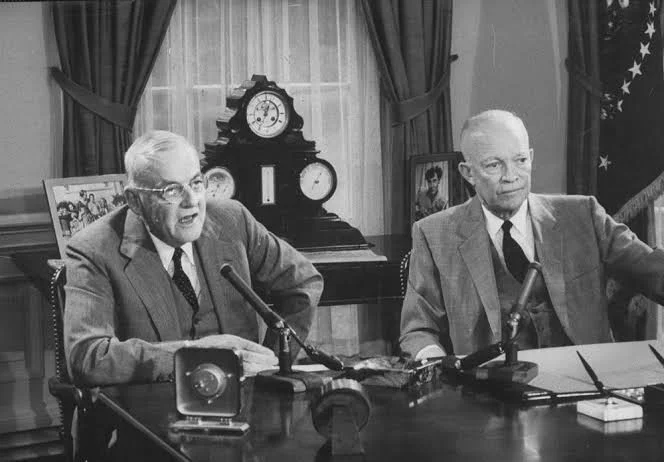
Eisenhower had a firm rule: no American act of war without Congress. On April 3, 1954, Secretary of State John Foster Dulles and Admiral Radford met eight congressional leaders from both parties, including the Senate Democratic leader, Lyndon B. Johnson.
Their answer was “not alone.” The lawmakers set conditions before they would support intervention:
- Allies must join, especially Britain and Commonwealth nations — no repeat of Korea, where Americans did most of the fighting.
- France must speed up independence for Vietnam, Laos and Cambodia, so America would not be fighting to keep a colony.
- France must keep its own forces in the war rather than hand it over to the U.S.
The Korean War had ended in an armistice only nine months earlier, after more than 36,000 American deaths. Few in Congress wanted another land war in Asia.
Reason 2: The Army Said Bombing Would Not Be Enough
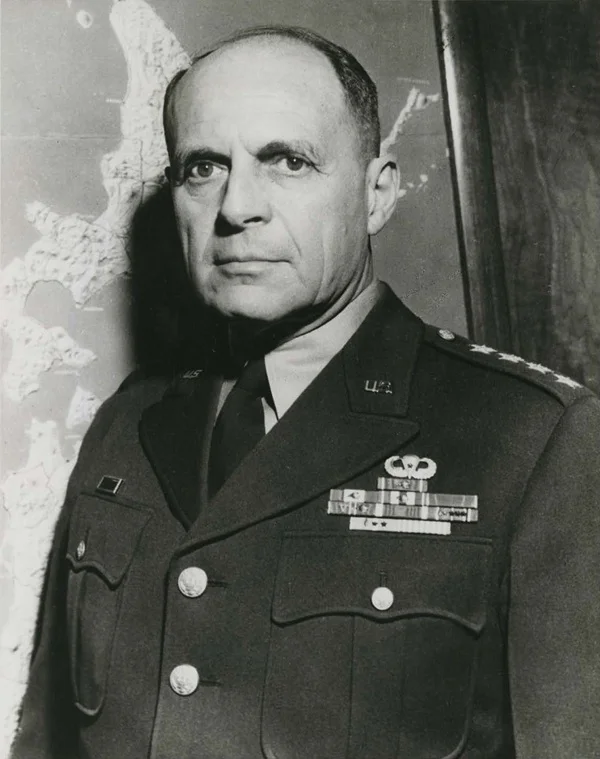
Inside the Pentagon, the Army Chief of Staff, General Matthew Ridgway, was alarmed at talk of fixing the problem from the air. His staff gave the National Security Council a blunt paper in the first week of April 1954. Its numbers, preserved in the Pentagon Papers, were sobering:
| Scenario (Army estimate, April 1954) | U.S. ground forces needed to win |
|---|---|
| France withdraws, China stays out | 7 divisions |
| France stays, China intervenes | 7 divisions |
| France withdraws, China intervenes | 12 divisions |
| Air and naval power alone | “A victory in Indochina cannot be assured” |
The same paper warned that atomic weapons “would not reduce the number of ground forces required.” In other words, Operation Vulture would be the first step, not the last. Eisenhower, a former five-star general, had told his National Security Council in January that a war in Indochina “would absorb our troops by divisions.”
Reason 3: Britain Said No
Dulles tried to build a coalition he called “United Action”, which he announced in a speech on March 29, 1954. The idea was that the U.S., Britain, France, Australia, New Zealand, Thailand, the Philippines and the Associated States of Indochina would act together.
Everything depended on Britain. Prime Minister Winston Churchill and Foreign Secretary Anthony Eden believed Dien Bien Phu could not be saved by air power, feared a wider war with China, and wanted to see what the Geneva peace conference, opening at the end of April, could achieve. Britain’s final refusal came in late April. Without it, Congress’s first condition could not be met, and Operation Vulture was dead.
Did the U.S. Offer France Atomic Bombs?
This is the most debated part of the story. French Foreign Minister Georges Bidault later said that Dulles offered France two atomic bombs in April 1954. Dulles denied making any such offer, and American records show no formal proposal.
What the records do show is that U.S. military planners studied using a small number of nuclear weapons, and that the idea reached the President. Eisenhower rejected it. According to accounts by historians, he told his advisers that America could not use those weapons against Asians for a second time in less than ten years.
The fair summary: nuclear use was discussed in Washington, Bidault believed an offer was made, and no bombs were ever transferred or authorized.
So Did the U.S. Help the French at All?
Yes — more than most people realize, just not with combat forces.
- Money: as shown above, about 78% of France’s war costs in 1954.
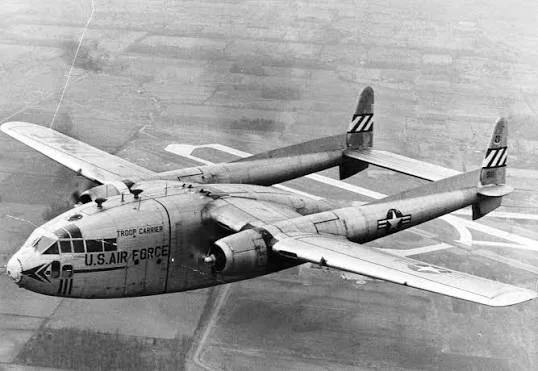
- Aircraft and mechanics: the U.S. lent B-26 bombers and C-119 transport planes, and sent 200 Air Force mechanics to keep them flying — the first uniformed Americans assigned to the war.
- Pilots: 37 American civilian pilots working for Civil Air Transport, an airline secretly owned by the CIA, flew French-marked C-119s over Dien Bien Phu, making 682 supply drops.
On May 6, 1954, one day before the base fell, pilot James McGovern — nicknamed “Earthquake McGoon” — and his co-pilot Wallace Buford were dropping a howitzer to the southern outpost called Isabelle when anti-aircraft fire hit their plane. They nursed it about 75 miles into Laos before it crashed. Both were killed, along with French crewmen. Fifty-one years later, in February 2005, France made the CAT pilots of Dien Bien Phu knights of the Legion of Honor.
Was Eisenhower Blocked — or Did He Want to Stay Out?
Historians disagree, and the question still matters for understanding presidential power.
- “Congress stopped him”: a Washington Post writer, Chalmers Roberts, called April 3, 1954, “the day we didn’t go to war,” suggesting the President wanted to act and lawmakers held him back.
- “He set conditions he knew could not be met”: many later historians argue Eisenhower privately opposed a land war in Asia and used Congress and allies as a way to say no without looking weak.
- “He kept his options open”: a third view holds that Eisenhower was genuinely willing to intervene if his conditions were met — and kept pushing for “United Action” after Dien Bien Phu fell.
All three agree on the outcome: the decision not to bomb was made in Washington and London, not on the battlefield.
What Happened Next?
Dien Bien Phu surrendered on May 7, 1954. The next day, the Geneva conference began talks on Indochina. By July, France had agreed to leave and Vietnam was divided at the 17th parallel.
The failure of “United Action” did not end the idea. In September 1954, the U.S., Britain, France and five other countries signed the Southeast Asia Collective Defense Treaty, creating SEATO — the coalition Dulles had wanted in April, formed a few months too late for the French. And the United States, having refused to send bombers for France, began sending advisers and money to the new government of South Vietnam.
Why It Matters to Americans
In 1954, an American president, a Congress still scarred by Korea, and an Army general who did the math all concluded that air power alone could not win in Vietnam and that ground troops would be needed by the hundreds of thousands. Eleven years later, the U.S. sent those troops anyway. The debate over Dien Bien Phu is the first time Washington asked the question that would define the next two decades — and, that spring, answered no.
Keep Reading
- Why Are Americans Still Missing in Vietnam 50 Years Later?
- What Happened to the Vietnamese Boat People? Where They Went, How Many Died, and Why the Camps Closed
- What Happened to Amerasian Children After the Vietnam War?
- How Did the Cu Chi Tunnels Work? Inside the Underground War — and the Tunnel Rats Sent to Fight It
- Why the 17th Parallel? How Vietnam’s Dividing Line Was Chosen in 1954
Frequently Asked Questions
Why did the U.S. support France in Indochina?
After China’s Communist victory in 1949 and the Korean War in 1950, Washington saw the war in Vietnam as part of the fight against communism in Asia, and it needed France as a strong ally in Europe. U.S. aid began with $10 million in 1950 and reached about 78% of France’s war costs in 1954.
What was Operation Vulture?
Operation Vulture was a proposed U.S. air operation in 1954 to break the siege of Dien Bien Phu, using about 60 B-29 bombers from the Philippines and Navy carrier aircraft. It was never carried out.
Who was the first American killed in Vietnam?
That depends on how you count. Lt. Col. Peter Dewey of the OSS was killed in Saigon in 1945; CAT pilots James McGovern and Wallace Buford were killed in combat over Dien Bien Phu in 1954; and the official Vietnam War memorial list begins with deaths from 1956.
Why did the British refuse to help at Dien Bien Phu?
Churchill’s government doubted that air strikes could save the base, feared a wider war with China, and preferred to seek a settlement at the Geneva conference that opened in late April 1954.
Sources
- U.S. Department of Defense, Pentagon Papers, Part II and Part IV.A.2 “Aid for France in Indochina, 1950–54” — National Archives, declassified 2011
- Foreign Relations of the United States, 1950, Vol. VI and 1951, Vol. VI — NSC 64 and its first progress report
- U.S. National Archives — Ho Chi Minh’s telegram to President Truman, February 28, 1946 (NARA ID 305263); DocsTeach
- U.S. Department of Defense, United States–Vietnam Relations, 1945–1967 (Pentagon Papers), Part II.B “Toward a Negotiated Settlement” — Army position paper, April 1954
- Foreign Relations of the United States, 1952–1954, Vol. XIII — documents on the April 3, 1954 congressional meeting and Dulles’s April 24 reply to France (history.state.gov)
- FRUS 1952–1954, Vol. XIII — Ridgway memorandum to the Joint Chiefs, April 6, 1954
- Office of the Historian — “Dien Bien Phu & the Fall of French Indochina, 1954”
- Vietnam War Commemoration — “Viet Minh Attack Dien Bien Phu” and “Two American CAT Pilots Die at Dien Bien Phu” (vietnamwar50th.com)
- CIA Museum — “Earthquake’s Final Flight” (cia.gov)
- Air America Association — “CAT Pilots to Be Honored by France” (air-america.org)
- BBC News Magazine — “Dien Bien Phu: Did the US offer France an A-bomb?” (May 5, 2014)
- Air & Space Forces Magazine — “Dien Bien Phu” (Eisenhower NSC remarks, January 8, 1954)
- Eisenhower for Our Time (Cornell University Press) — historians’ debate over April 3, 1954