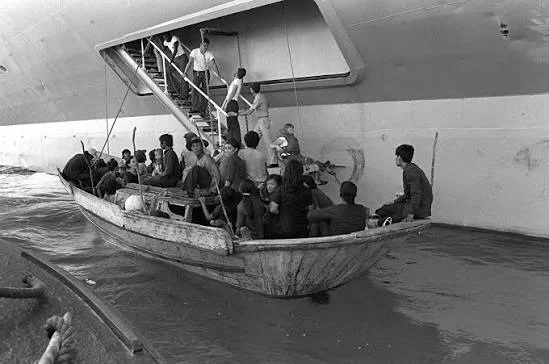
After the Vietnam War, hundreds of thousands of Vietnamese fled their country in small, overcrowded boats. Between 1975 and 1995, almost 800,000 boat people reached safety in other countries, according to the UN refugee agency (UNHCR) — and the agency estimates that at least 200,000, and possibly far more, died at sea from storms, hunger and pirate attacks. Most survivors spent months or years in camps across Southeast Asia and Hong Kong before resettling in the United States, Canada, Australia, France and other countries. The last camp closed in 2000.
Their story began as the war ended and lasted another 25 years. It changed refugee law, filled whole neighborhoods in American cities, and is still remembered very differently in Vietnam and abroad.
Key Facts
- Who: Vietnamese — including many ethnic Chinese (Hoa) — who left by sea after April 1975
- Peak: 1978–1979; arrivals reached about 56,000 in the single month of June 1979
- Reached safety, 1975–1995: almost 800,000 (UNHCR)
- Died at sea: UNHCR estimates 200,000–250,000; some estimates run to 400,000
- Turning points: Geneva conferences of July 1979 and June 1989
- Largest resettlement country: the United States — over half of all boat people
Who Were the Boat People?
“Boat people” — thuyền nhân in Vietnamese — were people who escaped Vietnam by sea after the Communist victory in 1975. In Vietnamese, the act of escaping was called vượt biên, “crossing the border.” They were former South Vietnamese soldiers and officials, shopkeepers, farmers, fishermen, students, Catholics and Buddhists, and a very large number of ethnic Chinese Vietnamese, known as the Hoa.
They are different from the roughly 130,000–140,000 people who left with the American evacuation in April 1975. The boat people left later, on their own, without permission and usually at night.
Why Did the Vietnamese Boat People Leave?
There was no single reason. Most refugees described a mix of fear, loss and hunger.
- Re-education camps: hundreds of thousands of former South Vietnamese officers, officials and others were sent to camps, some for many years. Their families faced suspicion and fewer chances for school and work.
- Loss of property: in 1978 the government moved to end private trade in the South. Businesses in Saigon’s Cholon district, many owned by ethnic Chinese, were seized.
- “New Economic Zones”: many city families were sent to clear land in remote rural areas, often with few tools and little food.
- War again: in late 1978 Vietnam invaded Cambodia, and in early 1979 China attacked Vietnam’s northern border. Young men faced conscription.
- Poverty: the postwar economy was in crisis until reforms began in the late 1980s.
Why Did So Many Ethnic Chinese Leave in 1978–1979?
As relations between Vietnam and China collapsed, the Hoa — about 4% of Vietnam’s population in 1975 — came under suspicion as a possible “fifth column.” From spring 1978, ethnic Chinese began leaving in very large numbers, first overland into China and then by sea. By the end of 1979, about 250,000 had found refuge in China alone.
Many sea departures in 1978–1979 were not entirely secret. British Hong Kong officials gathering refugee accounts at the time reported that departing ethnic Chinese had to pay in gold and sign a declaration giving their property to the government before leaving from ports such as Vung Tau. In Vietnamese, these trips are sometimes called the “semi-official” departures. Vietnam’s Foreign Ministry, in a June 1978 statement, rejected China’s accusations that it was persecuting the Hoa. By 1989, the Hoa population in Vietnam had fallen by about half.
What Happened at Sea?
The journey was the deadliest part. Boats were often river or fishing craft never built for the open sea, carrying many times their safe load. People ran out of water and fuel, engines failed, and storms swamped boats in the South China Sea.
Pirates, many of them fishermen from the Gulf of Thailand, attacked boats repeatedly — robbing refugees of the gold they had hidden, assaulting women and killing many. In 1982, Thailand and UNHCR began an anti-piracy program with international funding, which reduced but did not end the attacks.
How many died? Nobody can know. UNHCR has estimated 200,000 to 250,000 deaths; other estimates reach 400,000. Many boats simply disappeared.
Who Rescued Them?
Passing merchant ships sometimes sailed by, because rescuing refugees could mean weeks of delay and ports that refused to let them land. Others stopped. Navy ships from the United States and other countries picked up thousands of people. In 1979, a German group chartered a freighter, the Cap Anamur, to search for boats in the South China Sea, and similar private rescue ships followed.
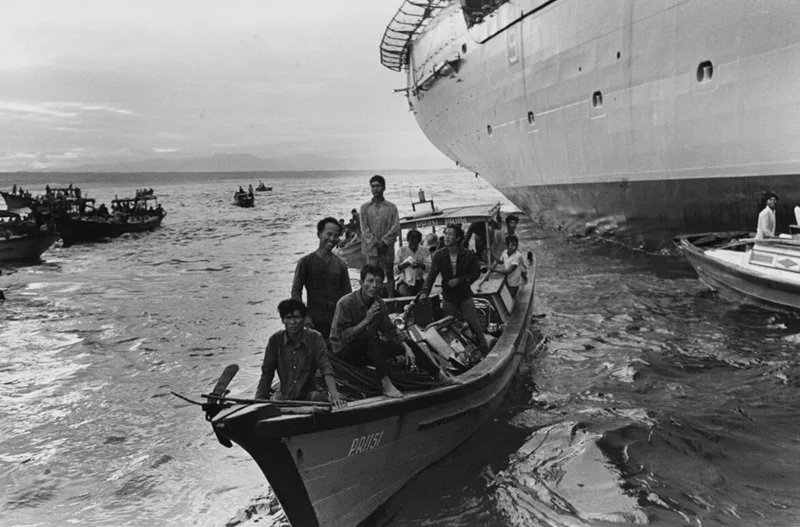
Some rescues were large and dramatic. In late 1978 and early 1979, freighters such as the Hai Hong and Huey Fong arrived off Malaysia and Hong Kong carrying 2,500 to 3,300 refugees each, raising suspicions that some voyages were organized for profit.
Where Did the Vietnamese Boat People Go?
Almost all boat people first landed in a nearby country that gave them temporary shelter — “first asylum” — while they waited for a country willing to take them permanently.
| First landing place | Arrivals (period) | What happened |
|---|---|---|
| Malaysia | over 124,000 (1975–1979) | Most held on Pulau Bidong island; about 250,000 passed through it by 1991 |
| Indonesia | over 51,000 (1975–1979) | Camps on Galang and other islands |
| Thailand | nearly 26,000 (1975–1979) | Also received land refugees from Laos and Cambodia |
| Philippines | over 12,000 (1975–1979) | Later hosted a processing center that taught English to refugees headed to the U.S. |
| Hong Kong | more than 200,000 (1975–2000) | About 143,000 resettled abroad and 72,000 returned to Vietnam (Hong Kong government) |
| China | about 250,000 ethnic Chinese by end of 1979 | Most stayed; about 290,000 refugees from Vietnam were still in China in 2000 |
From the camps, most boat people moved on. The United States took more than half of them. Canada, Australia and France each accepted tens of thousands, and smaller numbers went to Britain, West Germany, Norway, Japan and other countries.
Life in the Refugee Camps
Camps ranged from crowded open islands to fenced detention centers. Pulau Bidong, a small island off Malaysia, opened in August 1978 and at times held tens of thousands of people in shacks of wood and plastic sheeting. Refugees ran schools, churches, pagodas and markets while they waited for interviews. Some waited months; others, years.
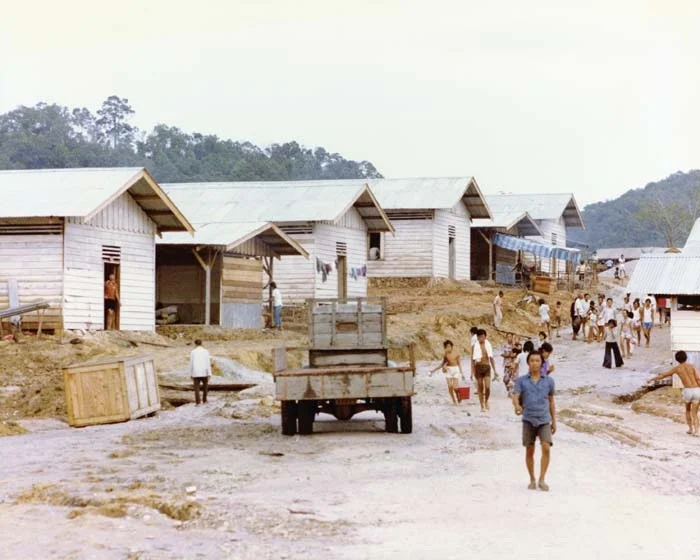
By 1979, the system was near collapse. Malaysia began towing boats back out to sea, and other first-asylum countries threatened to do the same.
How Did the World Respond? Geneva 1979
In July 1979, the UN called an international conference on Indochinese refugees in Geneva. Sixty-five countries attended. The deal had three parts: Southeast Asian countries would keep giving temporary asylum, Western countries pledged about 260,000 resettlement places and $160 million, and Vietnam agreed to try to stop illegal departures and allow an Orderly Departure Program — a legal way to emigrate without risking the sea.
It worked for a time. Departures fell to a few thousand a month, and resettlement rose from about 9,000 a month to about 25,000. The United States led on both slots and money. The next year Congress passed the Refugee Act of 1980, which created the modern U.S. system for admitting refugees every year.
Why Did the Camps Close? The 1989 Plan
In the late 1980s, departures rose again, especially to Hong Kong — but Western countries were taking fewer people, and many new arrivals were seen as leaving for economic reasons. In June 1989, a second Geneva conference adopted the Comprehensive Plan of Action (CPA).
- Everyone arriving after a cut-off date would be screened individually. Only those found to be refugees would be resettled.
- Those “screened out” would be sent back to Vietnam, with UNHCR monitoring their return and providing small grants.
- Legal emigration through the Orderly Departure Program would be expanded.
The CPA was controversial. Refugees in Hong Kong protested, some violently, against forced return. But it ended the exodus. Pulau Bidong closed on October 30, 1991. The CPA formally ended on December 31, 1995. The last camp, Pillar Point in Hong Kong, closed at midnight on May 31, 2000, and its remaining residents were allowed to settle in Hong Kong.
What Happened to the Boat People Who Came to America?
Most settled near earlier Vietnamese arrivals, in California, Texas, Washington state, Virginia and elsewhere. Between 1975 and 1995, more than 1 million Vietnamese resettled in the United States through all programs — the 1975 evacuation, the boat exodus, the Orderly Departure Program and special programs for former re-education camp prisoners and Amerasians.
The early years were hard: low-paid jobs, language barriers, and sometimes hostility from neighbors. Over time, communities such as Little Saigon in Orange County, California, grew into centers of business and culture. Today the Vietnamese American population is more than 2 million people, and many of the children of boat people became doctors, engineers, soldiers, writers and elected officials.
How Does Vietnam See the Boat People Today?
For years, Vietnam’s government described those who left illegally as traitors or as economic migrants lured by the West. That view has softened. Since the economic reforms of the late 1980s, Vietnam has courted overseas Vietnamese, known as Việt kiều, as visitors, investors and senders of money home, and many former boat people now travel back to Vietnam. Memorials to the boat people abroad, however, still sometimes draw objections from Hanoi.
Keep Reading
- Why Are Americans Still Missing in Vietnam 50 Years Later?
- What Happened to Amerasian Children After the Vietnam War?
- How Did the Cu Chi Tunnels Work? Inside the Underground War — and the Tunnel Rats Sent to Fight It
- Why the 17th Parallel? How Vietnam’s Dividing Line Was Chosen in 1954
- Why Didn’t the U.S. Save the French at Dien Bien Phu? Inside Operation Vulture
Frequently Asked Questions
How many Vietnamese boat people died?
No one knows exactly. UNHCR has estimated 200,000 to 250,000; other estimates reach 400,000. Many boats vanished without a trace.
When did the boat people stop leaving Vietnam?
Large-scale departures ended in the early 1990s after the 1989 Comprehensive Plan of Action made resettlement depend on individual screening. The last camp, in Hong Kong, closed in 2000.
Were the boat people refugees or economic migrants?
Both, depending on when and why they left. Until 1989 almost all were accepted as refugees; after 1989, each person was screened, and many were judged not to qualify and were returned.
Why It Still Matters
The boat people crisis shaped how the world handles refugees today: the idea of temporary “first asylum,” shared resettlement quotas, legal departure programs and individual screening all came out of it. For Americans, it also explains how a war that ended in 1975 created one of the country’s largest immigrant communities — built in large part by people who once crossed the South China Sea in boats no one expected to survive.
Sources
- UNHCR — The State of the World’s Refugees 2000, chapter on the Indochinese exodus; Refugees Magazine No. 99 (1995), “Final act: closing down the CPA”
- Wikipedia — “Vietnamese boat people” and “Indochina refugee crisis” (UNHCR figures, Hoa population, monthly arrivals)
- Cambridge University Press — chapter on Vietnamese resettlement in the United States, 1975–1995 (ASEAN arrival figures; Geneva 1979 pledges)
- Hong Kong Government — Hong Kong Yearbook 2002 and 2003, “Vietnamese Refugees and Migrants”
- Hong Kong in Texts (histsyn.com) — British Hong Kong report “Refugees from Vietnam” (1978–1979) and “Vietnamese Boat People: Historical Background Brief”
- Wilson Center Digital Archive — Statement by Vietnam’s Ministry of Foreign Affairs on the Hoa, June 6, 1978
- U.S. Committee for Refugees, World Refugee Survey 2001 — Vietnam (via Refworld)
- Human Rights Watch — “Hong Kong: Historical Background” (1997)
- International Peace Institute — Alexander Casella, “Managing the ‘Boat People’ Crisis: The Comprehensive Plan of Action” (2016)
- Vietnamese Heritage Museum — Pulau Bidong camp history (vietnamesemuseum.org)