Last updated:
The Pacific War was the part of World War II fought between Japan and the Allies — led by the United States — across the Pacific Ocean and East Asia from December 1941 to August 1945. Japan expanded fast after attacking Pearl Harbor, but lost the initiative at Midway in June 1942. The U.S. then fought its way toward Japan island by island. After bloody battles at Iwo Jima and Okinawa, the atomic bombings of Hiroshima and Nagasaki, and the Soviet Union’s entry into the war, Japan announced its surrender on August 15, 1945, and signed it on September 2.
For Americans, it was a war fought far from home, on islands most had never heard of — and it reshaped the country’s place in the world.
Key Facts
- Dates (U.S. involvement): December 7, 1941 – September 2, 1945
- Main sides: Japan vs. the United States, China, Britain and the Commonwealth, Australia, New Zealand, the Netherlands, and (from August 1945) the Soviet Union
- Key American commanders: Admiral Chester Nimitz (Pacific Ocean Areas) and General Douglas MacArthur (Southwest Pacific)
- Turning point: the Battle of Midway, June 4–7, 1942
- End: surrender announced August 15, 1945 (V-J Day); signed aboard USS Missouri on September 2, 1945
Why Did Japan Go to War With the United States?
Japan had been at war in China since 1937 and wanted control of East Asia’s resources, especially oil, rubber and tin. It had almost no oil of its own and bought most of it from the United States.
In July 1941, after Japanese troops moved into southern French Indochina, the U.S., Britain and the Netherlands froze Japanese assets, cutting off its oil supply. Japan’s leaders faced a choice: pull back from China, or seize the oil fields of the Dutch East Indies (today’s Indonesia). They chose war — and decided to knock out the U.S. Pacific Fleet first so it could not interfere.
1941–1942: Japan’s Lightning Advance
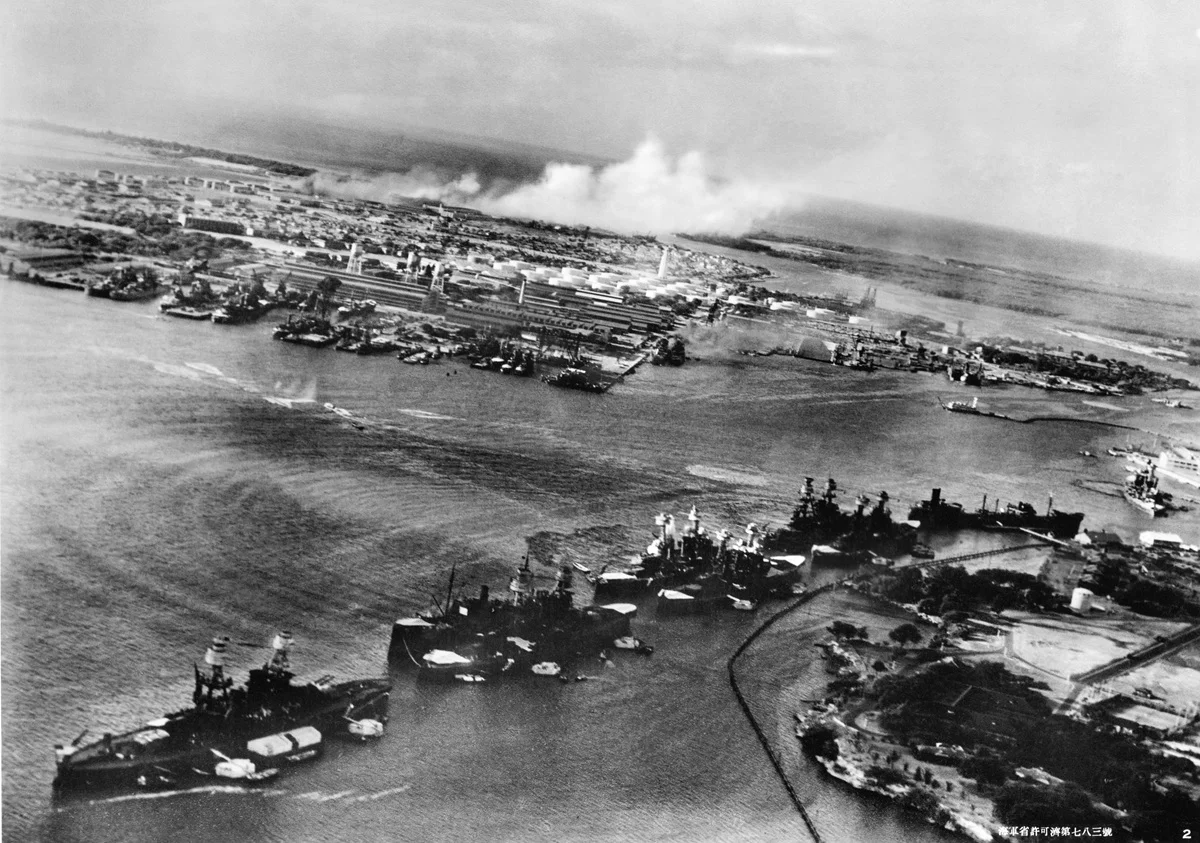
On December 7, 1941, Japanese carrier planes struck the U.S. fleet at Pearl Harbor, Hawaii, sinking or damaging eight battleships and killing more than 2,400 Americans. The carriers left without launching a third strike at the base’s fuel tanks and repair yards — a decision still debated today. Within hours, Japan also attacked the Philippines, Guam, Wake Island, Malaya and Hong Kong.
Four days later, Germany declared war on the U.S., turning two wars into one global conflict.
At home, fear of a Japanese attack on the West Coast led to Executive Order 9066 in February 1942. About 120,000 Japanese Americans, most of them U.S. citizens, were forced into camps for the rest of the war.
The next five months were a string of Allied defeats. Hong Kong, Malaya and Singapore fell. In the Philippines, American and Filipino troops held out on the Bataan Peninsula until April 9, 1942, and on Corregidor until May. Thousands of the prisoners from Bataan died on a forced march to prison camps that became known as the Bataan Death March.
The Turning Points
| Battle | When | Why it mattered to America |
|---|---|---|
| Coral Sea | May 4–8, 1942 | First battle fought entirely by carrier aircraft; stopped Japan’s move toward Australia |
| Midway | June 4–7, 1942 | Four Japanese carriers sunk; Japan lost the initiative for good |
| Guadalcanal | August 1942 – February 1943 | First major U.S. ground offensive; Japan forced to retreat |
| Philippine Sea | June 19–20, 1944 | Japanese naval air power destroyed — the “Great Marianas Turkey Shoot” |
| Leyte Gulf | October 23–26, 1944 | Largest naval battle in history; Japan’s navy ceased to be a major fighting force |
Midway
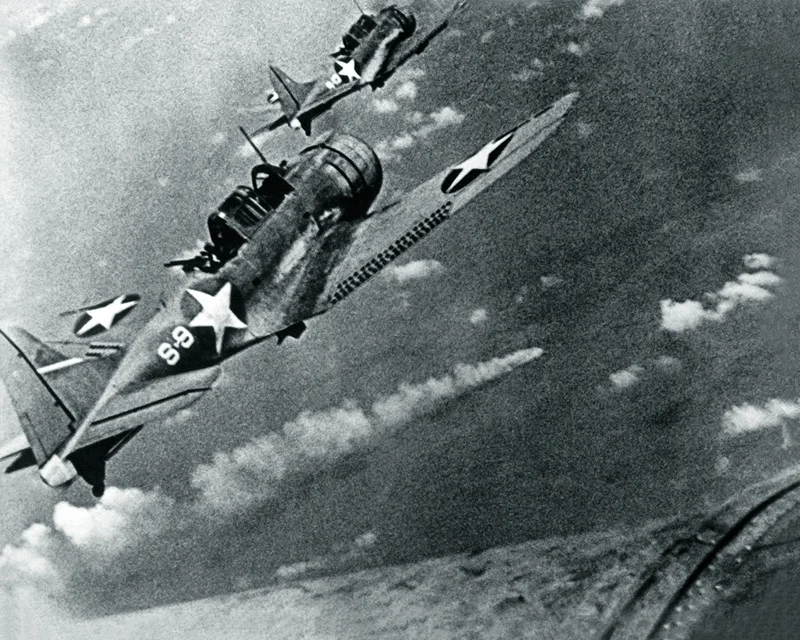
U.S. Navy codebreakers learned that Japan planned to attack Midway Atoll. Admiral Nimitz set a trap with his three available carriers. On June 4, 1942, American dive bombers caught the Japanese carriers while they were rearming and sank three of them within minutes; a fourth was sunk later that day. The U.S. lost the carrier USS Yorktown. Japan never fully replaced its carriers or its experienced pilots.
Guadalcanal
In August 1942, U.S. Marines landed on Guadalcanal in the Solomon Islands to seize a Japanese airfield. What followed was six months of jungle fighting, disease and night naval battles. When Japan withdrew in February 1943, it was the first time its army had been pushed back for good.
How Did the U.S. Fight Back? Island Hopping
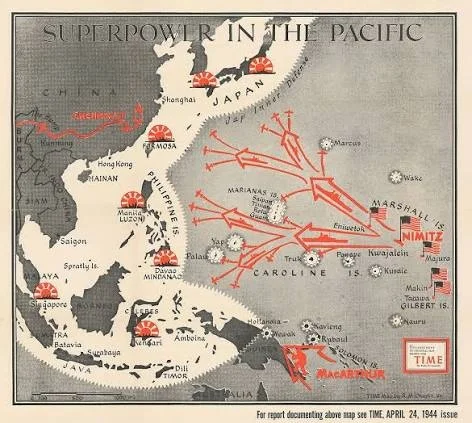
Instead of attacking every Japanese-held island, American commanders captured selected islands that could host airfields and bases, and bypassed others, leaving their garrisons cut off. This became known as “island hopping.” The huge Japanese base at Rabaul, for example, was never invaded; it was surrounded, bombed and left to wither.
Two drives moved toward Japan:
- Central Pacific (Nimitz): the Gilbert Islands (Tarawa, November 1943), the Marshalls, then the Marianas — Saipan, Guam and Tinian in summer 1944.
- Southwest Pacific (MacArthur): New Guinea, then a return to the Philippines at Leyte in October 1944, fulfilling MacArthur’s 1942 promise, “I shall return.”
Capturing the Marianas put Japan’s home islands within range of America’s new long-range B-29 bomber.
1945: The Road to Japan
Iwo Jima and Okinawa
The last island battles were the bloodiest. At Iwo Jima (February–March 1945), about 6,800 Americans were killed taking an eight-square-mile island; nearly all of its 21,000 Japanese defenders died. At Okinawa (April–June 1945), over 12,000 Americans died, along with more than 100,000 Japanese soldiers and a huge number of Okinawan civilians — estimates range from about 40,000 to 150,000. Japanese kamikaze pilots sank or damaged hundreds of U.S. ships.
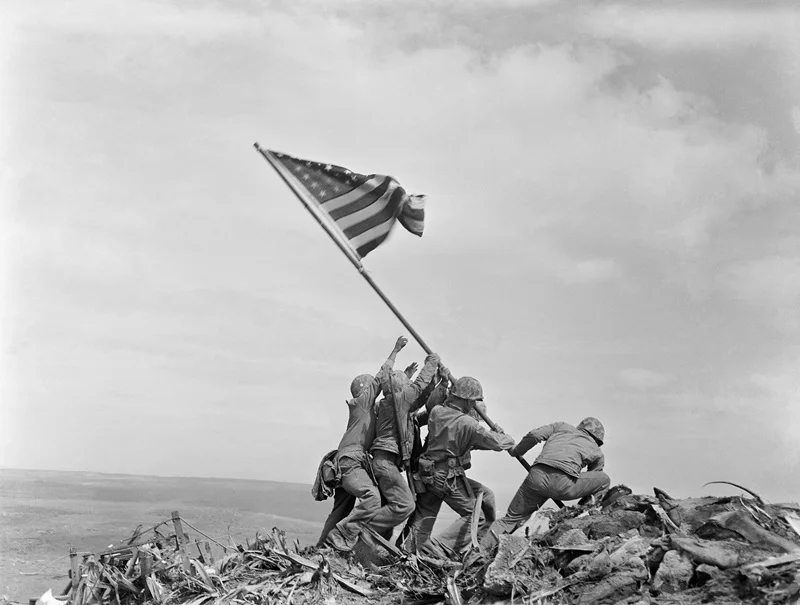
These losses shaped how American leaders thought about invading Japan itself.
The Bombing of Japan
From late 1944, B-29s bombed Japanese cities. A firebombing raid on Tokyo on the night of March 9–10, 1945, killed roughly 80,000 to 100,000 people — more than either atomic bomb’s immediate toll. By summer, dozens of Japanese cities had been burned out.
Hiroshima, Nagasaki and Surrender
On August 6, 1945, the United States dropped an atomic bomb on Hiroshima. On August 8, the Soviet Union declared war on Japan and invaded Manchuria. On August 9, a second bomb destroyed much of Nagasaki. Estimates suggest around 140,000 people had died in Hiroshima and about 70,000 in Nagasaki by the end of 1945.
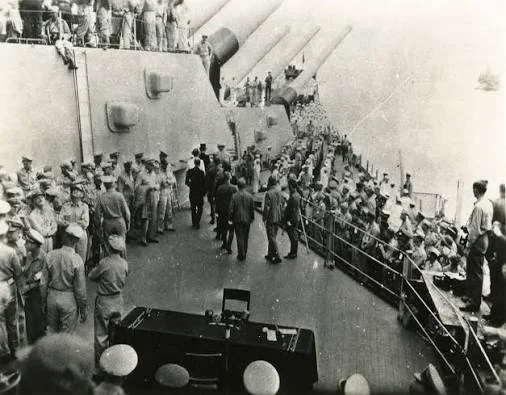
On August 15, Emperor Hirohito announced Japan’s surrender in a radio broadcast — the first time most Japanese had ever heard his voice. The formal surrender was signed aboard USS Missouri in Tokyo Bay on September 2, 1945.
Why Did the U.S. Use the Atomic Bomb?
This remains one of the most debated decisions in American history.
- The case made at the time: President Harry Truman and his advisers argued the bombs would end the war quickly and avoid an invasion of Japan that, judging by Okinawa, could cost hundreds of thousands of American lives and many more Japanese lives.
- The case made by critics: some historians argue Japan was close to surrender, especially once the Soviet Union entered the war, and that a demonstration, a clearer offer to keep the emperor, or more time might have worked. Others point to the bombs’ targeting of cities full of civilians.
Historians still disagree on how much the bombs, compared with the Soviet declaration of war, drove Japan’s decision to surrender.
What Did the Pacific War Cost?
About 100,000 to 110,000 Americans died fighting Japan, out of roughly 405,000 U.S. military deaths in all of World War II. Japan lost around 2.1 million military dead and several hundred thousand civilians. The heaviest toll fell on China and the rest of Asia, where estimates run to well over 15 million deaths from war, massacre, famine and disease.
Figures vary widely between sources, especially for Chinese and other Asian civilians.
Keep Reading
- What Happened to Japanese Americans After the Internment Camps?
- What Happened to Easy Company After WWII? The Real “Band of Brothers” After the War
- What Happened to the Nazi Scientists Brought to America? Operation Paperclip Explained
- What Happened to the Doolittle Raiders Captured by Japan? The Fate of the Eight
- Why Did Japanese Soldiers Refuse to Surrender in WWII? From Iwo Jima to Hiroo Onoda
Frequently Asked Questions
When did the Pacific War start and end?
For the U.S., it began with Pearl Harbor on December 7, 1941, and ended with Japan’s surrender announced August 15, 1945, and signed September 2, 1945. In China, war with Japan had begun in 1937.
Who won the Pacific War?
The Allies, led by the United States. Japan surrendered unconditionally, was occupied by U.S.-led forces until 1952 and adopted a new constitution renouncing war.
Why is it called the Pacific War?
Because most of the fighting between Japan and the Western Allies took place across the Pacific Ocean and its islands, although major campaigns were also fought in China, Burma and India.
Why It Still Matters
The Pacific War made the United States a Pacific power, began the nuclear age and turned Japan from enemy into one of America’s closest allies within a generation. Its battles — Midway, Iwo Jima, Okinawa — are part of the American story. Behind them are smaller stories just as powerful: the third wave that never came, the airmen captured after the Doolittle Raid, the crew of USS Indianapolis lost at sea, and the soldiers who refused to surrender long after the guns fell silent.
Sources
- Ronald H. Spector, Eagle Against the Sun: The American War with Japan (Free Press, 1985)
- Ian W. Toll, Pacific Crucible, The Conquering Tide and Twilight of the Gods (W.W. Norton, 2011–2020)
- Richard B. Frank, Downfall: The End of the Imperial Japanese Empire (Random House, 1999)
- The National WWII Museum — “The Pacific War” and “Research Starters: Worldwide Deaths in World War II”
- Naval History and Heritage Command — battles of Coral Sea, Midway, Leyte Gulf and Okinawa
- U.S. Department of Veterans Affairs — “America’s Wars” fact sheet (U.S. military deaths)
- Atomic Heritage Foundation / National Museum of Nuclear Science & History — Hiroshima and Nagasaki casualty estimates