
Last updated:
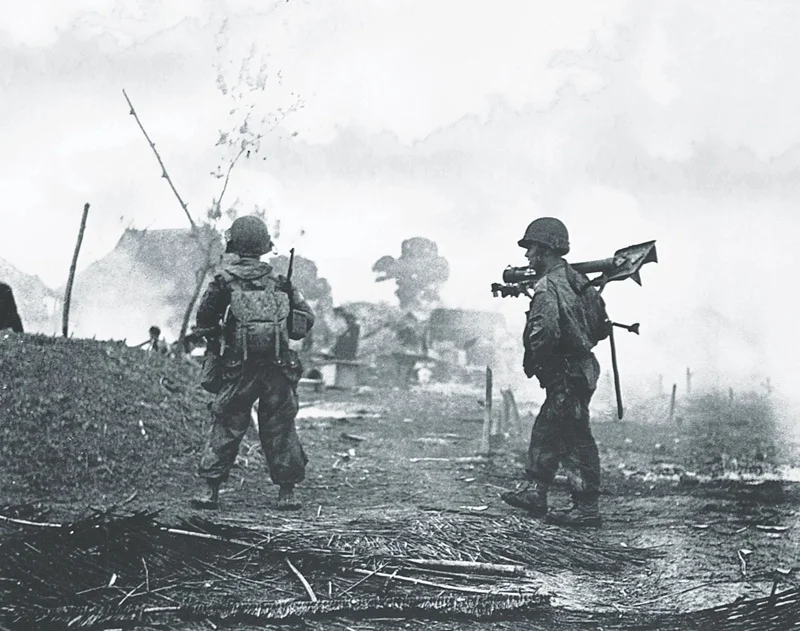
The First Indochina War (1946–1954) was fought between France and the Viet Minh, a communist-led independence movement headed by Ho Chi Minh. France fought to restore its colonial rule after World War II; the Viet Minh fought for independence. It ended with a stunning French defeat at Dien Bien Phu in May 1954 and the Geneva Accords, which split Vietnam in two at the 17th parallel. By then, the United States was paying most of France’s war bill — the first step on America’s own road into Vietnam.
Key Facts
- Dates: December 19, 1946 – July 1954 (fighting in the South began in September 1945)
- Where: French Indochina — mainly Vietnam, also Laos and Cambodia
- Sides: France, the French Union forces and the State of Vietnam vs. the Viet Minh (Democratic Republic of Vietnam)
- Backers: United States (France, from 1950) · China and the Soviet Union (Viet Minh, from 1950)
- Key leaders: Ho Chi Minh, Vo Nguyen Giap · Jean de Lattre de Tassigny, Henri Navarre
- Decisive battle: Dien Bien Phu, March 13 – May 7, 1954
- Result: Viet Minh victory; Geneva Accords; Vietnam divided at the 17th parallel
- Deaths: roughly 75,000–95,000 French Union troops; 175,000–300,000 Viet Minh (Western estimates); civilian deaths in the hundreds of thousands
What Was the First Indochina War?
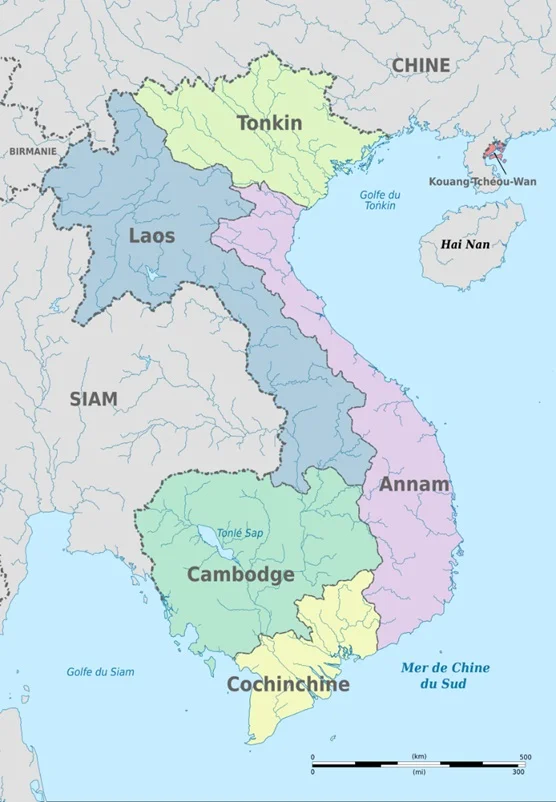
For about 90 years before World War II, Vietnam was a French colony. Starting with an attack on Da Nang in 1858, France took the country piece by piece and split it into three regions — Tonkin in the north, Annam in the center and Cochinchina in the south — then joined them with Laos and Cambodia to form French Indochina.
The First Indochina War was the fight over what would replace that colony after 1945. It pitted France against the Viet Minh (the League for the Independence of Vietnam), founded by Ho Chi Minh in 1941. The Viet Minh were nationalists fighting for independence, but their leadership was communist — and that fact would turn a colonial war into a Cold War battleground.
Five players shaped the war: France, determined to keep its empire and its status as a great power; the Viet Minh of Ho Chi Minh and General Vo Nguyen Giap; the United States, which came to see Vietnam as a front line against communism; Communist China, which armed the Viet Minh from 1950; and Bao Dai, Vietnam’s last emperor, whose “State of Vietnam” France backed as a non-communist alternative.
1945: A Declaration Borrowed From America
World War II broke French rule. After France fell to Germany in 1940, Japanese troops moved into Indochina while the French colonial government stayed in place. On March 9, 1945, Japan suddenly attacked and disarmed the French across the region. Almost a century of French control collapsed overnight.
The same spring, a terrible famine struck northern Vietnam. Estimates of the dead range from about 400,000 to 2 million; no reliable count exists.
When Japan surrendered in August 1945, the Viet Minh moved fast. In a wave of uprisings known in Vietnam as the August Revolution, they took power in Hanoi on August 19 and in Hue and Saigon within days. Emperor Bao Dai abdicated on August 30.
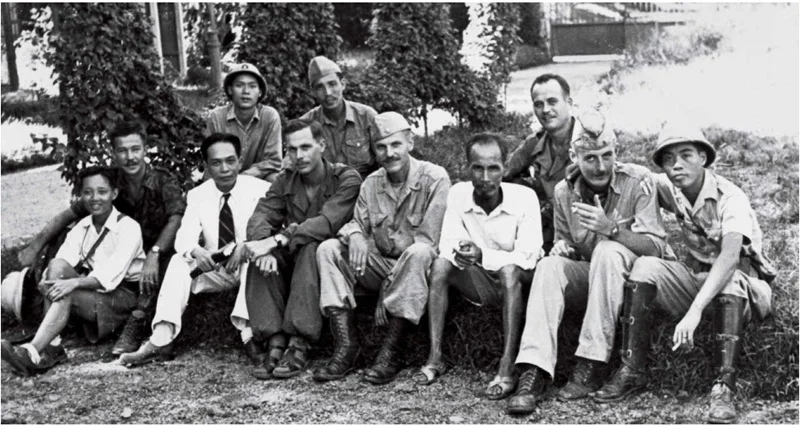
There was an American thread in all this. That summer, a small team from the OSS — America’s wartime intelligence service — was working with the Viet Minh in the mountains north of Hanoi, training fighters to use American weapons against the Japanese.
On September 2, 1945, in Hanoi’s Ba Dinh Square, Ho Chi Minh declared the independence of the Democratic Republic of Vietnam. His opening lines came straight from Thomas Jefferson: “All men are created equal. They are endowed by their Creator with certain unalienable Rights; among these are Life, Liberty, and the pursuit of Happiness.” Over the next months, Ho wrote repeatedly to Washington asking for support. He received no reply.
1945–1946: France Returns and Talks Fail
The Allies had already decided who would disarm the Japanese: Nationalist Chinese troops north of the 16th parallel, British troops in the south. In Saigon, the British commander, General Douglas Gracey, released and rearmed French soldiers held by the Japanese. On September 23, 1945, French forces seized control of Saigon. Fighting spread into the Mekong Delta as French reinforcements under General Leclerc arrived.
Why did France come back at all? After the humiliation of 1940, French leaders across the political spectrum believed France’s standing as a world power depended on its empire.
In the north, Ho faced both French and Chinese armies. He chose to bargain. On March 6, 1946, he signed an agreement recognizing Vietnam as a “free state” within the French Union, allowing 15,000 French troops into the north for five years, and promising a referendum on whether the south would join. Talks in France that summer, at Fontainebleau, failed over the future of Cochinchina.
Tensions exploded in the port of Haiphong. After clashes over customs control, French ships and artillery bombarded the city on November 23, 1946. The death toll is disputed; the most commonly cited estimate is about 6,000. Even France’s Ministry of the Armed Forces now says the bombardment made war inevitable.
On the night of December 19, 1946, Viet Minh forces attacked French positions in Hanoi. Most historians date the start of the full war to that night. The Viet Minh held parts of the city for about two months, then withdrew into the mountains.
It was not only a war between Vietnamese and French. In these years the Viet Minh also moved, often violently, against rival Vietnamese nationalist parties, while many Vietnamese tried to stay out of the conflict altogether.
1947–1949: A War in the Mountains
The Viet Minh government retreated to the Viet Bac, a region of steep limestone hills and forest north of Hanoi, close to the Chinese border. In October 1947, France launched Operation Léa, a giant pincer movement with paratroopers dropped directly on the Viet Minh base. The goal was to capture Ho Chi Minh and end the war in weeks.
It nearly worked. French paratroopers landed close to the Viet Minh leadership but missed Ho. Then a French plane was shot down and the Viet Minh recovered maps of the entire operation. The French pincer never closed, and by December the troops had pulled back. The war would be long.
France’s political answer was Bao Dai. Under agreements signed on March 8, 1949, the former emperor became head of a new State of Vietnam that, for the first time, united north, center and south — but France still controlled its army and foreign policy. Critics called it independence in name only.
1950: China, America and the Disaster on Route 4
Everything changed in 1950. In October 1949, Mao Zedong’s communists won China’s civil war. Suddenly, the Viet Minh had a powerful friend next door. In January 1950, China and then the Soviet Union recognized Ho Chi Minh’s government. Chinese advisers, weapons and training soon followed.
Washington reacted quickly. In February 1950 the United States recognized Bao Dai’s government. On May 1, President Truman approved $10 million in urgent military aid for the French in Indochina. When the Korean War broke out in June, aid sped up dramatically, and by autumn a U.S. Military Assistance Advisory Group was at work in Saigon.
That same autumn, the Viet Minh struck the chain of French forts along Route Coloniale 4, the road that ran along the Chinese border. In October 1950, two French columns evacuating Cao Bang were ambushed and destroyed in the mountains. French losses were in the thousands, and France abandoned the entire border. France’s own defense ministry still calls it a catastrophe. The Viet Minh now had an open road to China.
| Year | U.S. role in the French war |
|---|---|
| 1945 | OSS team works with the Viet Minh against Japan |
| 1950 | U.S. recognizes Bao Dai’s state; first $10 million in military aid; advisory group sent to Saigon |
| 1951–1952 | U.S. aircraft, weapons and vehicles pour in; aid grows each year |
| 1953 | U.S. pays about a third, then more, of France’s war costs |
| 1954 | U.S. covers about 78% of the cost; considers air strikes at Dien Bien Phu; two American civilian pilots killed |
1951–1952: “King Jean” and the Battle for the Delta
Paris sent its best general. Jean de Lattre de Tassigny arrived in December 1950 as both commander-in-chief and high commissioner. His first order: no more retreats.
He got his chance at once. In early 1951, Giap’s divisions attacked the Red River Delta three times — at Vinh Yen, Mao Khe and along the Day River. All three offensives failed. French air power, including napalm, much of it supplied by the United States, tore apart the Viet Minh’s massed attacks. De Lattre then built a belt of concrete bunkers around the delta, known as the De Lattre Line.
The war took a personal toll. In May 1951, de Lattre’s only son, Lieutenant Bernard de Lattre, was killed near Ninh Binh. He was 23.
In November 1951, de Lattre seized Hoa Binh, a town southwest of Hanoi, hoping to lure Giap into a battle on French terms. Instead, the Viet Minh cut French supply routes and slipped units behind the lines into the delta. De Lattre, already seriously ill with cancer, returned to France and died in January 1952. In February, his successor, General Raoul Salan, quietly pulled out of Hoa Binh.
1952–1953: Na San, Laos and the Navarre Plan
Giap then turned to the mountains of the northwest, where French posts were small and scattered. In late 1952, French troops fell back to Na San, where they built a fortified camp around an airstrip, supplied entirely by air. When Viet Minh divisions attacked in late November and early December, the camp held.
Na San seemed to prove that an air-supplied “hedgehog” could beat Giap’s army. It was a lesson that would prove fatal.
In April 1953 the Viet Minh pushed into Laos, threatening the royal capital of Luang Prabang. In May, France sent a new commander, General Henri Navarre, with a plan to hold on, build up the Vietnamese National Army and then strike in 1954–55. The plan depended on American money: in September 1953, Washington promised about $385 million more in aid.
In France, the war had become deeply unpopular. Paris never sent its conscripts; the war was fought by professional soldiers, the Foreign Legion, colonial troops from North and West Africa, and Vietnamese, Lao and Cambodian soldiers.
1953–1954: The Valley of Dien Bien Phu
On November 20, 1953, French paratroopers dropped into a remote valley near the border with Laos. The place was called Dien Bien Phu. Navarre wanted a strong base that could block the Viet Minh’s route into Laos and tempt Giap into a set-piece battle.
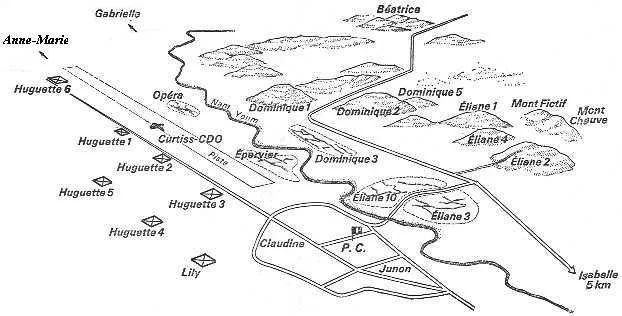
The French built a fortified camp around an airstrip, with a ring of strongpoints — reportedly named after women, such as Béatrice, Gabrielle, Dominique and Eliane. At its peak the garrison reached about 15,000 men. French commanders believed the Viet Minh could not bring heavy artillery through the mountains.
They were wrong. Giap’s army, supported by Chinese advisers and supplies, hauled guns over the mountains by hand and dug them into the hillsides overlooking the valley. Vietnamese figures count more than 260,000 civilian porters and some 20,000 bicycles used to carry supplies.
The attack began on March 13, 1954. Within days, the northern strongpoints Béatrice and Gabrielle had fallen. The French artillery commander, Colonel Charles Piroth, who had promised to silence the Viet Minh guns, took his own life. By the end of March, the airstrip was unusable, and everything had to be dropped by parachute.
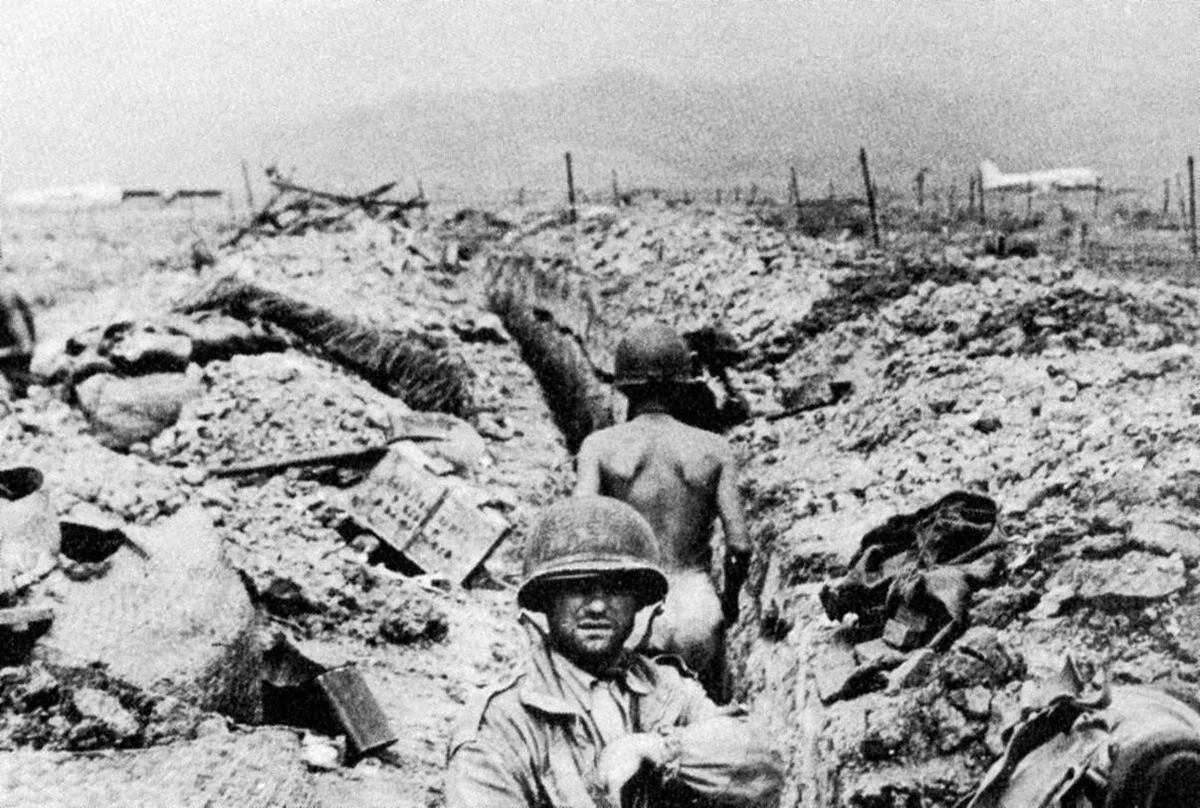
What followed was weeks of brutal fighting for the eastern hills. Viet Minh soldiers dug trenches ever closer to the French lines; the French dropped in more than 4,000 reinforcements, some of whom had never jumped before.
Would America step in?
In Washington, the question was urgent. U.S. and French officers sketched Operation Vulture, a plan for massive American air strikes on the Viet Minh positions. President Eisenhower refused to act without Congress and without allies; Britain declined to join. On April 7, 1954, Eisenhower explained what was at stake with a now-famous image — a row of dominoes: knock over the first, and the rest fall quickly.
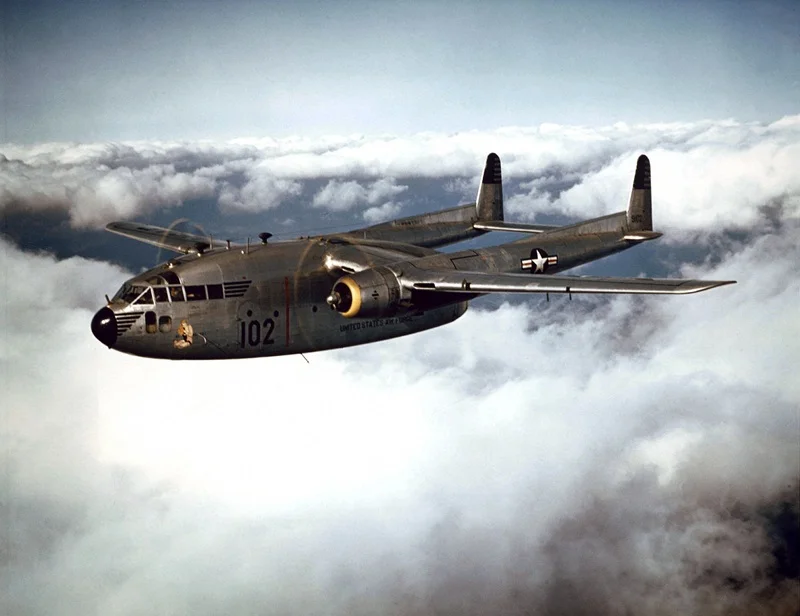
Americans did fly in the battle — as civilians. Pilots of Civil Air Transport, a CIA-owned airline, flew U.S.-supplied C-119 cargo planes in French markings. On May 6, 1954, pilots James McGovern and Wallace Buford were shot down and killed. They were the first Americans to die in combat in what would become the Vietnam wars.
May 7, 1954
On the evening of May 6, the Viet Minh detonated a large mine under the hill the French called Eliane 2. The next afternoon, Viet Minh troops overran the command bunker of General Christian de Castries. The siege had lasted 56 days.
About 11,700 French Union soldiers were taken prisoner. Weakened by wounds and disease, many did not survive the march to the camps; only about 3,300 were returned four months later, although the fate of some Vietnamese soldiers in French service remains unclear. Viet Minh losses were also heavy: Vietnamese figures give about 4,000 dead, while French estimates are around 8,000 dead and 15,000 wounded.
Geneva and a Divided Vietnam
The day after Dien Bien Phu fell, the Geneva Conference turned to Indochina. In June, France’s new prime minister, Pierre Mendès France, promised a settlement within a month. In the early hours of July 21, 1954, the parties signed ceasefire agreements:
- Vietnam was divided at the 17th parallel — described as a temporary military line, not a border.
- Ho Chi Minh’s government took the North; the State of Vietnam held the South.
- Nationwide elections were to reunify the country by July 1956.
- Laos and Cambodia became fully independent.
The United States did not sign the final declaration. It only “took note” of the agreements and promised not to use force to disturb them. The State of Vietnam objected to the division of the country.
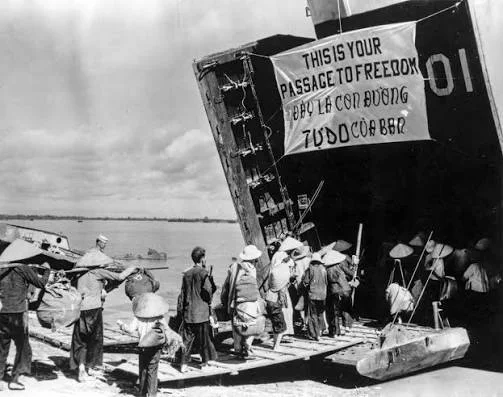
Over the next 300 days, people could choose which zone to live in. Somewhere between 600,000 and 1 million people moved south, many of them Catholics from the Red River Delta; the U.S. Navy’s Operation Passage to Freedom carried about 310,000 of them. Tens of thousands of Viet Minh fighters and supporters went north.
The promised elections never took place. In the South, Ngo Dinh Diem, appointed prime minister in 1954, pushed out Bao Dai in a 1955 referendum and refused to hold talks on the vote. U.S. officials privately expected that Ho Chi Minh would win a nationwide election.
Why Did France Lose?
- A war without a clear goal. French governments never agreed on what they were fighting for — empire, the French Union, or containing communism — and France itself went through about 19 governments in the war’s first seven years.
- Limited independence. Bao Dai’s state never gained enough real power or popular support to rival the Viet Minh.
- China’s support after 1950. An open border gave the Viet Minh weapons, training, artillery and a safe rear base.
- Underestimating the enemy. At Dien Bien Phu, the French assumed the Viet Minh could not move heavy artillery and supplies through the mountains.
- Little support at home. Without conscripts, France fought with a stretched professional and colonial army.
- The Viet Minh’s own strengths. A disciplined army, the ability to mobilize huge numbers of civilians, and the powerful appeal of national independence.
Why the First Indochina War Matters to Americans
For the United States, the French defeat was not the end but the beginning. By 1954, according to the Pentagon Papers, America was paying about 78% of the cost of France’s war. After Geneva, Eisenhower concluded that the problem lay in the relationship between the French and the Vietnamese, and Washington began dealing with South Vietnam directly. In September 1954, the U.S. led the creation of SEATO, a regional alliance that placed South Vietnam under its protection.
Within a decade, American troops would be fighting in Vietnam themselves. As one French historian put it, the end of France’s war simply made way for the United States — and for an even more violent war.
France’s war was over. America’s was just beginning.
| Date | Key event |
|---|---|
| March 9, 1945 | Japan overthrows the French in Indochina |
| September 2, 1945 | Ho Chi Minh declares Vietnam’s independence |
| September 23, 1945 | French forces seize Saigon; fighting begins in the South |
| March 6, 1946 | Ho–Sainteny agreement: Vietnam a “free state” in the French Union |
| November 23, 1946 | French bombardment of Haiphong |
| December 19, 1946 | Fighting erupts in Hanoi; full-scale war begins |
| October–December 1947 | Operation Léa fails to capture Viet Minh leaders |
| March 8, 1949 | Élysée Accords create Bao Dai’s State of Vietnam |
| January–February 1950 | China and USSR recognize Ho’s government; U.S. recognizes Bao Dai |
| October 1950 | French disaster on Route Coloniale 4 |
| 1951 | De Lattre defeats three Viet Minh offensives in the Red River Delta |
| November 1951 – February 1952 | Battle of Hoa Binh |
| November 1953 | French paratroopers occupy Dien Bien Phu |
| March 13 – May 7, 1954 | Battle of Dien Bien Phu |
| July 21, 1954 | Geneva Accords divide Vietnam at the 17th parallel |
Keep Reading
- The Vietnam War Explained: A Clear Summary (1955–1975)
- What Happened to the French Prisoners After Dien Bien Phu?
- Who Was the First American Killed in Vietnam? The Answer Is Older Than You Think
- What Happened to South Vietnamese Soldiers After the Fall of Saigon?
- How Did the Vietnam Draft Lottery Work? The Night America Drew Birthdays From a Jar
- Inside Ho Thuy Tien, Vietnam’s Abandoned Water Park
Frequently Asked Questions
When did the First Indochina War start and end?
Fighting began in southern Vietnam in September 1945, but most historians date the full-scale war from December 19, 1946, when fighting broke out in Hanoi. It ended with the Geneva Accords in July 1954.
Who won the First Indochina War?
The Viet Minh. Their victory at Dien Bien Phu in May 1954 forced France to negotiate, and the Geneva Accords ended French rule in Indochina.
Why did the United States help France in Indochina?
After China became communist in 1949 and the Korean War began in 1950, Washington saw the Viet Minh as part of a wider communist advance in Asia. It also needed French cooperation in Europe through NATO. By 1954 the U.S. was paying most of France’s war costs.
What is the difference between the First Indochina War and the Vietnam War?
The First Indochina War (1946–1954) was fought mainly between France and the Viet Minh. The Vietnam War (often dated 1955–1975) was fought between North Vietnam and its allies and South Vietnam, which was backed directly by U.S. combat troops from 1965.
How many people died in the First Indochina War?
Estimates vary widely. Roughly 75,000 to 95,000 French Union soldiers died; Western historians estimate 175,000 to 300,000 Viet Minh deaths; and civilian deaths ran into the hundreds of thousands.
Why was Vietnam divided at the 17th parallel?
It was a compromise at Geneva. France had proposed a line farther north and the Viet Minh one farther south. The 17th parallel was meant to be a temporary military line until nationwide elections in 1956, which never took place.
Sources
- Office of the Historian, U.S. Department of State — “Dien Bien Phu and the Fall of French Indochina, 1954” and Foreign Relations of the United States, 1952–1954, vol. XIII
- The Pentagon Papers, Part II: U.S. Involvement in the Franco-Viet Minh War, 1950–1954 (National Archives)
- Encyclopaedia Britannica — “Indochina wars” and “Battle of Dien Bien Phu”
- Naval History and Heritage Command — “Passage to Freedom“
- Central Intelligence Agency — history of Civil Air Transport at Dien Bien Phu
- Ministère des Armées (France) — Chemins de mémoire: “La guerre d’Indochine”
- Fredrik Logevall, Embers of War: The Fall of an Empire and the Making of America’s Vietnam (2012)
- Bernard B. Fall, Hell in a Very Small Place: The Siege of Dien Bien Phu (1966)
5 thoughts on “The First Indochina War: A Clear Summary of How France Lost Vietnam (1946–1954)”